Posted on 3 Comments

US tech firm reveals more about its plans to build one of Europe’s largest data centres in green belt land just to the south of Potters Bar

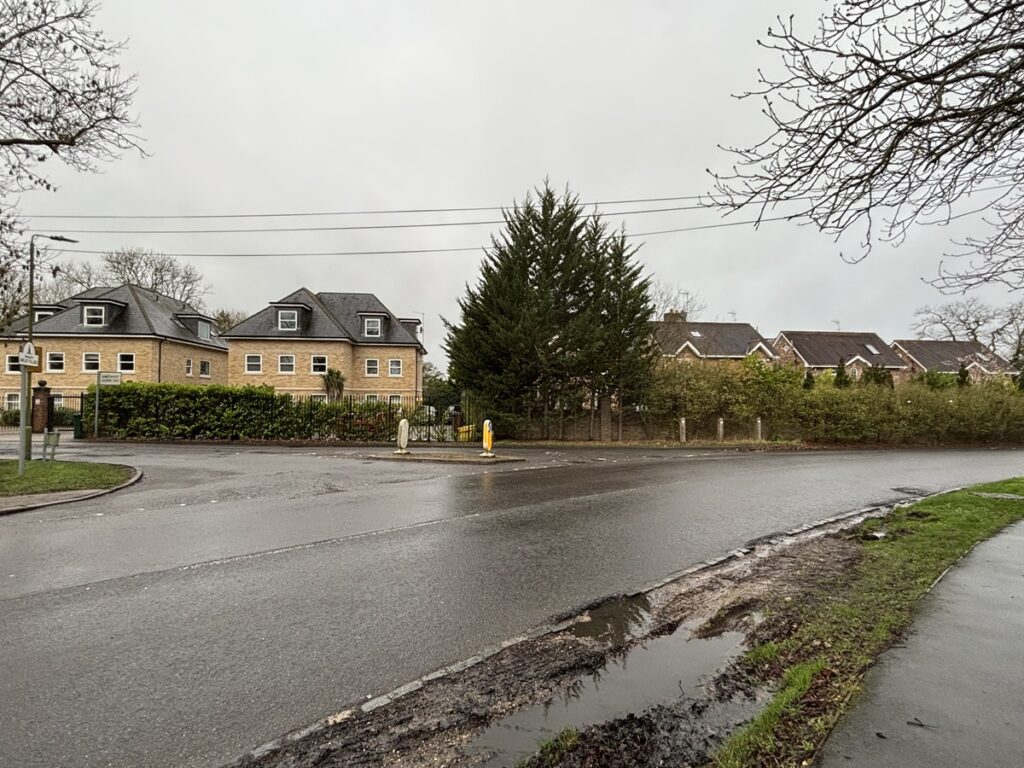
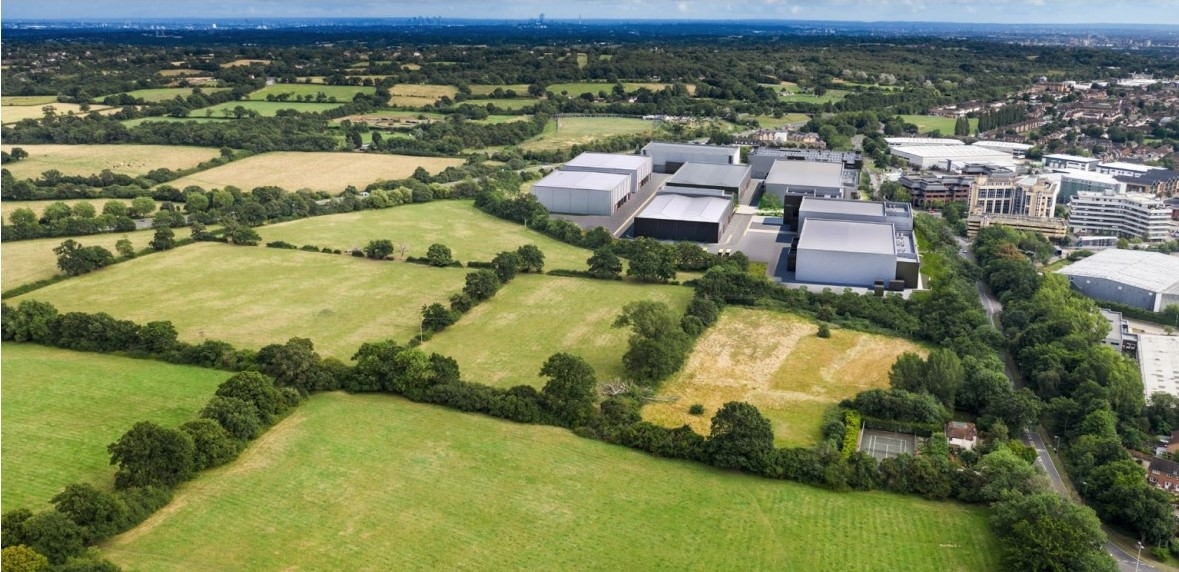
Potters Bar residents have had their first chance to learn more about a proposed data centre which is to be built on an 85-acre suite alongside the M25 motorway.

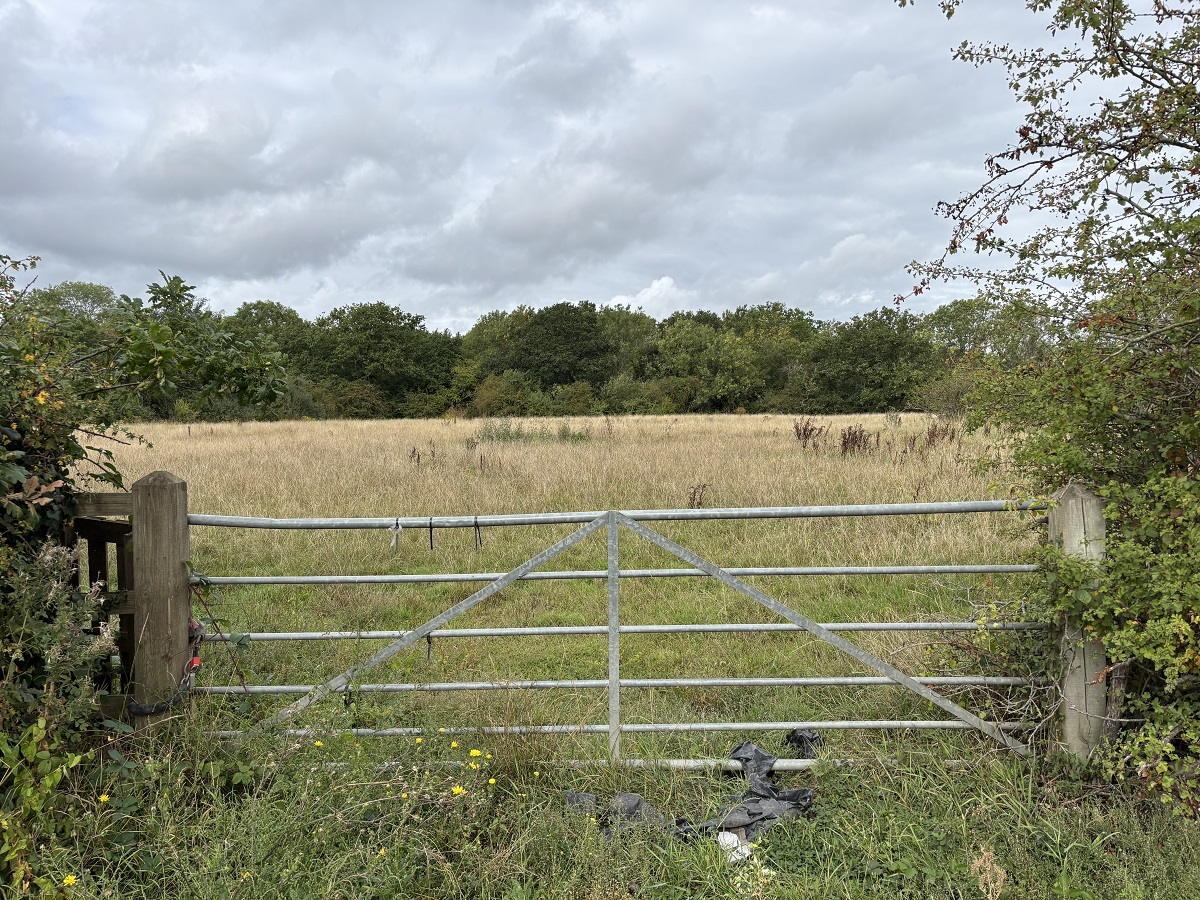
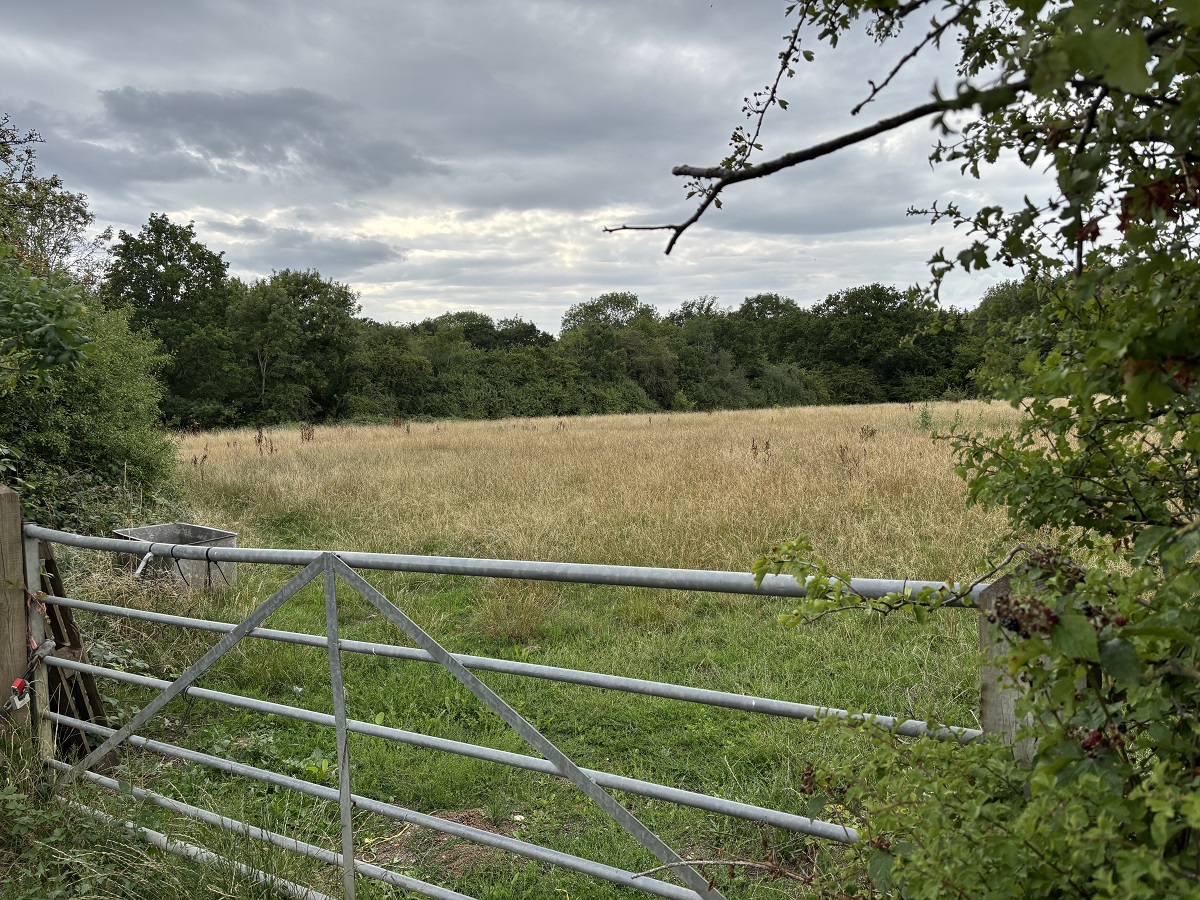
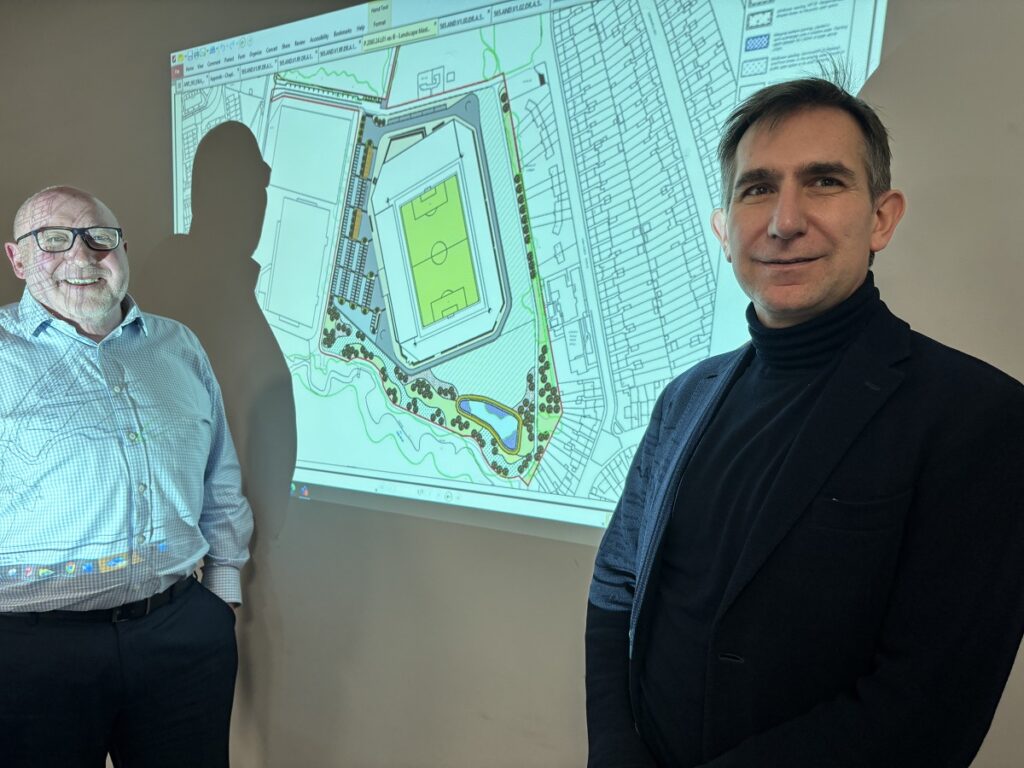
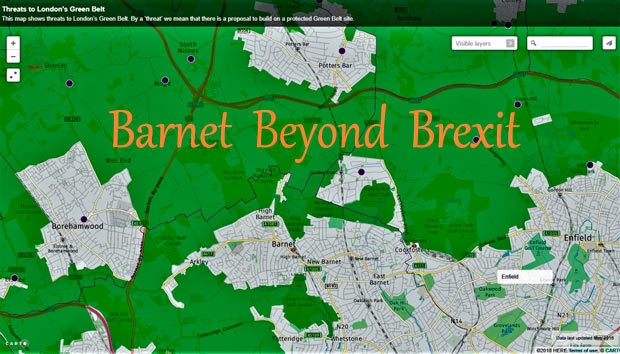
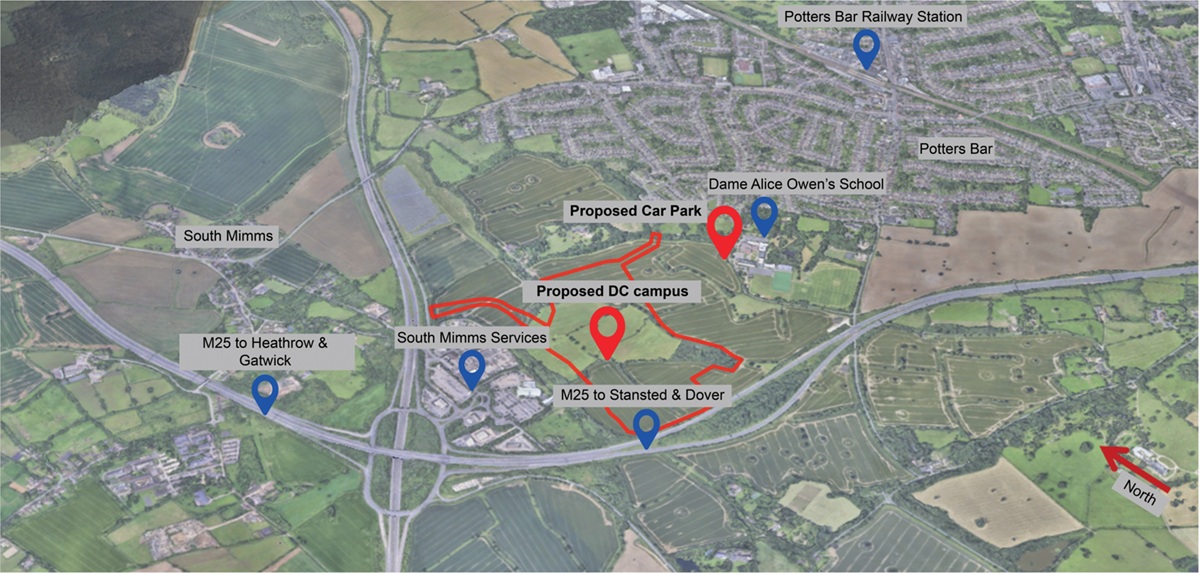
Itwill be so big it will almost fill the fields between the South Mimms service station at Junction 23 and Dame Alice Owen’s School – see diagram above.

Outline planning permission was approved by Hertsmere Borough Council a year ago for a 2 million square foot development which local objectors claim will be equal to the size of Wembley stadium and will obliterate green belt countryside.

Equinix, a US tech firm which is one of the world’s largest data centre operators, is proposing to invest £3.9 billion in the new centre which will be known as the Hertfordshire Campus, and which will be one of the largest in Europe.

The campus will require 250 megawatts of power – enough to run the equivalent of about 200,000 homes – and to meet the demand, National Grid is to supply the new campus with its own connection to the electricity grid ready for the data centre to come on stream in 2031.
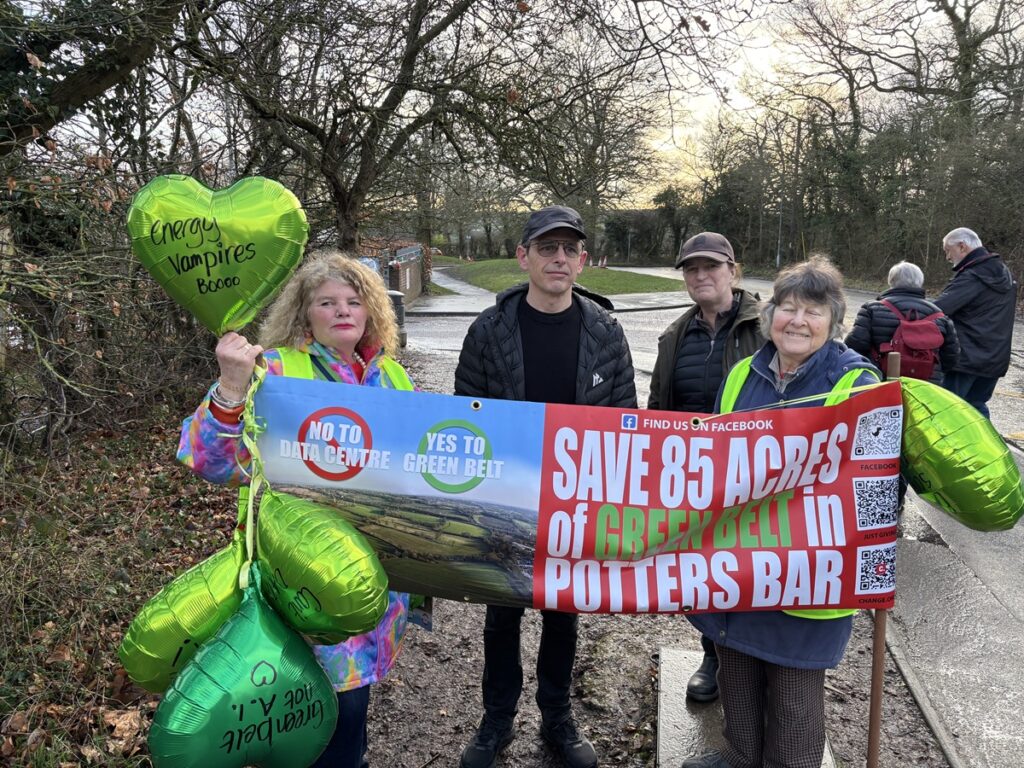
A two-day exhibition of Equinix’s plans was held at Dame Alice Owen’s School where a group of local objectors gathered outside to express opposition to the loss of “incredibly precious countryside” for a development which they say will blight the area.

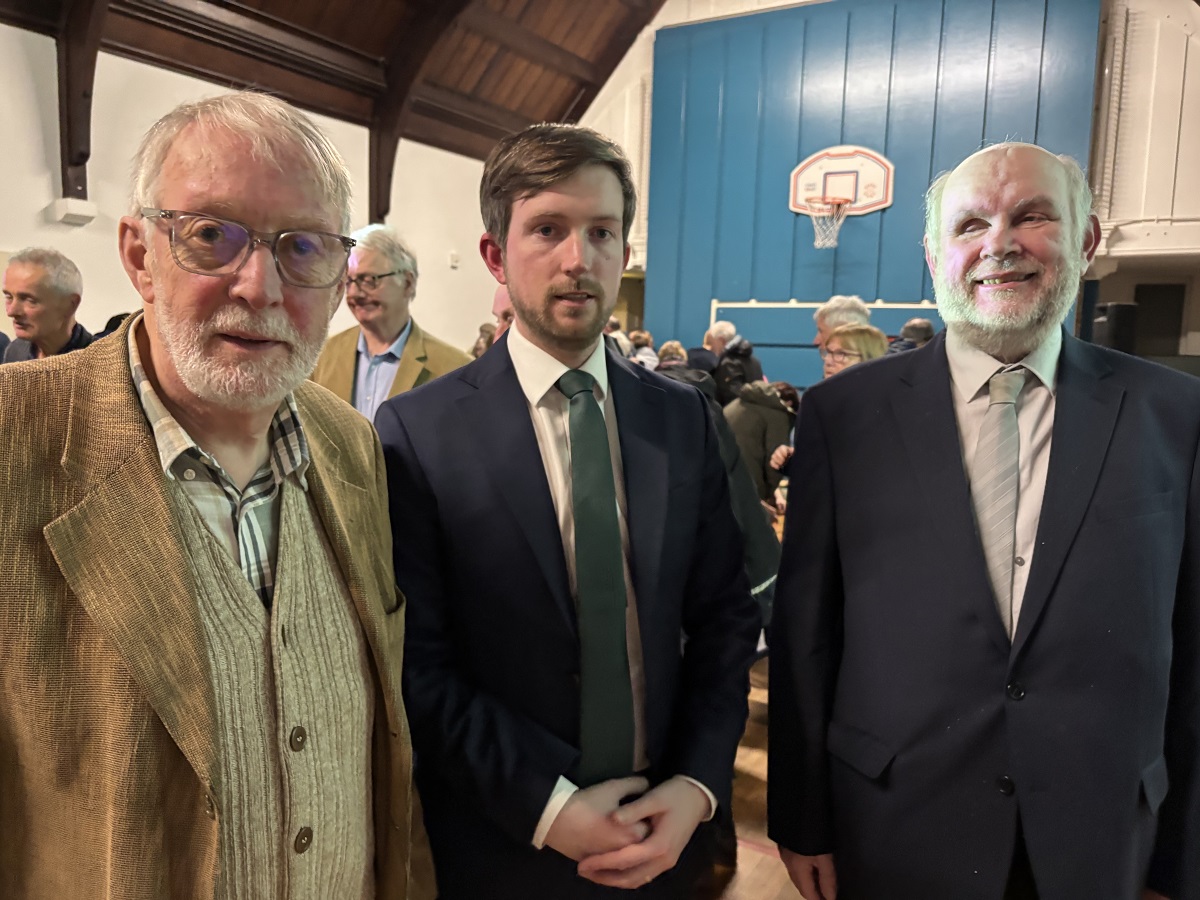
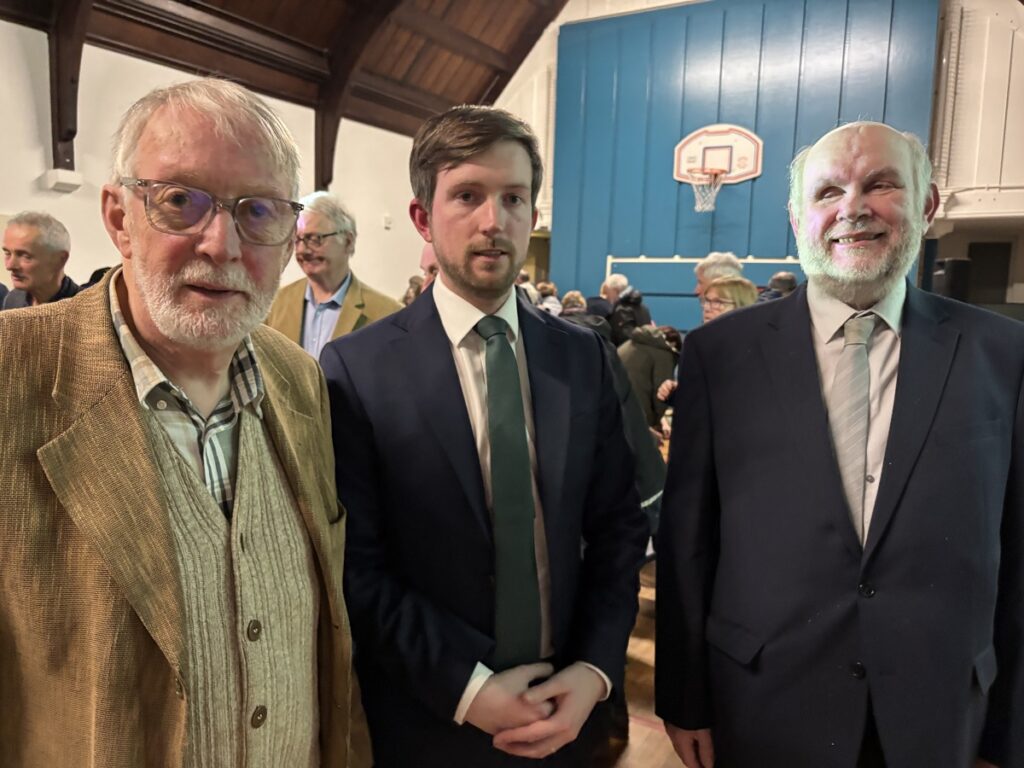
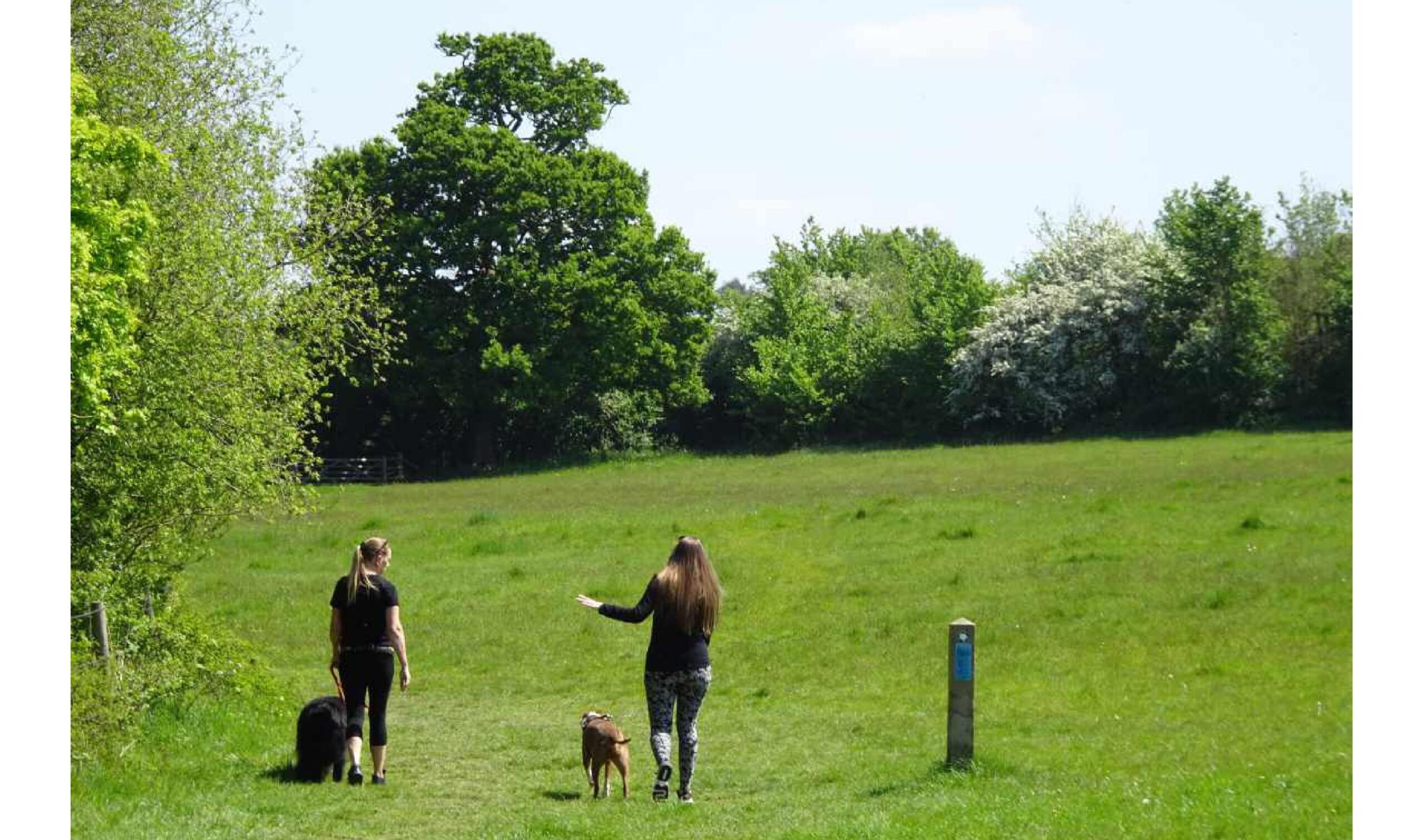
Ros Naylor (above, second from right), who is one of the lead protesters, said Potters Bar residents had enjoyed walking, riding and cycling along 11 rights of way across the fields between the outskirts of the town and the M25.

“The visual impact alone is going to obliterate local green belt land and instead we are going to have a monster development the size of Wembley stadium.”

She was joined for the protest by (from left to right) Fleur Albrecht, Councillor Simon Rhodes, and Margaret Ohren.
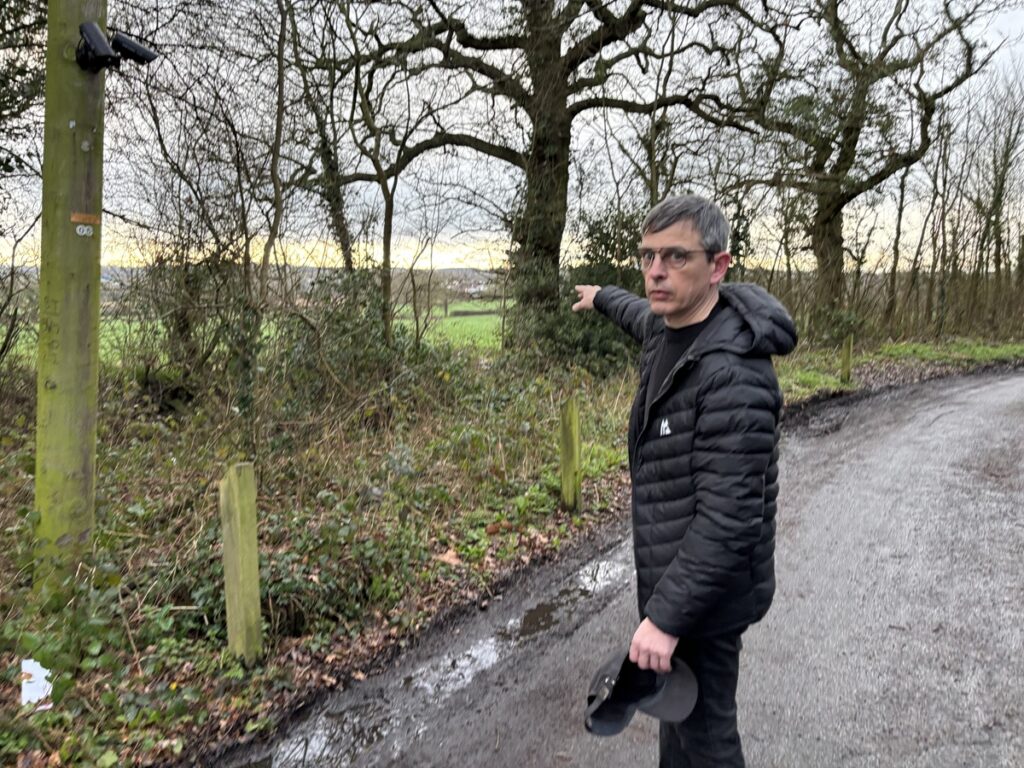
Councillor Rhodes, who serves on Hertfordshire County Council, pointed to the fields which would be lost when the data centre is built.

He had been shocked to discover that the emergency entrance would be via Bridgefoot Lane, directly opposite the entrance to Dame Alice Owen’s School.

“We are only just finding out what Equinix is proposing. We have checked with residents in around 1,500 houses nearby and none of them knew about it. Since January we have as a group registered 950 objections.”
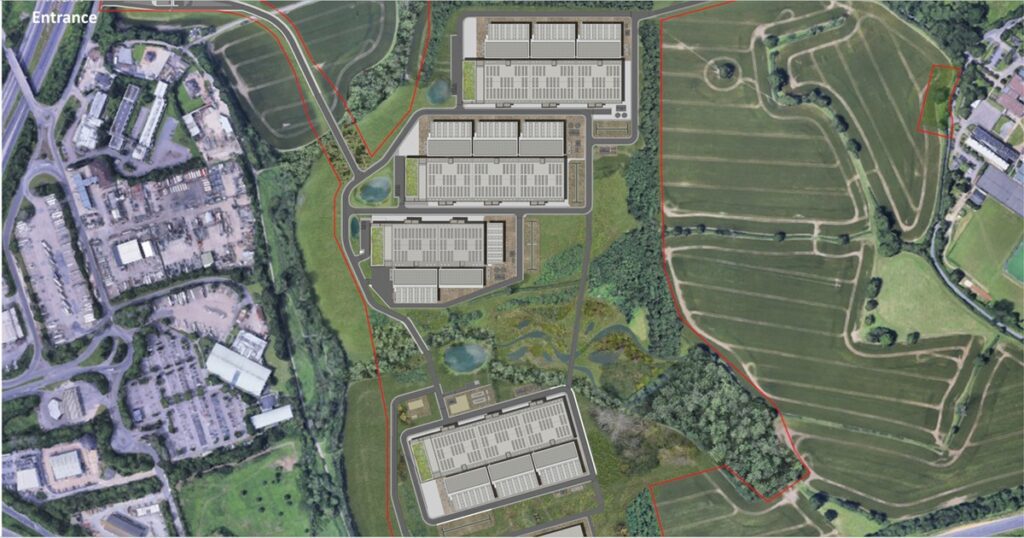
Equinix is proposing to build a campus which would comprise four separate data centre buildings – three would be of 72-megawatt processing capacity and one of 48-megawatt capacity.

Building the campus at South Mimms would represent a £3.9 billion investment in the area, creating 2,500 construction jobs and 200 permanent skilled roles. The campus would generate £18 million a year in business rates.
Potters Bar residents get chance to learn more about massive data centre to be built alongside M25 motorway on fields between Junction 23 service station and Dame Alice Owen's School

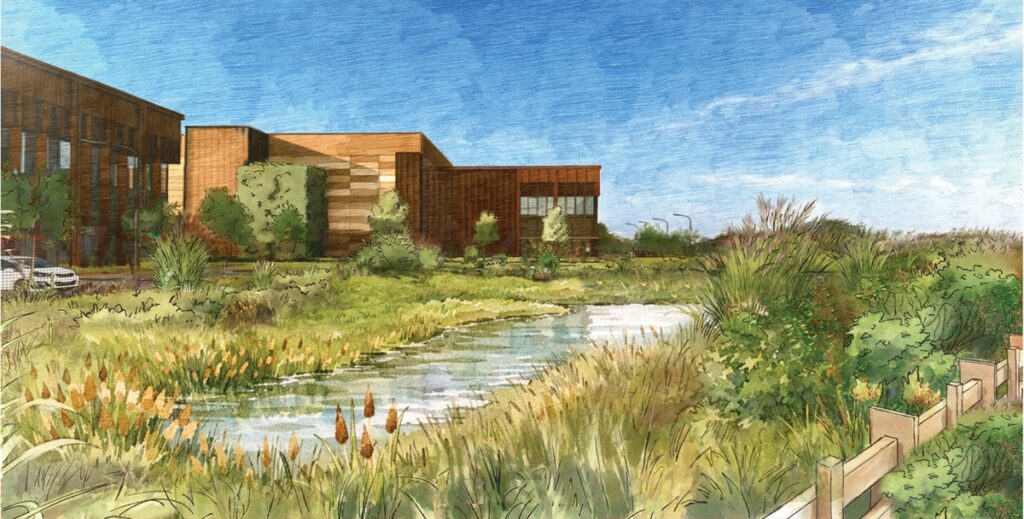
In presenting an artist’s impression of how the campus would look, Equinix said it intended to retain and improve all the pedestrian, cyclist and bridle ways across the site.

During March there would be an archaeological fields inspection of the site followed an ecological survey in May.

Outline approval for the scheme was granted to a consortium known as DC01UK.

Equinix signed up to proceed with the project and the company’s aim is to submit a detailed planning application in August/September in the hope of starting construction in mid-2027 and the centre going on stream in 2031.
Posted on 4 Comments

Request for pre-planning negotiations over possible development of a large housing estate in green belt land off Rowley Lane, Arkley

An application has been made to Barnet Council by a housing developer seeking permission to start discussions on building up to 300 homes on 17 acres of green belt land off Rowley Lane, Arkley.

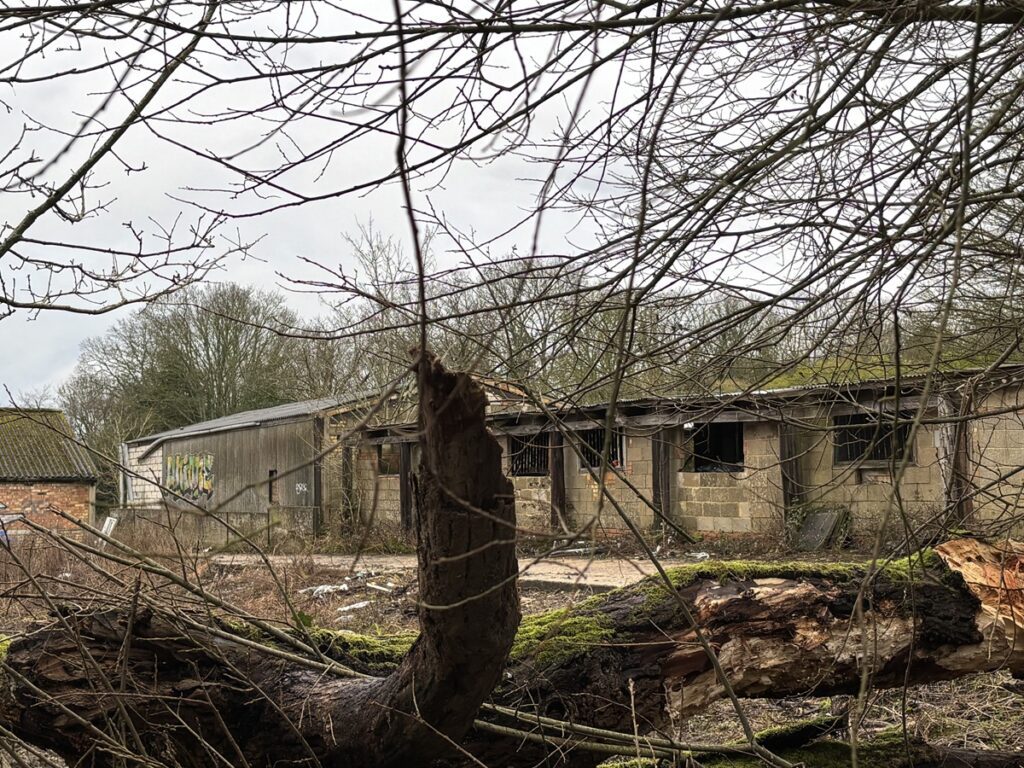
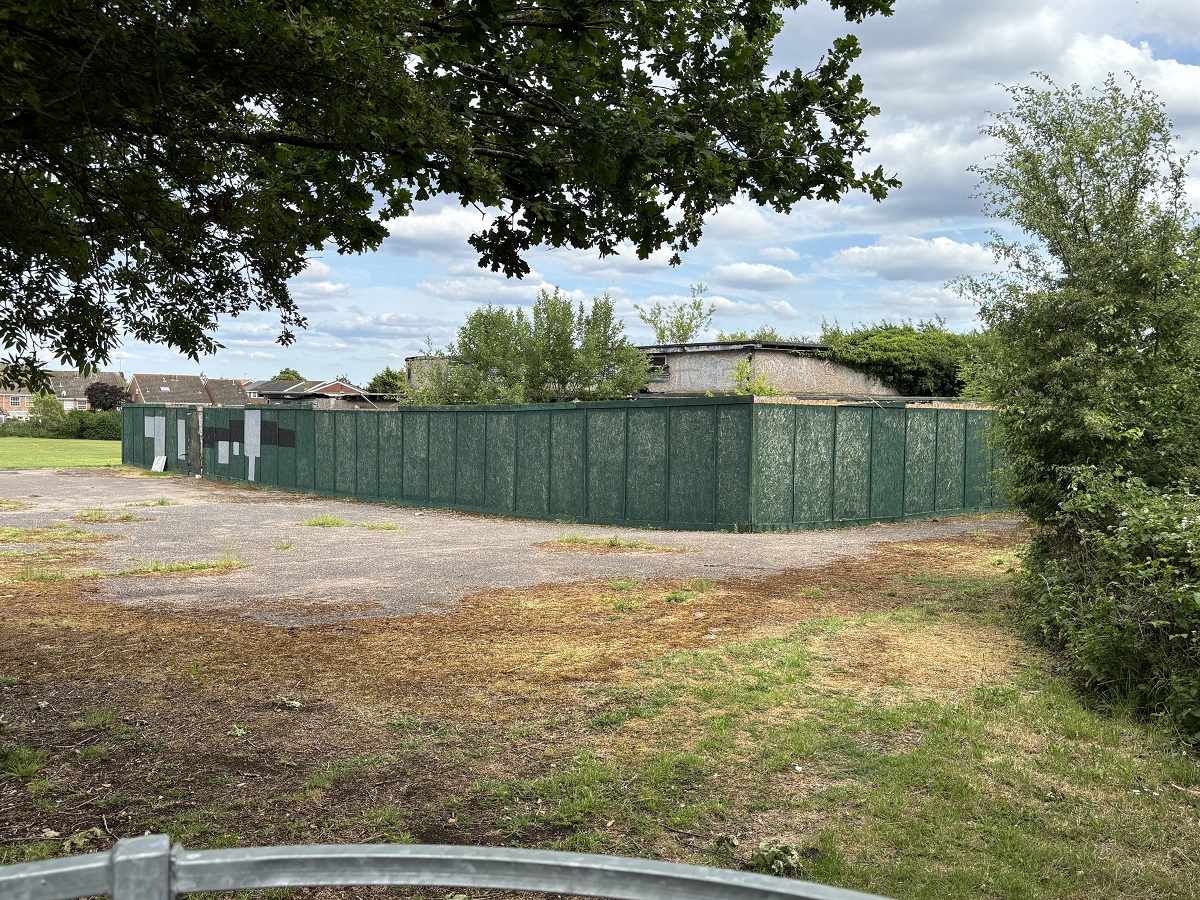
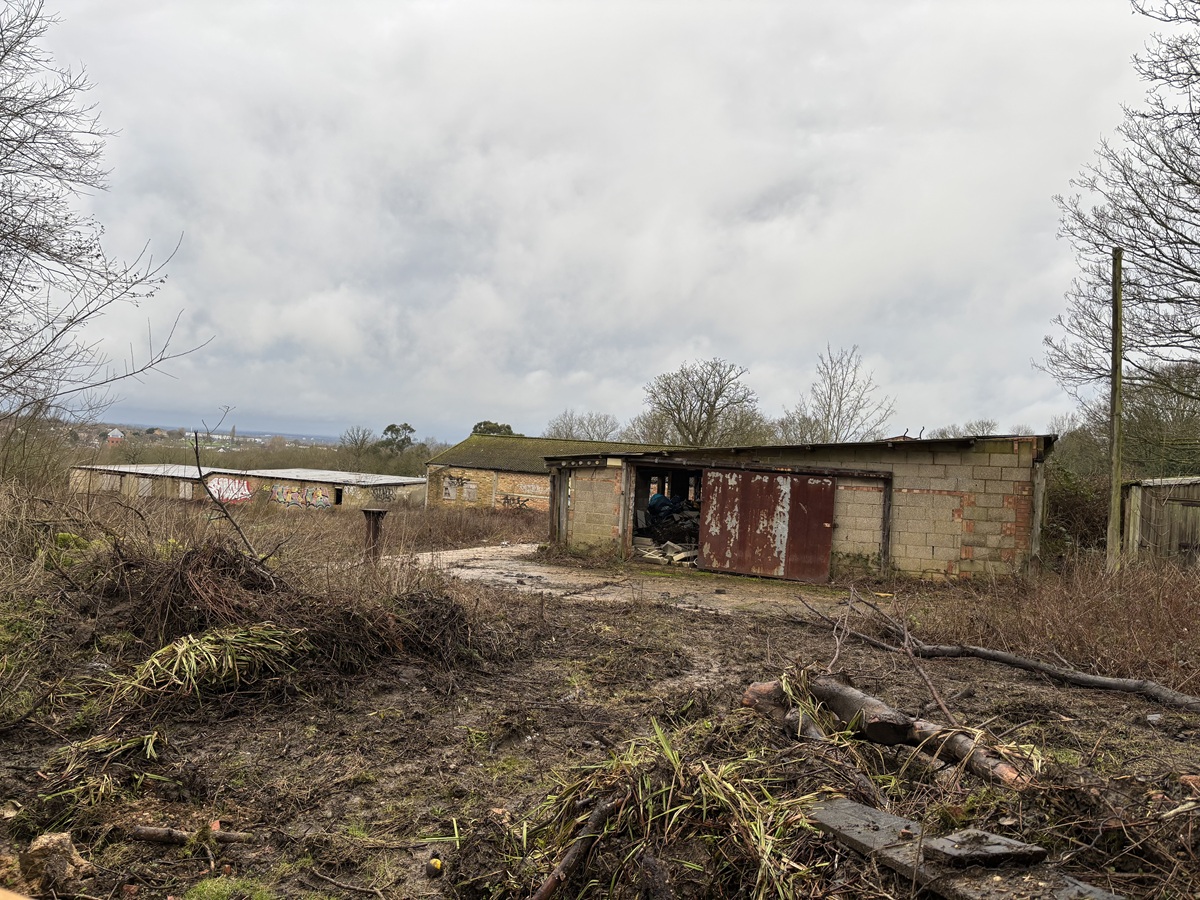
Part of the site was a former pig farm – see above – and the proposed development would take place in woods and scrubland between Rowley Lane and the A1 Barnet by-pass to the north of the Stirling Corner roundabout.

Bugler Homes of Rickmansworth is hoping to take advantage of new government guidance which came into effect a year ago and which allows for the release of some green belt land for housing.

Where there is green belt land which was “previously developed” and which does not “strongly contribute” to limiting urban sprawl, it can now be deemed grey belt land and can be developed for housing and other needs.

Arkley’s community group – Arkley Association – has been informed that Bugler Homes is at “an early stage of exploring opportunities to bring forward a grey belt application”.

The site has been purchased unconditionally by the company which says an assessment of the site indicates that it that would meet the criteria for grey belt approval.

Its “initial vision” is to build approximately 230 homes, with 50 per cent affordable housing; an 80-bed care home; publicly accessible green spaces and allotments; and improved public right of way footpaths.

“We want to work with the community to ensure the proposals reflect Arkley’s character and identity, help address local needs, and contribute positively to village life.”

Bugler has asked for a meeting with the association to discuss its proposal – a plan which has shocked and surprised many Arkley residents.

They fear that if approval is given it could connect to another large site closer to Stirling Corner which has been vacant since the demolition of a former police academy.

“Before we know it approval will have been given for housing on the whole of the triangle of land between Barnet by-pass, Barnet Road and Rowley Lane,” said one resident.

“That would desecrate the green belt, damage the village surroundings of Arkley and would lead to even more urban sprawl between Borehamwood and Barnet.”

Most of the houses in and around Arkley village are individual detached properties and except for Rockways off Barnet Road there are no significant housing developments.

If approval was given for up to 300 homes off Rowley Lane it would be Arkley’s first housing estate.

The 17-acre site which includes the former Rowley Bank Farm is to the rear of houses in Amethyst Close – see above – at the junction of Rowley Lane and Rowley Green Road.

Bugler Homes has asked to meet representatives of the Arkley Association which says it will now hold an extra-ordinary annual meeting to decide what action to take. Other interested groups will be invited to take part.

Government guidance on green belt land which might now be redesignated as grey belt says that this applies particularly to “previously developed” land such as the site of dis-used petrol stations or abandoned car parks.

Arkley Association informed of pre-planning application to build up to 300 homes on a 17-acre site off Rowley Lane. Bugler Homes to have discussions with Barnet Council.

The Arkley site includes abandoned buildings from the former pig farm – which have more recently been used for storage – and extensive hard standing.

When considering Bugler Homes’ plan, Barnet Council will be required under the government’s national planning policy framework, to assess the contribution which the site makes to the green belt and whether a grey belt approval would result in the remaining green belt in the area being “fundamentally undermined”.

Posted on 3 Comments

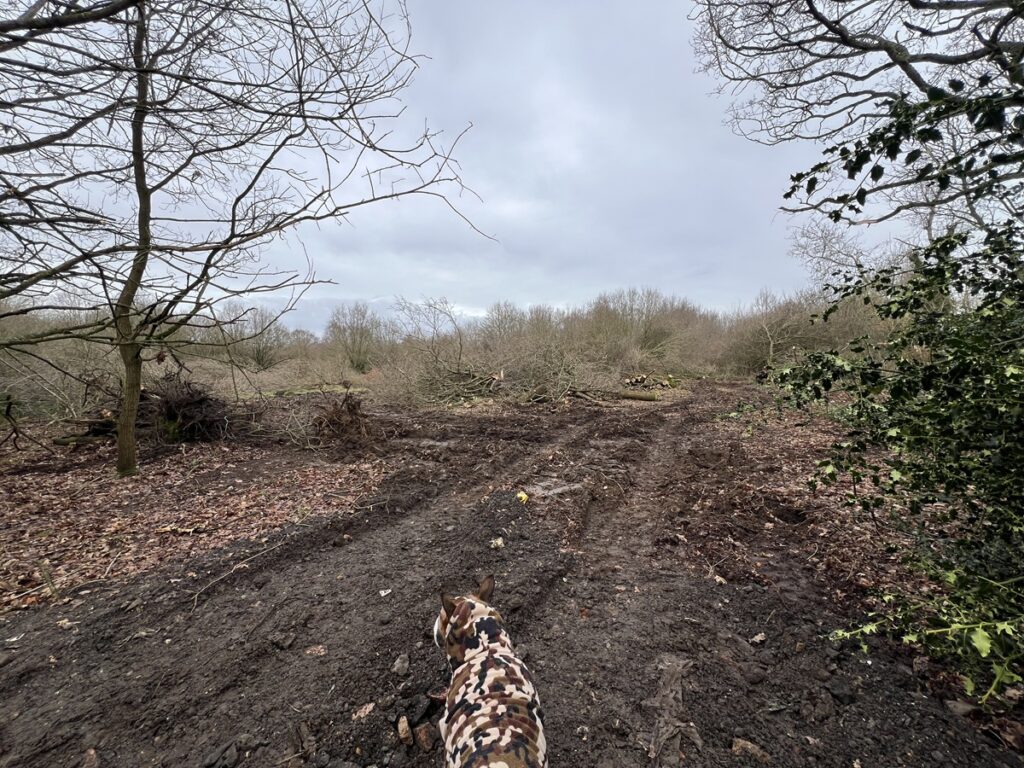
Unauthorised tree felling in protected woodland at Arkley has angered residents who fear a covert attempt to secure residential development

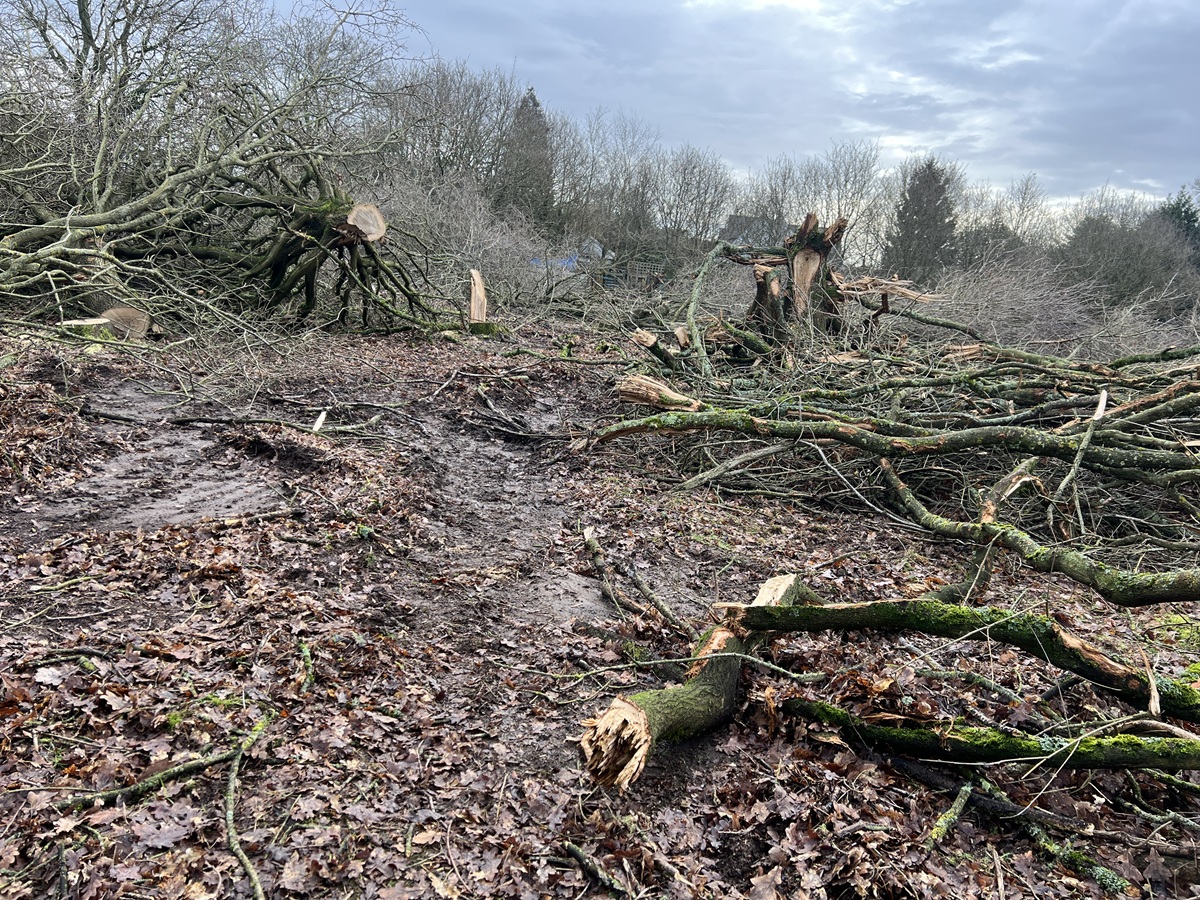
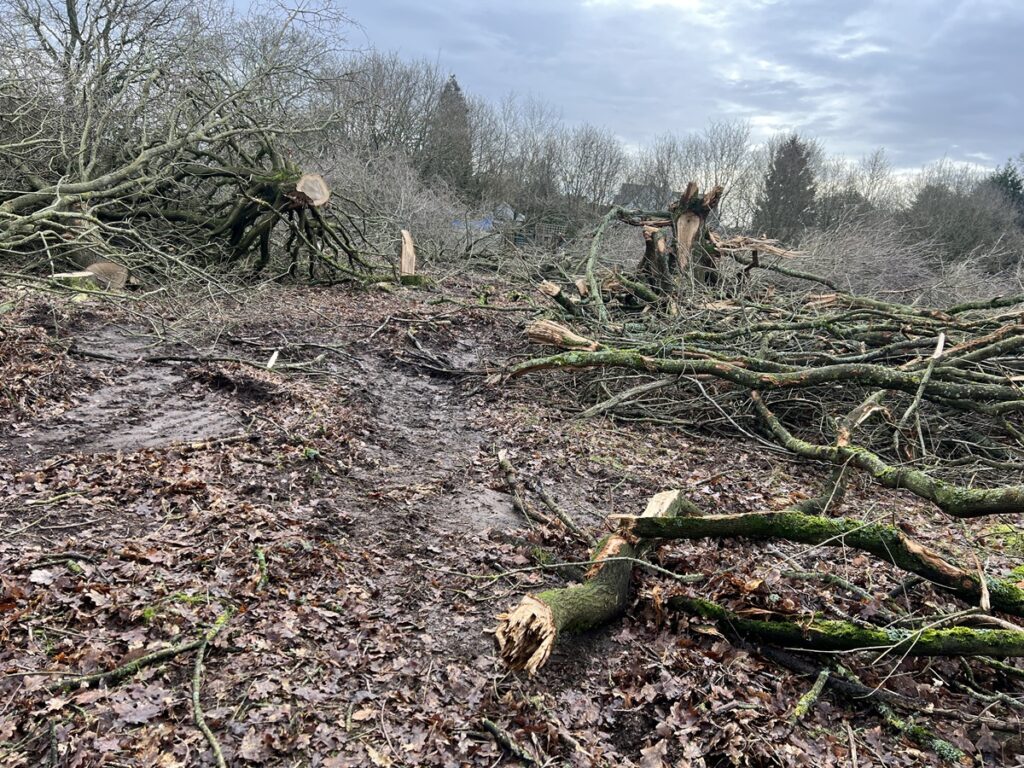
Arkley residents who have been campaigning for several years to safeguard woodland in Rowley Lane were shocked to see protected trees being felled across a one-acre plot – and their anger increased still further when Barnet Council apparently failed to take immediate action to stop the clearance.

They say it took the council’s tree protection team over 24 hours to intervene and by then most of the trees had already been cut down. Only a few that had been badly hacked about were still standing.

The plot where the clearance has taken place is part of a ten-acre woodland which is protected by a special nature conservation order designed to protect it from any land use change which might damage a protected habitat or species.

The residents fear that if developers get their way the woodland will be turned into sites for new houses.

Once this Green Belt land has been cleared of trees, the concern in the surrounding community, is that Barnet Council might be more likely to grant planning permission, despite approval having been refused in the past.  

When an adjoining one-acre plot was cleared in 2023 without permission the residents succeeded in obtaining a tree preservation order covering the whole site.

The wording of the nature conservation order was also strengthened to reflect the character of the land as “wooded with open glades of grass or scrub”.

The woodland, which is at the rear of Rowley Lodge, was sold off by a previous owner of the house and was subdivided into ten separate one-acre plots which were sold for a combined total of £1.3 million.

What has so angered the residents is that they say nothing happened on the day they complained to the council (18.2.2026) and when they notified the council again the following morning (19.2.2026) the protection team did not arrive until the afternoon.

“Within that 24-hour period the trees had been cut down. It is devastating. We now have Arkley’s very own Sycamore Gap; a woodland left with a gaping hole. It is a tragedy,” said one distraught resident.

Workmen who were challenged by the residents said the one-acre which was being cleared was being subdivided into three plots for houses.

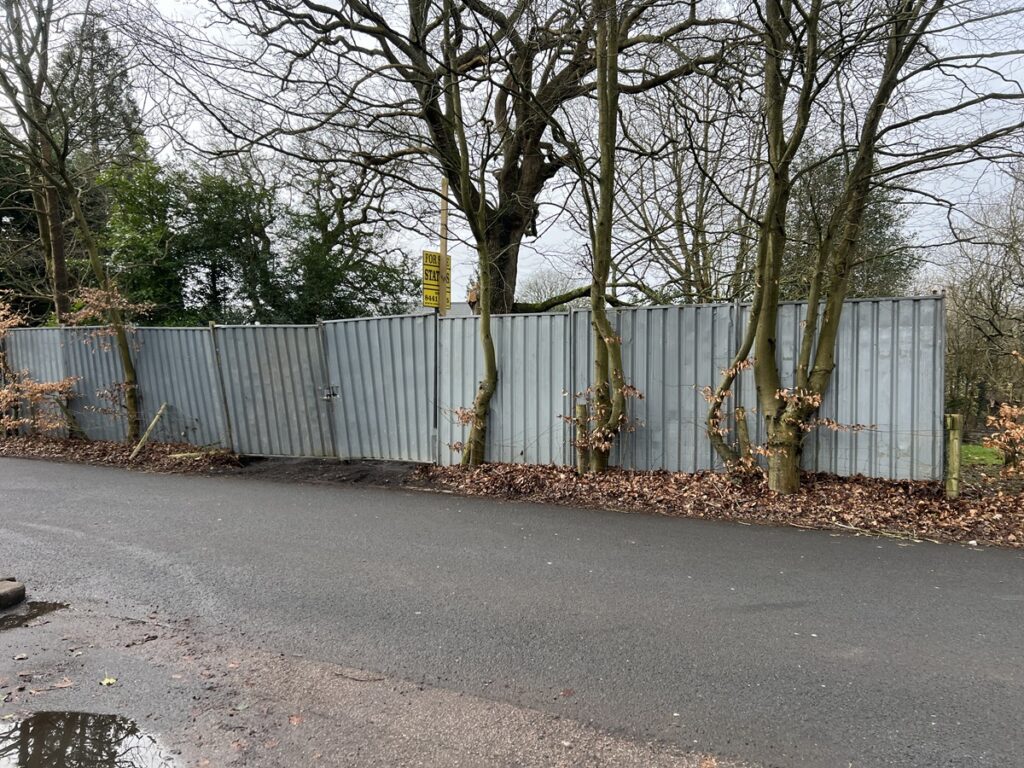
“We have been assured planning permission will not be granted because it is Green Belt but the boarded off entrance to the woodland already has an agents’ sign indicating that plots are for sale.

When the ten acres were first sold off, five of the individual acres were purchased by householders whose properties backed on to the land and who were determined that it should be preserved as a woodland.

Two of the five acres in the hands of individual plot holders have now been cleared without permission and residents fear that there might be an attempt to prepare the other three acres for residential development.

Residents have appealed to Barnet councillor Emma Whysall to intervene of their behalf.  

(Photos supplied by residents)

Posted on Leave a comment

A community orchard is the latest feature to be completed at a new base in Mays Lane for outdoor activities for young people

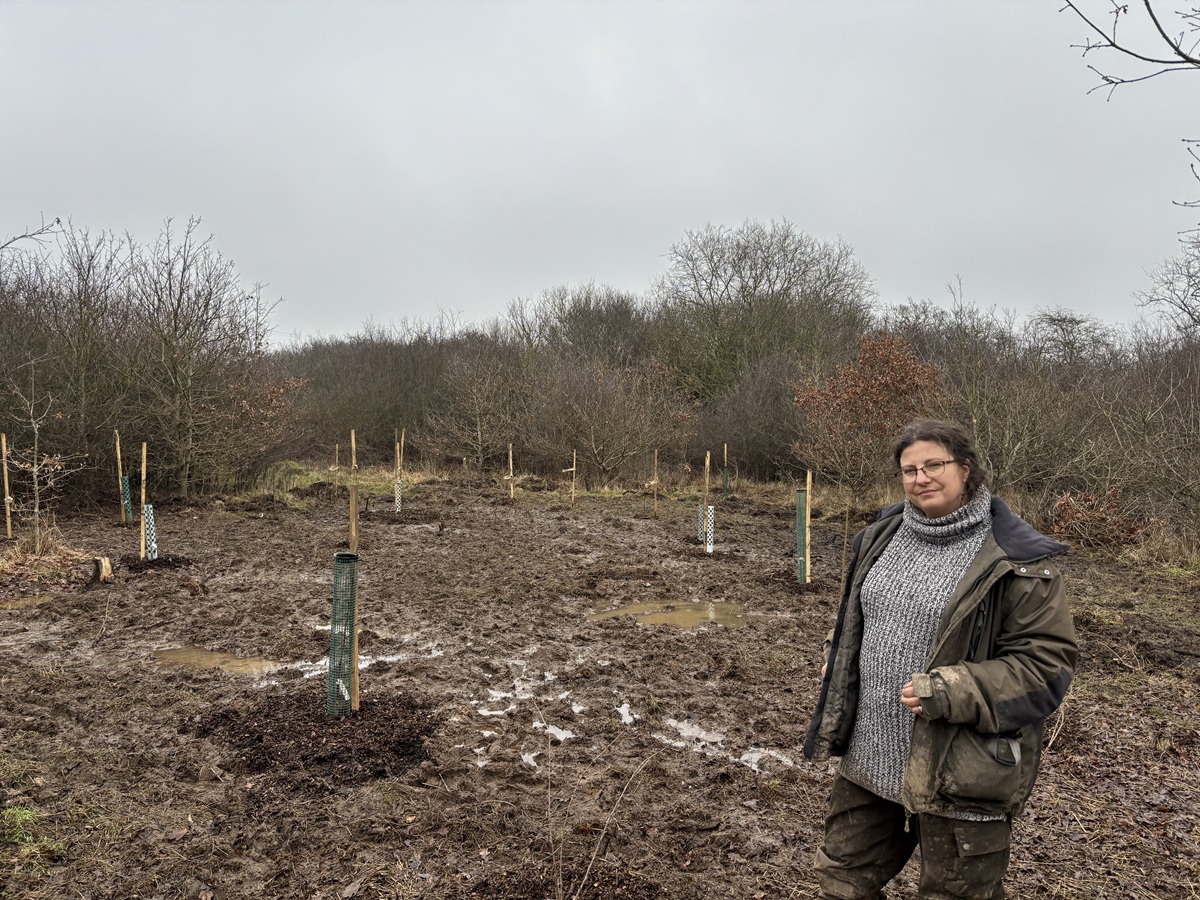
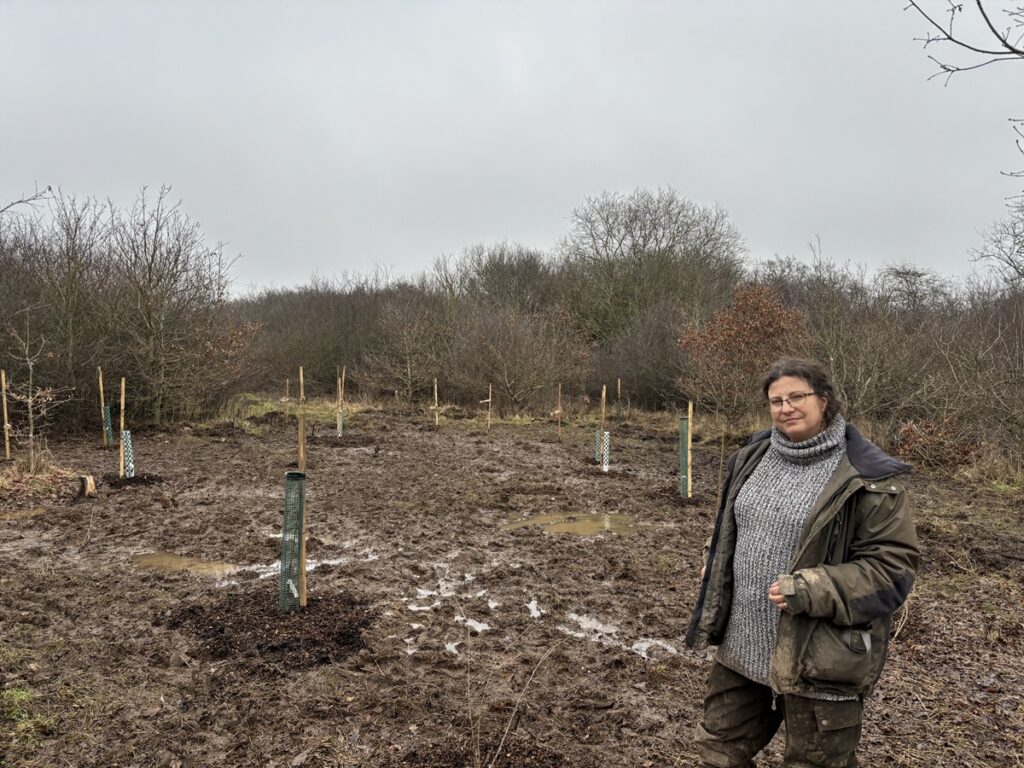
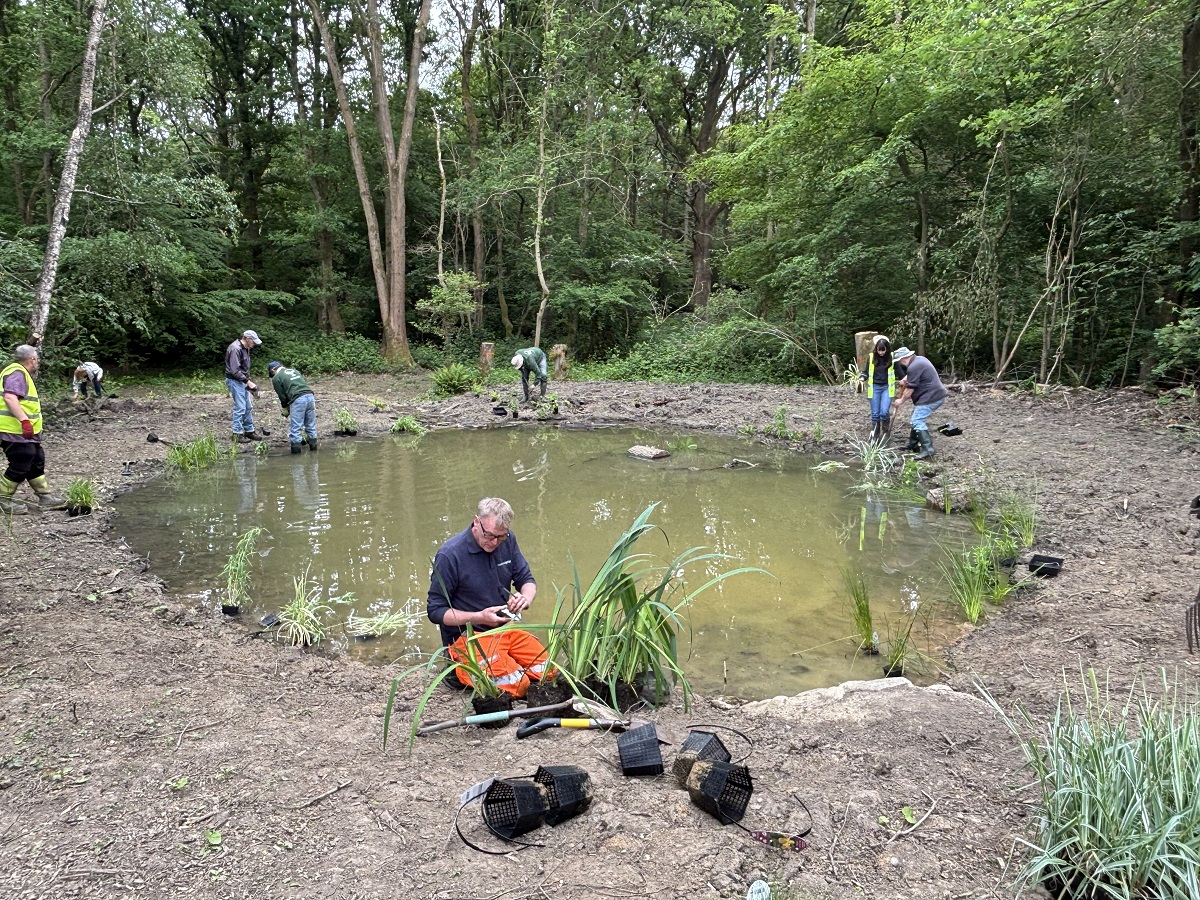
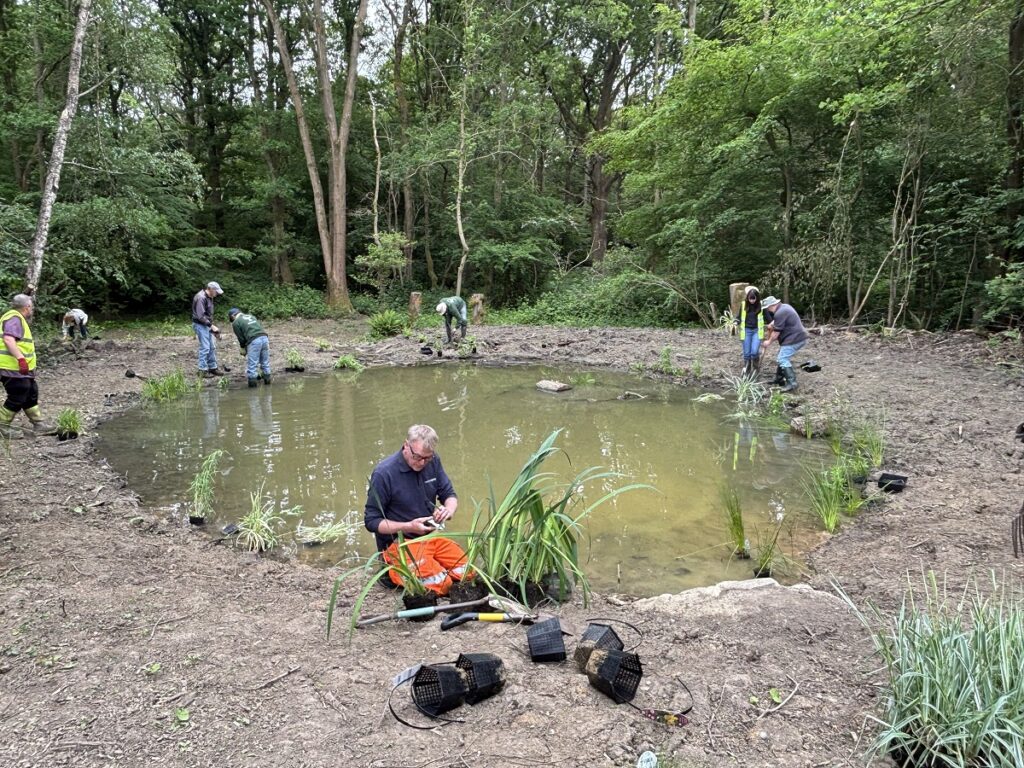
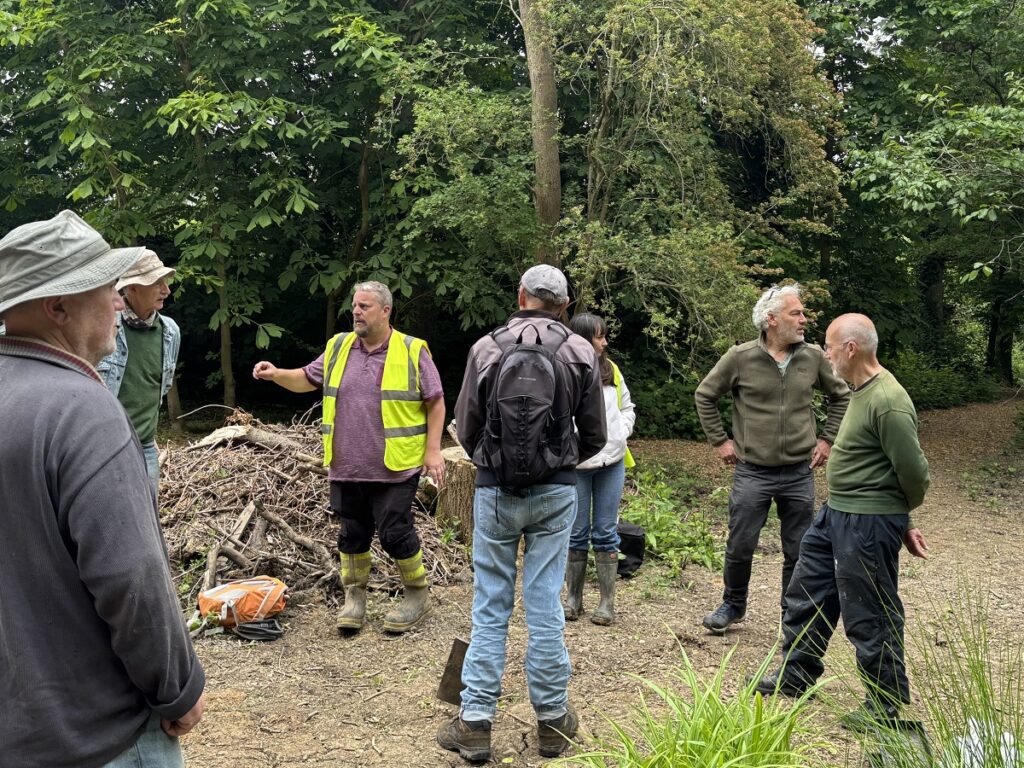
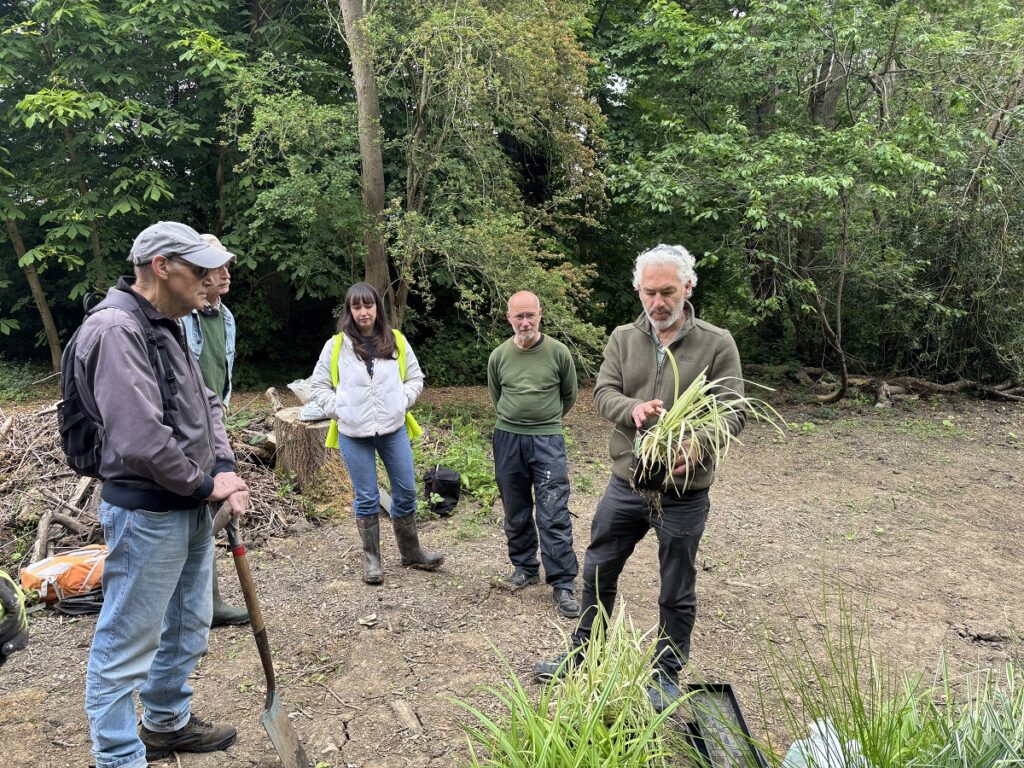
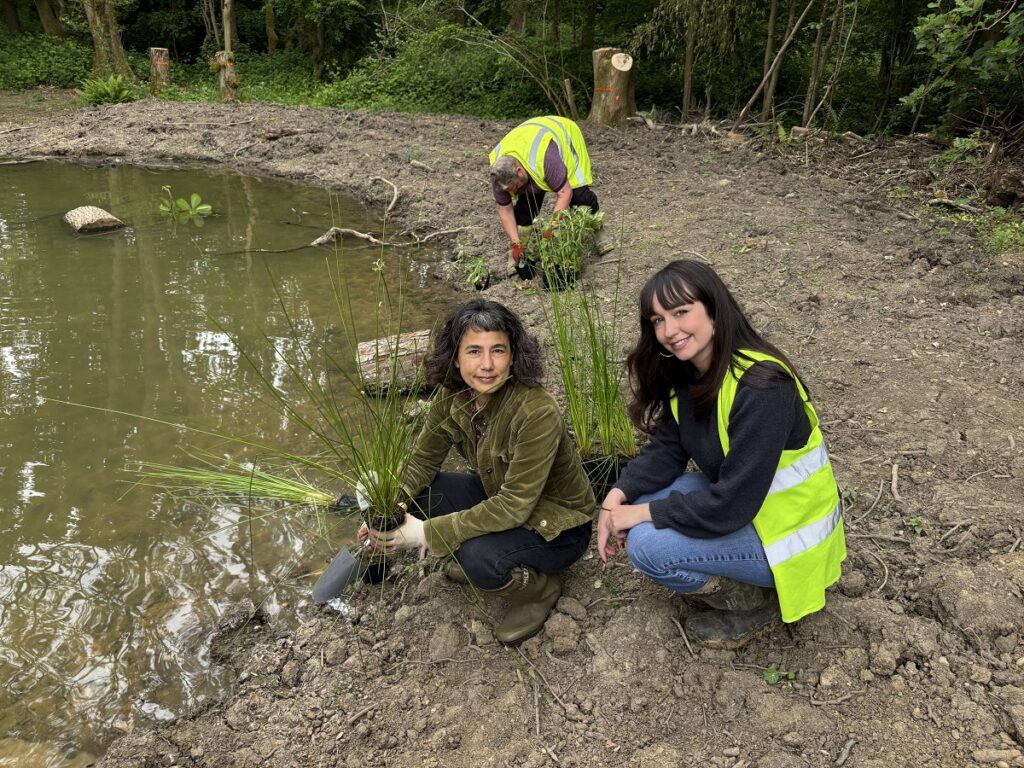
Despite the wettest of winters and having to struggle through mud, volunteers completed the planting of a community orchard in former farmland off Mays Lane, Barnet, which has become the home of The Green Wellbeing Hub.

A five-acre site within the Dollis Valley Green Belt was made available to the charity by Barnet Council as a base for outdoor activities to support young people with social, emotional and mental health needs.

Students from secondary schools and alternative education across the borough are among those who take part in activities at the hub and the planting of the orchard was a project which brought together youngsters and families.

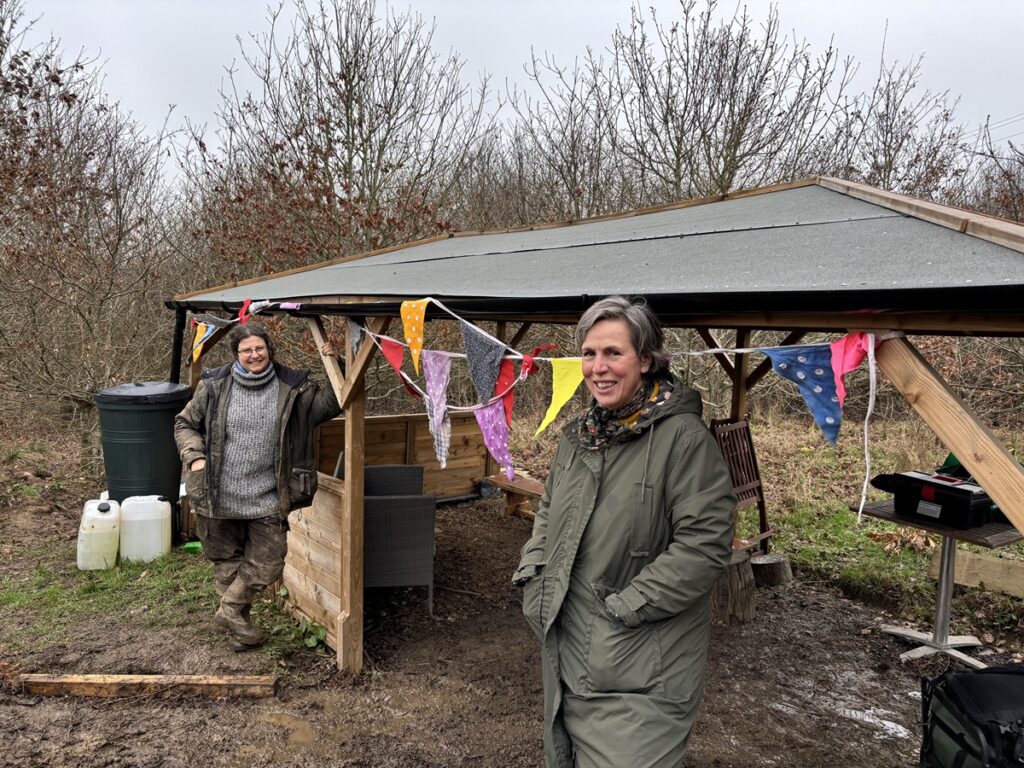
Charlotte Antoniou, hub co-ordinator (see above) said apple, mulberry, quince, greengage and fig were among the fruit trees which had been planted after the land had been cleared of blackthorn and undergrowth.

Since moving on to the site in the summer of 2024, Charlotte and fellow co-ordinator Janine Young (above, right), have seen through the installation of facilities such as a wet-weather shelter, composting toilet and other features including a log campfire circle for events in the summer.

“The Green Wellbeing Hub is so fortunate to have use of the site which is made up of emerging woodland and tree covered glades,” said Janine who has been working on the project with Charlotte for the last five years.

Support and funding to help establish the hub has been provided by a range of groups including the charity Wild About Our Woods, Young Barnet Foundation and Big Lottery.

Oak trees are well established on much of the site and where areas have been cleared of blackthorn and undergrowth, there have been new plantings of wild cherry, rowan and birch. Many of the saplings were donated by the Woodland Trust.

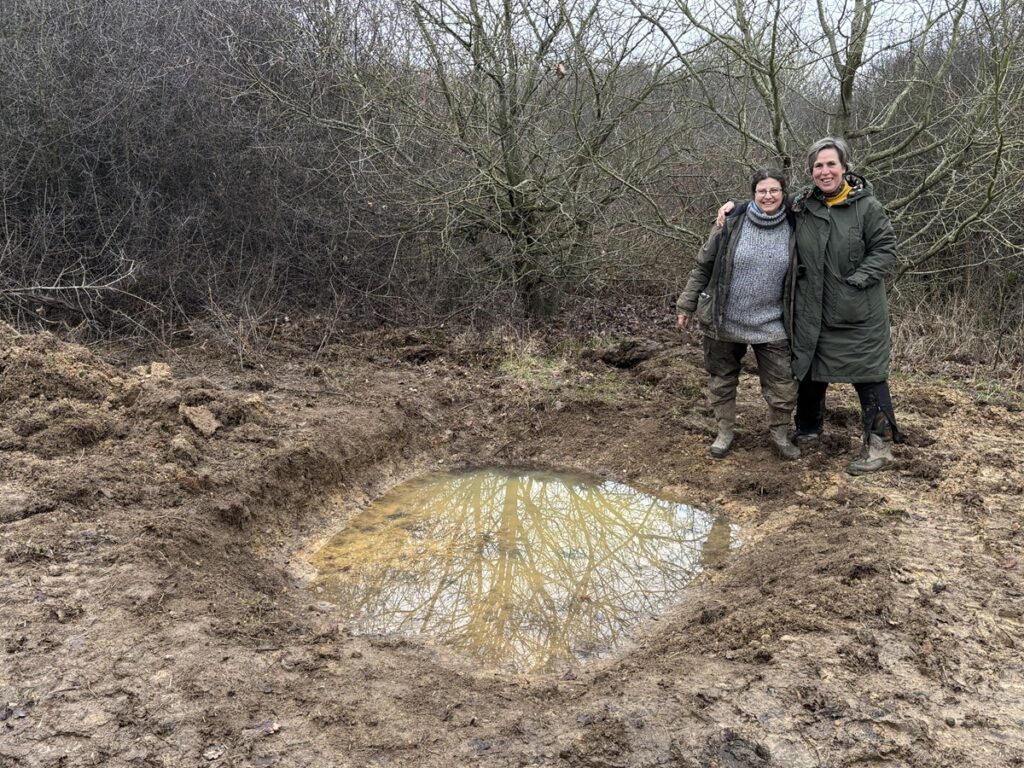
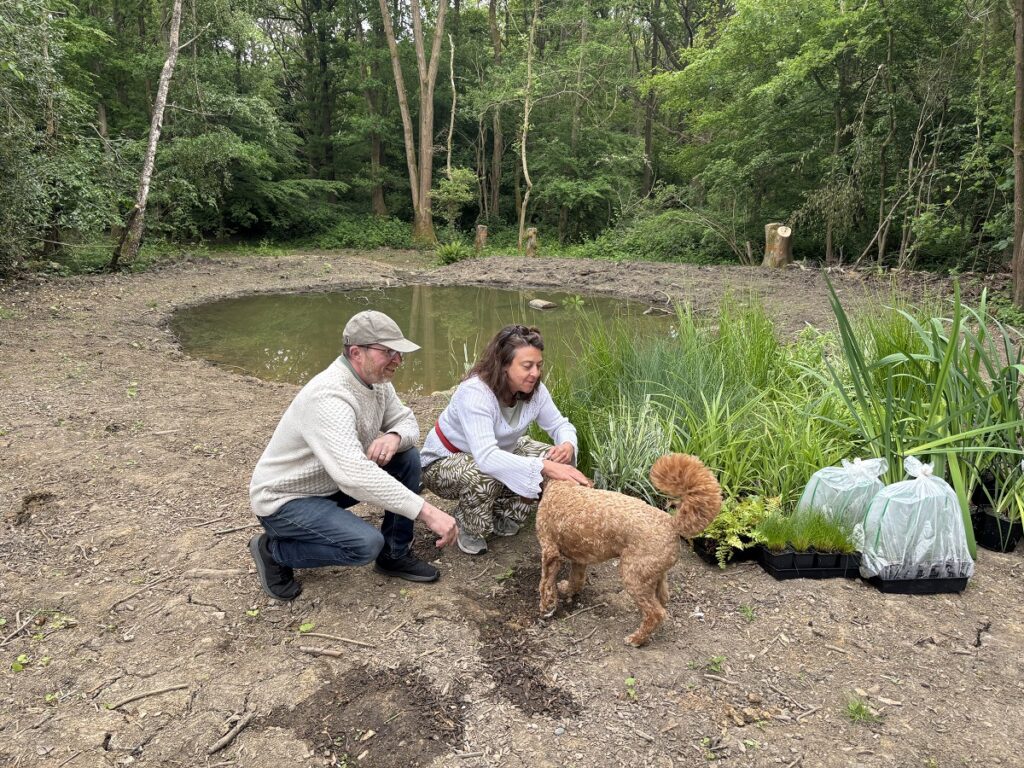
The Green Wellbeing Hub, in Mays Lane, Barnet, an outdoor centre for activities for young people, is adding new attractions such as a community orchard and biodiversity pond.

Recent excavations include digging out a pond which it is hoped will add biodiversity to the hub and attract frogs, newts and perhaps dragon flies.

“We are developing what we hope will be a unique nature-based programme using tried and test outdoor therapeutic interventions to support the positive mental health of young people and adults,” said Janine.

“Activities connected with nature and outdoor skills such as cooking and bushcraft help young people build resilience and the deal with the challenges they face.”

The hub is close to the Dollis Valley Green Walk – which forms part of the London Loop – and the site can be accessed from either Underhill or Hendon Wood Lane providing an excellent route for summer walks, avoiding traffic on Mays Lane.  

For more information email: thegreenwellbeinghub@gmail.com

Posted on 1 Comment

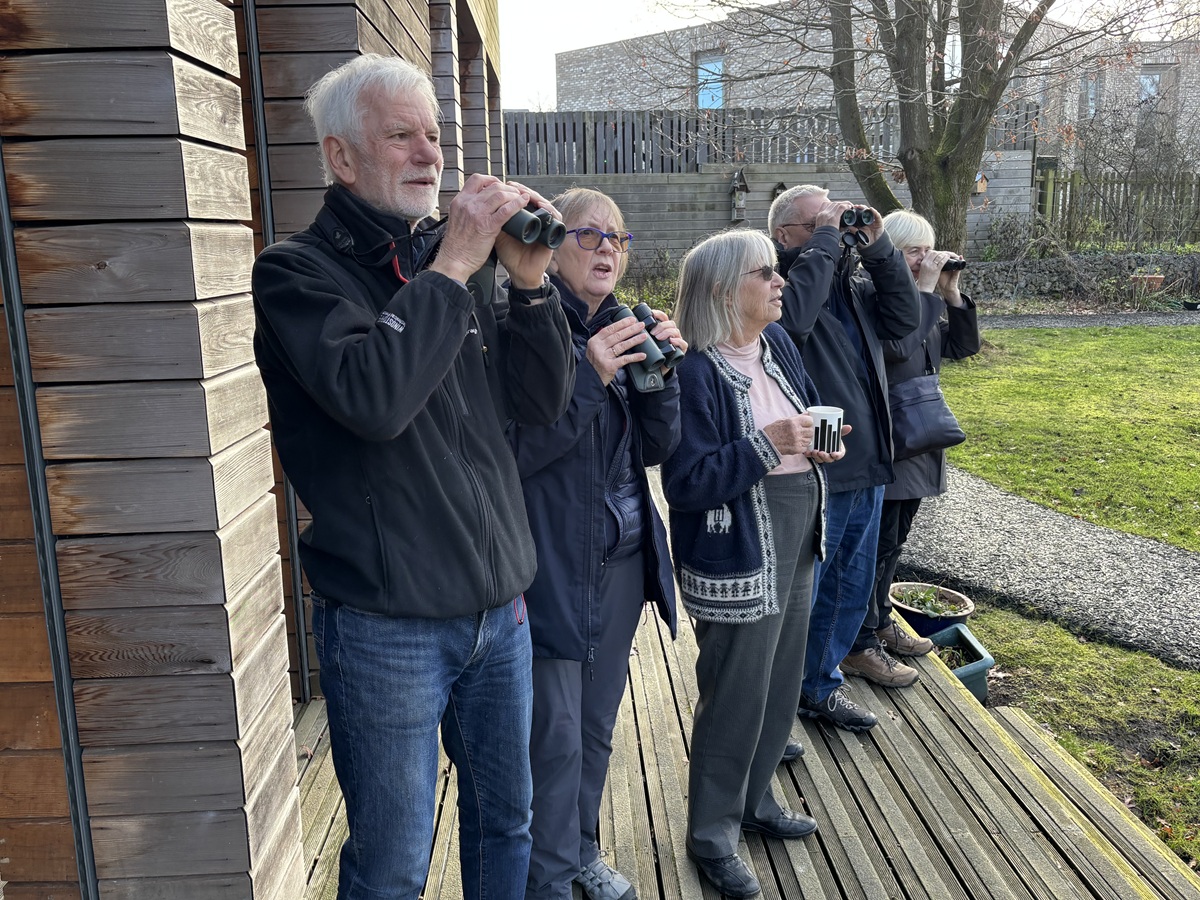
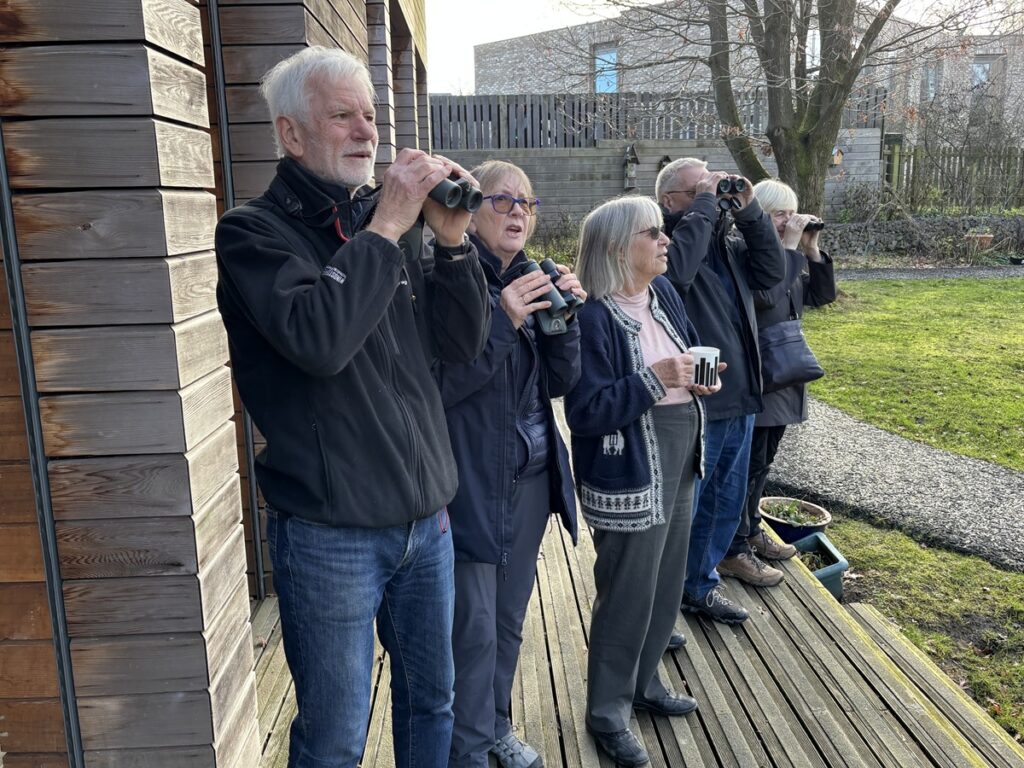
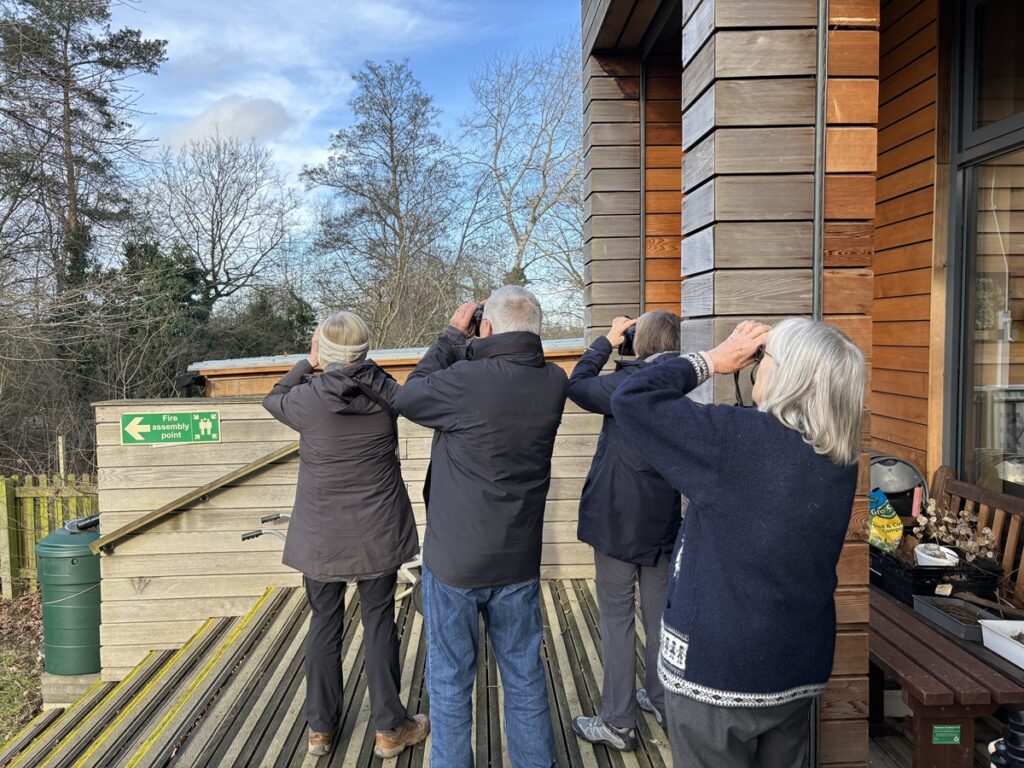
A great spotted woodpecker – and a sparrow hawk above – were just two of the species recorded during a Barnet Big Garden Bird Watch.

A sparrow hawk seen hovering and alighting in the trees disrupted the start of the Big Garden Bird Watch which was held at the Barnet Environment Centre in Byng Road.

Once it had flown off and they no longer felt threatened by a bird of prey, smaller birds returned to the centre’s bird table.

At the end of the hour allocated for the watch, a total of 13 different species had been recorded.

Ian Sharp – above, far left – group leader of the Royal Society for the Protection of Birds for Potters Bar and Barnet – said he was impressed by the centre’s nature reserve.

It was his first visit to the Byng Road centre to assist with a Big Garden Bird Watch, and he was delighted with the range of birds they had seen and identified.

To have seen a sparrow hawk – and the fear it created among smaller birds – was always a special moment and another treat had been to see a great spotted woodpecker.

Other birds seen during the watch included three great tits, four fieldfares, a redwing, a gold finch, and a blackbird, plus two of the inevitable parakeets.

Ian said that so far this winter he had not detected signs of the invasion of redwings, fieldfares and siskins from as far afield as Scandinavia which had been reported in some parts of the country due to hard winter weather in Europe.

RSPB Big Garden Bird Watch at Barnet Environment Centre records 13 different species including a great spotted woodpecker sparrow hawk

However, just after finishing the one hour allocated for the birdwatch, there was great excitement when a small flock of 11 fieldfares was seen flying into the nature reserve.

What Ian said he had found so encouraging was the environment centre’s success in attracting a younger generation of bird watchers and its extensive programme of visits by pupils from schools around Barnet.

Posted on 7 Comments

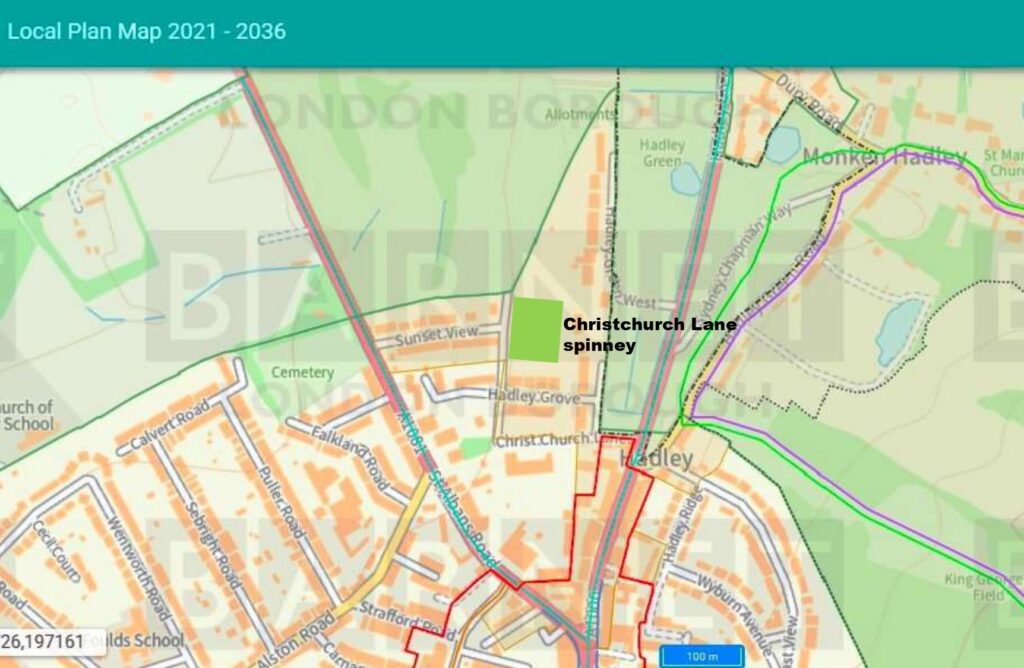
Planning application in to build a house in Christchurch spinney

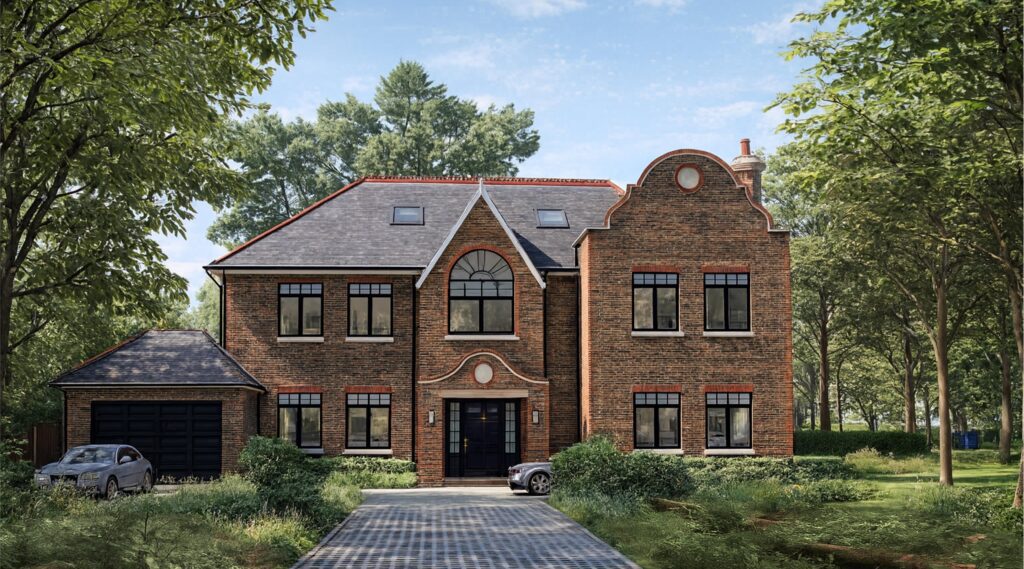
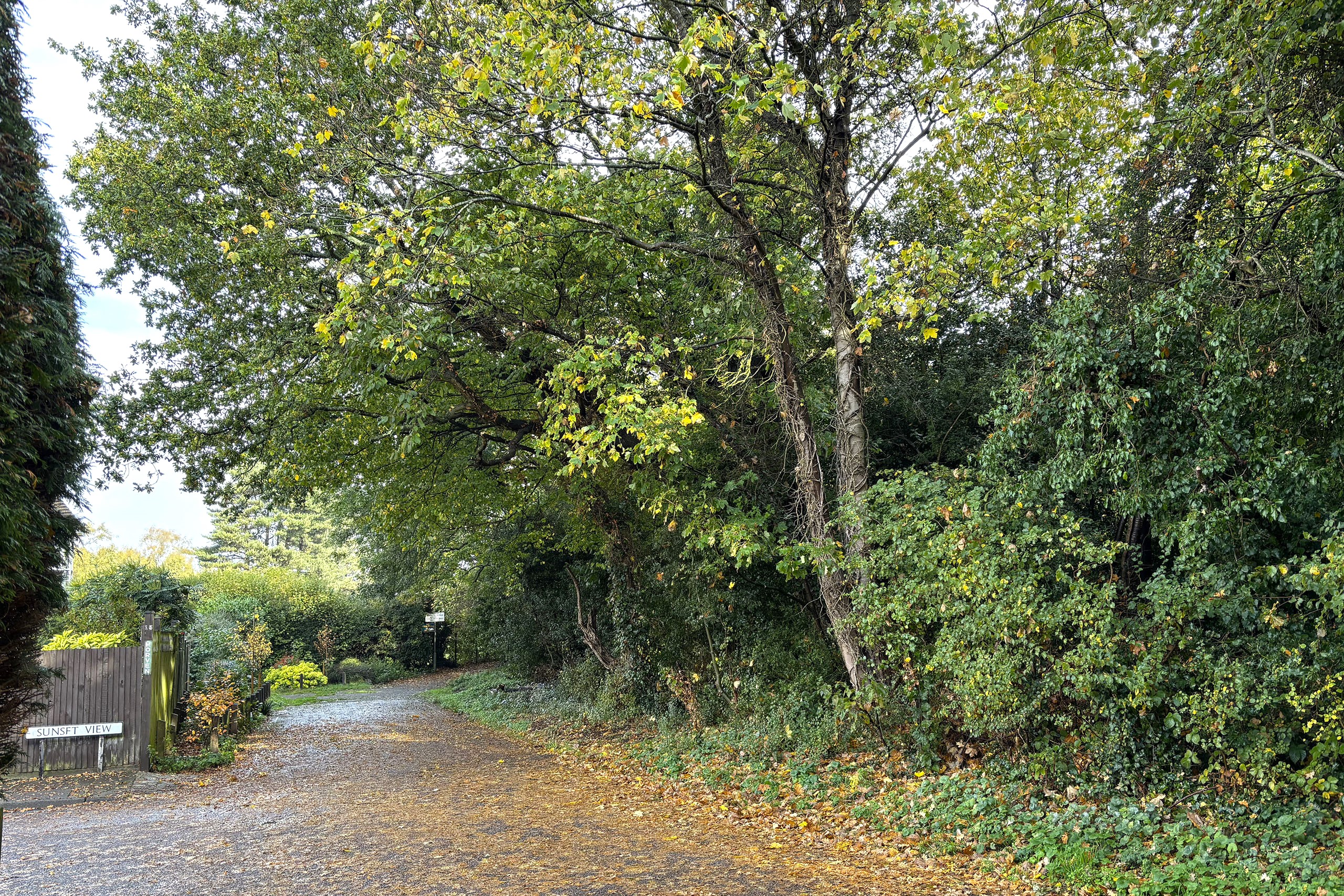
Above is a visualisation of the new 6-bedroom house proposed by its designers, Alan Cox Architects, in secluded woodland barely 200 metres from Barnet High Street. The site is described by the applicants as ‘unkempt’, and by locals petitioning against development as a ‘wildlife haven’. The site is within the Monken Hadley Conservation Area and close to the Green Belt. Some trees have individual Tree Preservation Orders; however all the trees are protected by the conservation area status.

The application is a test of Barnet Council’s commitment to protecting the environment. You can comment on the proposals until Thursday 12 February – see below for details.

Barnet Council declared a Climate and Biodiversity Emergency in 2022. Barnet Labour’s Green Manifesto promised to ‘Protect ALL existing green spaces in the Borough’. And its recently-adopted Local Plan contains policies and supplementary planning documents specifically to protect green spaces. Mayor Khan has similar planning policies, and recently consulted on London’s first Nature Recovery Plan to reverse biodiversity loss.

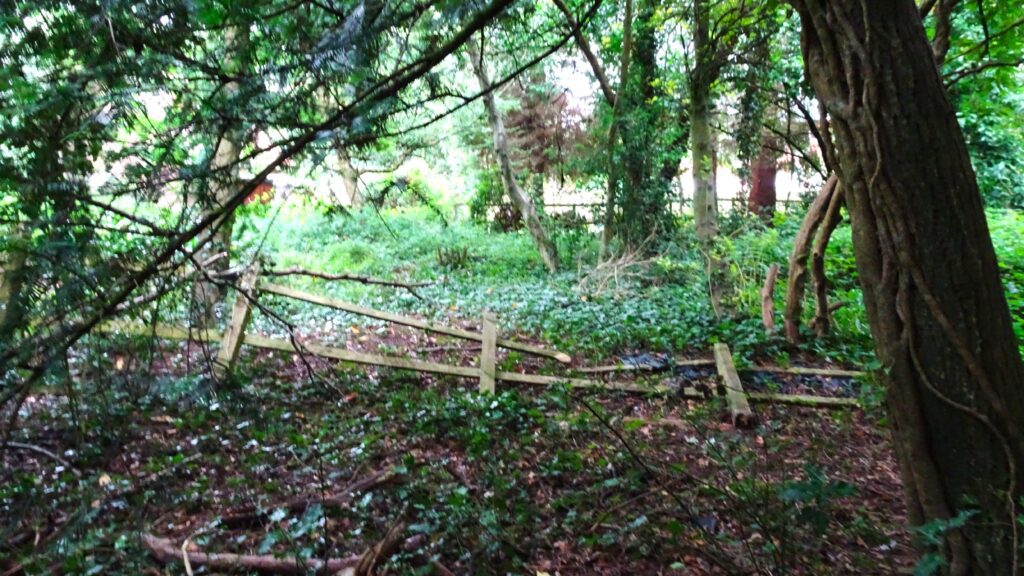
The site is mainly established deciduous woodland. Although small in area its ecological value is great because it provides a vital undisturbed ‘green corridor’ for the transit of insects, animals and flying creatures between the Old Fold Manor golf course and Hadley Green, both of which are in the Green Belt. It is not managed, however, and its biodiversity is limited by the dominance of cherry laurel and bramble on the east side of the site.

In 2024 the Council authorised the sale of part of the spinney that it owns for £430,000, subject to the buyer obtaining planning consent.

The planning application is by Christchurchgrove Ltd, a developer in a joint venture with Barnet Recreation Trust (BRT), which owns the other part of the present site. BRT is a charity that supports ‘the provision of facilities in the interest of social welfare for recreational and leisure-time occupation’ locally.

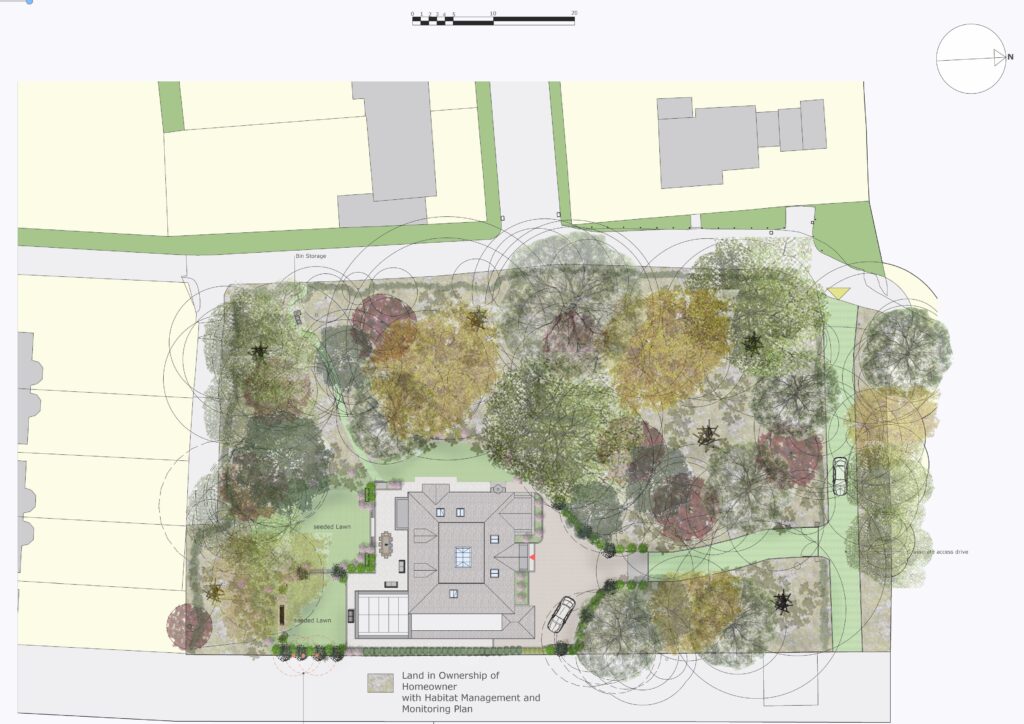
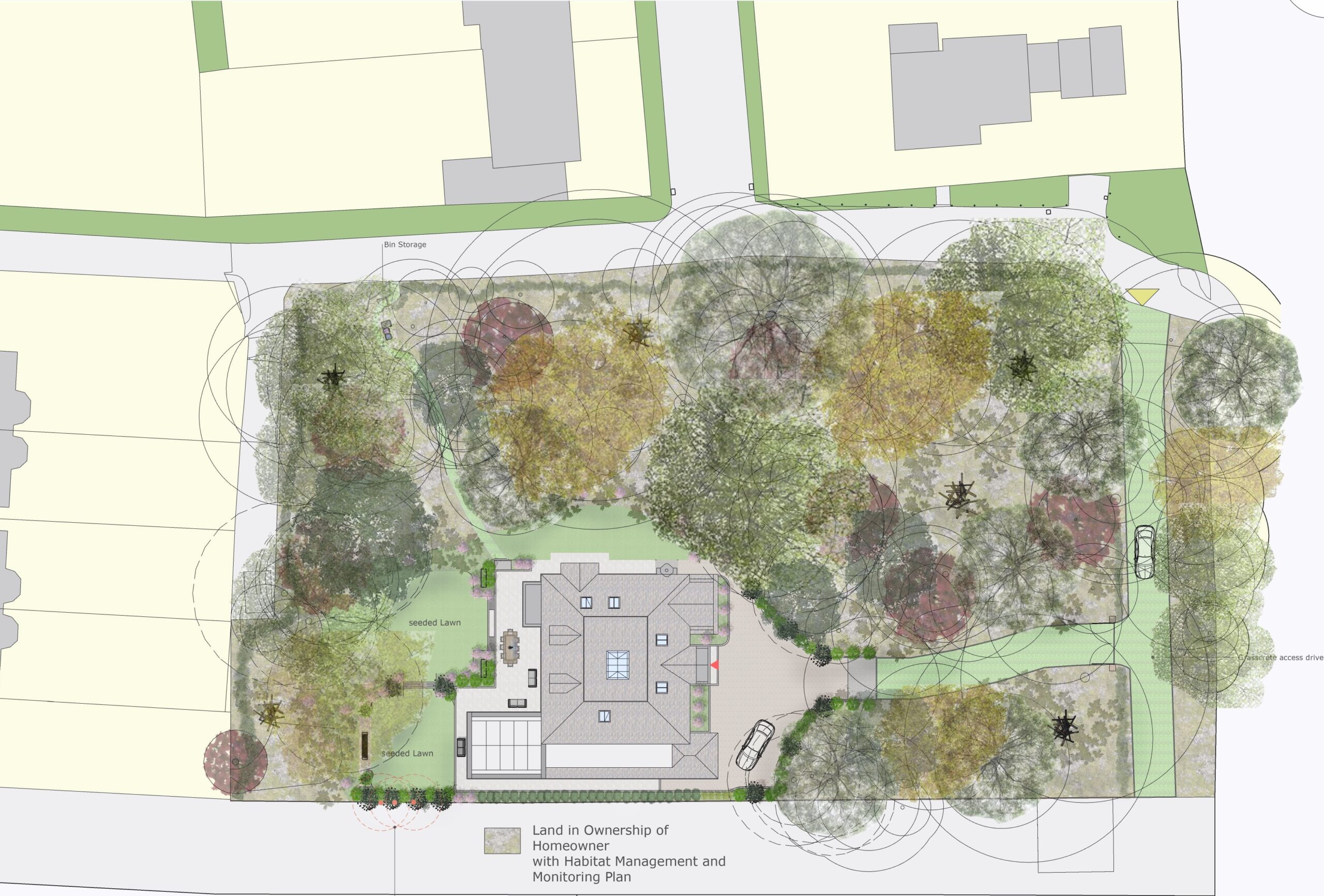
Both organisations would profit from the sale of the substantial (567 sq m) new house and garden that would occupy about a third of the site. The house-owner would be responsible for the rest of the (0.4 hectare / 1 acre) site, which includes almost all the existing protected trees. (See plan below by Helene Landscape and Garden Design).

A public consultation on the proposals was held before Christmas, and Nick Jones’s report on that can be found here. You can also read my earlier post on the issues this project raises for nature protection.

Ideally, the Barnet Society would like to see Christchurch spinney and its wildlife conserved, enhanced and protected, with a minimum of landscaping to enable some public access. In practice, that would require funding and organisation that the Council can’t currently provide. It’s a pity no effort seems to have been made to find a community group or charity to take it on.

Although we’d prefer no house to be built at all, we wouldn’t object to permission being given for one on the least ecologically valuable part of the site on certain conditions:

  • The house and garden must be in keeping with their natural setting.
  • They must be built to high environmental standards.
  • The site as a whole must be subject to a long-term management plan to safeguard and enhance the environment.

The scheme the Society was shown last year fell short on all these counts. To the developer’s credit, however, it has been improved in the light of our comments. Overall, therefore, we’re neutral about the application. But because we aren’t yet convinced about a number of critical details, we’ll submit a list of conditions that must be met before approval.

How you can comment

Have your say one of these ways:

  1. on the Council’s planning portal (ref. no. 26/0116/FUL) via the Comments tab;
  2. email comments direct to planning.consultation@barnet.gov.uk (cc tania.sacordeiro@barnet.gov.uk); or
  3. post your comments to the Planning Officer: Tania Sa Cordeiro, Planning and Building Control, Barnet Council, 2 Bristol Avenue, Colindale, NW9 4EW.

In the cases of 2 & 3, be sure to include:

  • the application ref. no. (26/0116/FUL) clearly at the top
  • the site address (Land Opposite 15 Sunset View Barnet EN5 4LB) and
  • your name, address and postcode.

Sending a copy to our MP dan.tomlinson.mp@parliament.uk and to your local Councillors will increase the effectiveness of your comments.

Posted on 1 Comment

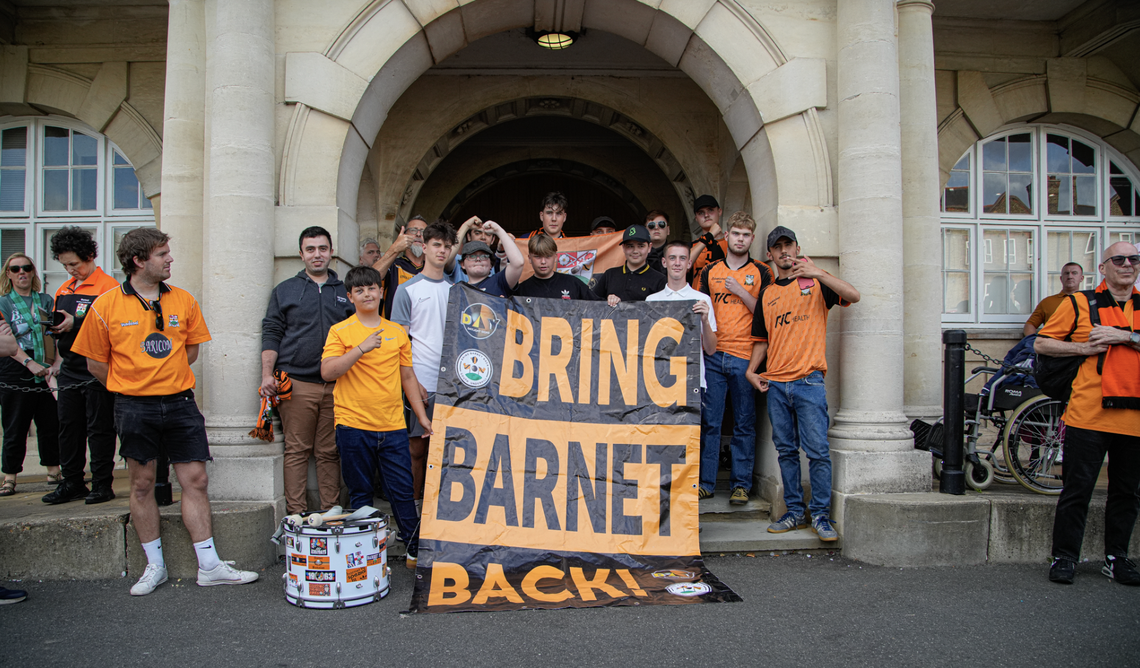
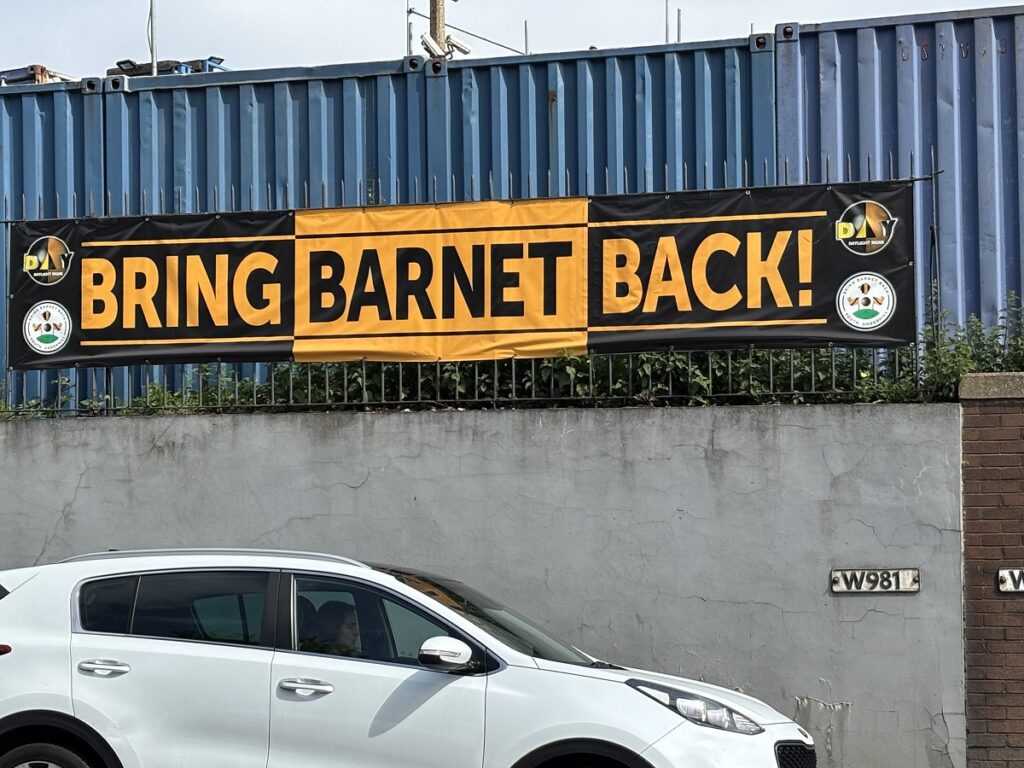
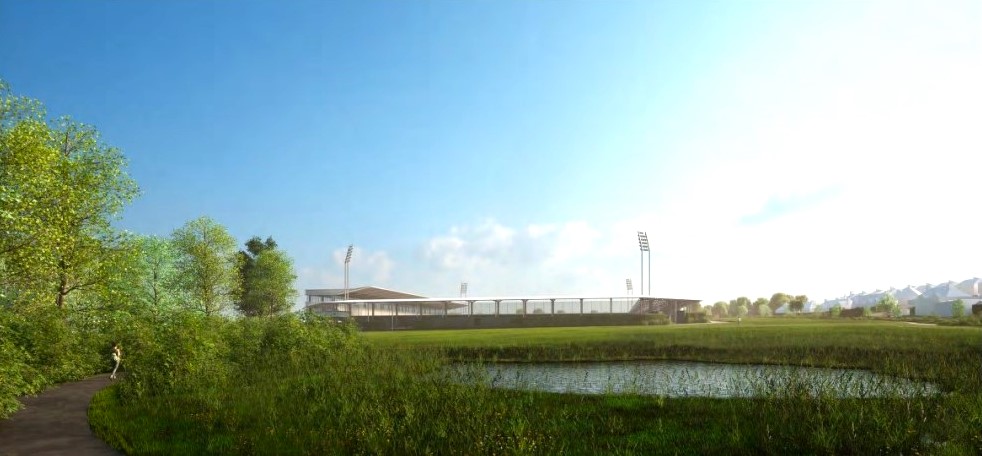
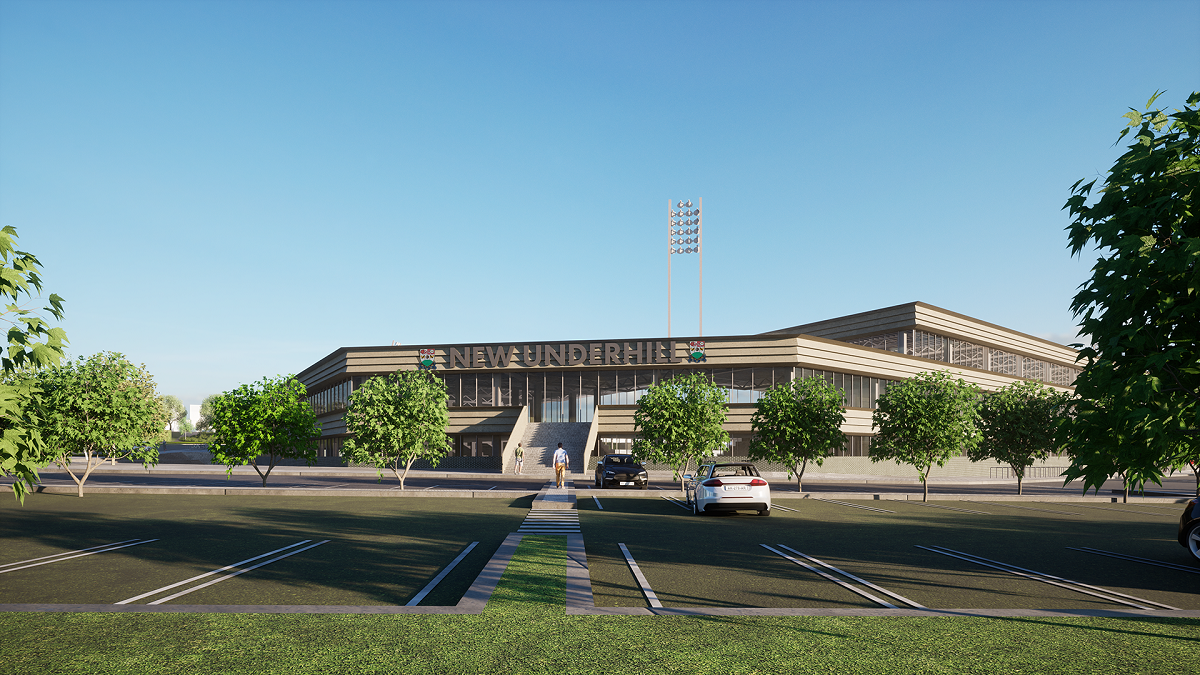
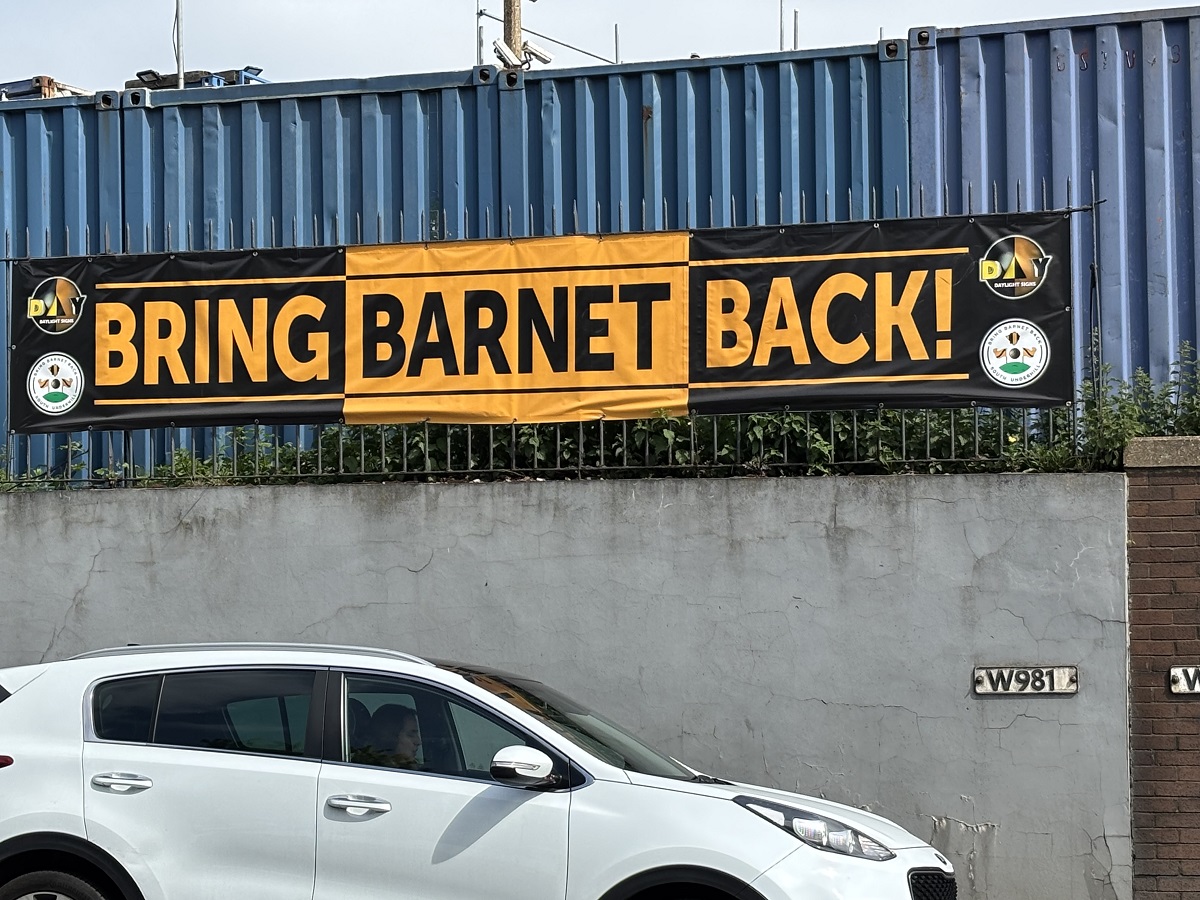
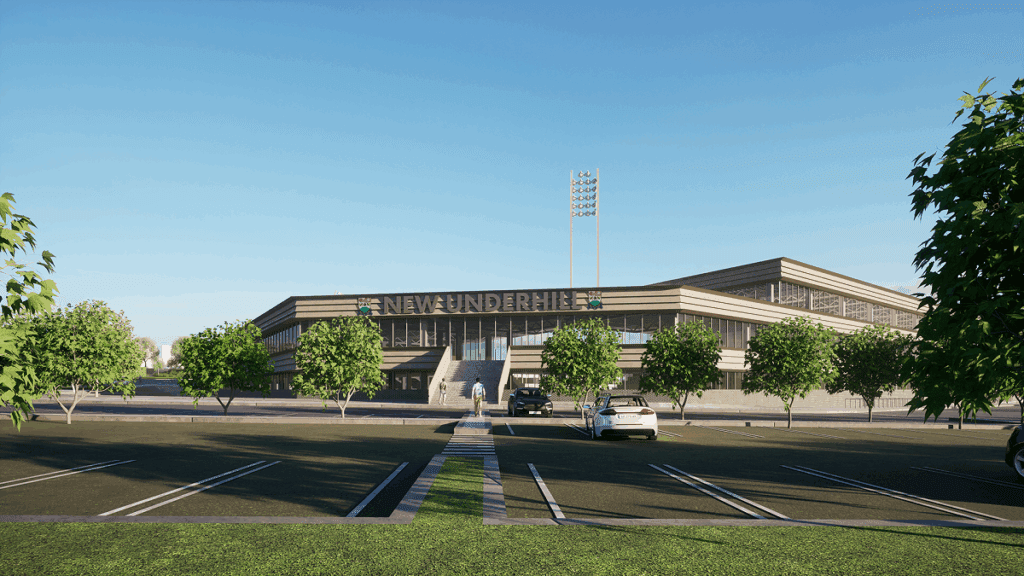
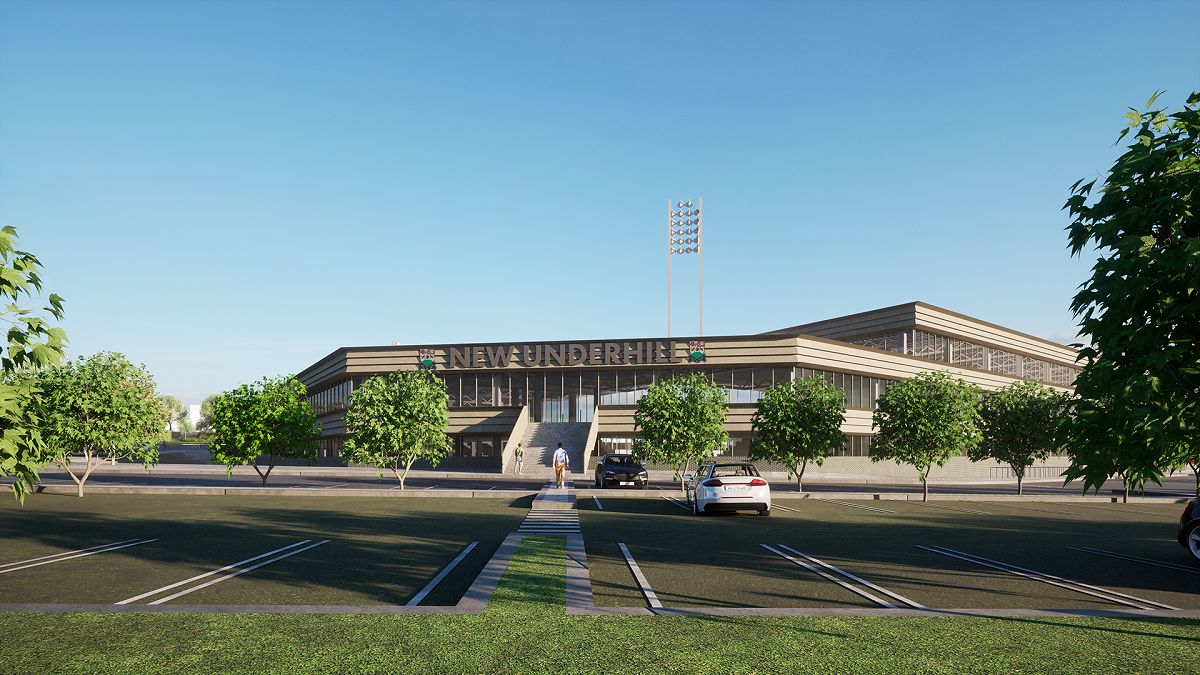
Barnet Football Club abandons planning appeal over stadium at Underhill as Bring Barnet Back identifies possible new locations   

A short list of four or five possible locations for a new stadium for Barnet Football Club is now being considered in depth by supporters of the Bring Barnet Back campaign after lengthy discussions with Barnet councillors and planners.

In view of what the campaign says is now a “very positive” dialogue, the club has decided not to appeal against the strategic planning committee’s refusal last July to approve an application for a new stadium on Barnet playing fields at Underhill.

The last date for an appeal is January 24, but the Bring Back Barnet campaigners urged the club’s chairman Tony Kleanthous against challenging the council.

“Constructive conversations” with councillors and planners have succeeded in producing a shared sense of good will over the push to secure a move from the club’s existing stadium at The Hive, Harrow, and a return to the town.

A total of 51 alternative sites for a stadium were identified and evaluated by the campaign and the highest scoring four to five sites will now be assessed in greater detail.

They are all in what is described as a “ring of suitable sites” – in an area within High Barnet, New Barnet and East Barnet.

As an indication their good faith in trying to find a site acceptable to the council, the campaigner says they will not identify sites on their short list so as to prevent the long-standing controversy over Barnet FC’s return to the town becoming a political football at the council elections in May.

Bring Barnet Back had been thinking of whether to promote candidates – or a symbolic single candidate – in the May elections to demonstrate the strength of their support but decided against the move so as not to jeopardise the constructive relationship which they have established with councillors across the political parties.

However, the campaign will establish a clear public record of which candidates “clearly articulate” their backing for the principle of the club’s return so that supporters can make “informed decisions”. 

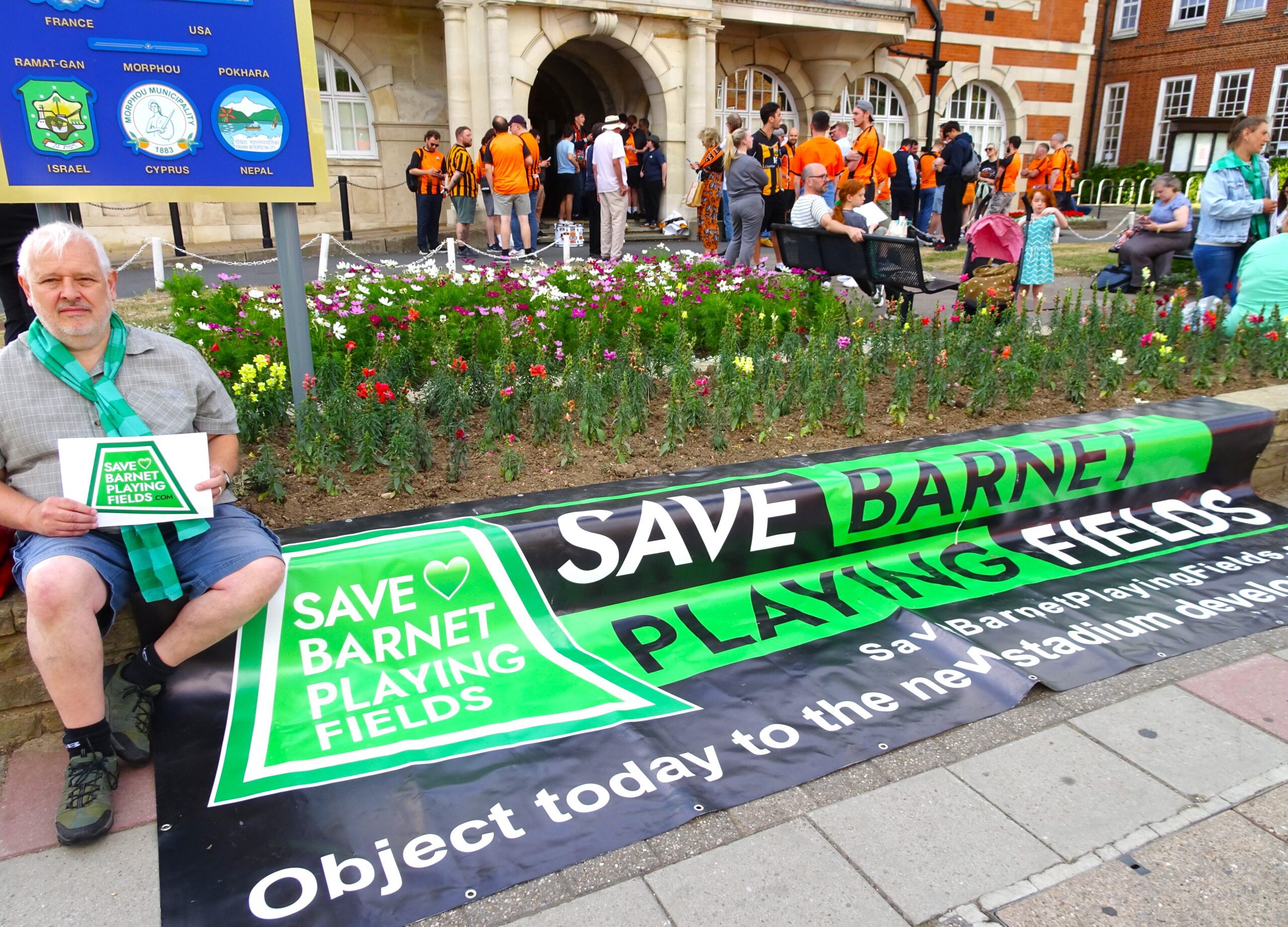
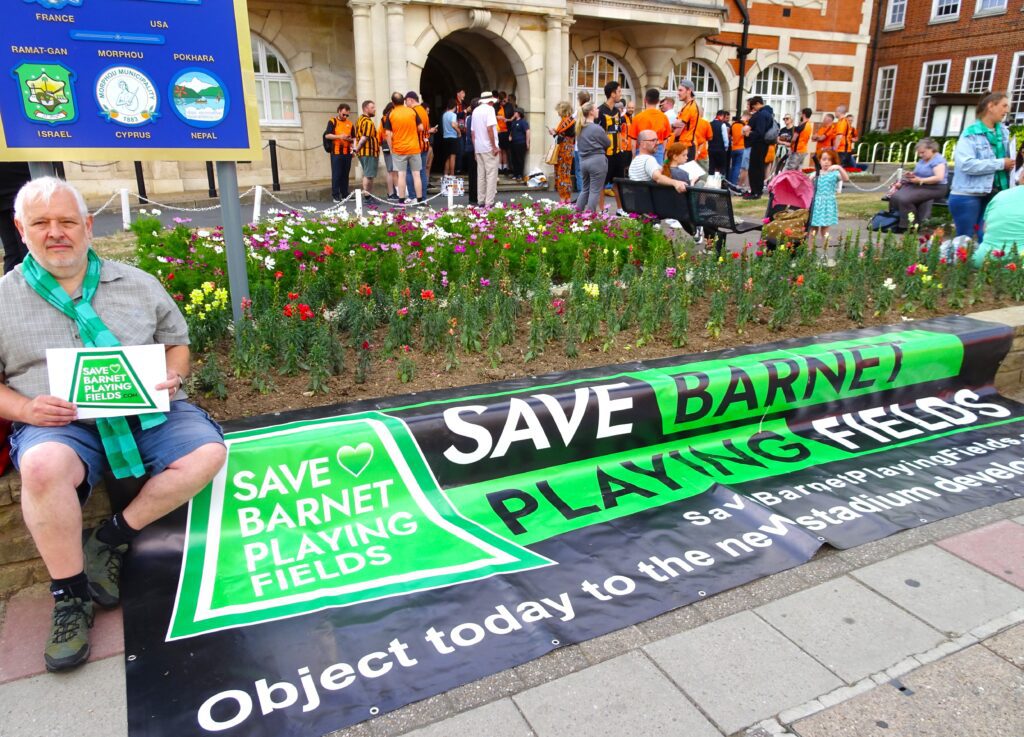
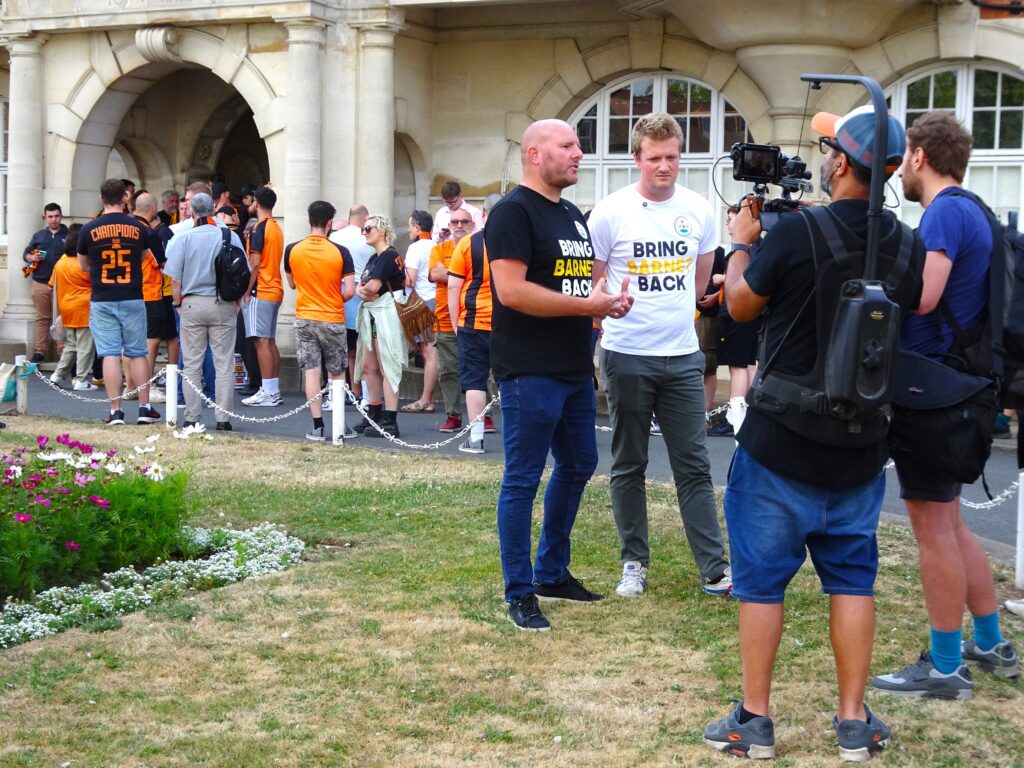
The application for a new stadium at Underhill was rejected by the strategic planning committee last July – see supporters above outside the town hall at Hendon – on the grounds that it failed to demonstrate “very special circumstances” for breaching the Green Belt.

Barnet FC’s planning consultants, WSP, and other consultants, advised that the club would have a “very good opportunity” to appeal on the grounds that the government was now encouraging certain developments within what was deemed “Grey Belt” land.

But the campaign feared an appeal might take 12 to 18 months, with no guarantee of success and even less likelihood of the council agreeing to lease a site on Barnet playing fields.

Conversations over the last few months have indicated that councillors believed the campaign had not been “sufficiently explicit” about why returning to the town was essential for the club.

At stake was the long-term sustainability of the club, given its reliance on continued financial support for the chairman.

The current stadium at the Hive is over an hour away from Barnet on public transport and over a quarter of the club’s local fans no longer attend, creating an annual deficit for Barnet FC of over £1 million.

“Without a permanent asset – a stadium – in its home town, the club’s long-term future remains structurally insecure.

“We now believe there is a shared understanding with all councillors we have spoken to that this is not a matter of sentiment, but of sustainability.”

However, the campaign recognised that the needs of the football club could not be considered in isolation and needed to be grounded in the “delivery of clear, substantial and demonstrable community benefit”.

Although the July application for a stadium had included proposals for a sports hub, medical facilities and wider economic benefits for the town, councillors were clear that a fresh application needed to be “more tightly and explicitly” linked to the need for additional community facilities and collaboratively designed to help deliver the council’s wider objectives.

Any revised plan would take into account issues like the number of school pupils with special education needs, how best to alleviate pressure on the adult social care budget, community-based medical provision and support for young people.

“Prior to these conversations Bring Back Barnet did not fully understand why the original application failed; these discussions have now provided clarity and are reshaping the approach going forward.

“Councillors stressed the importance of designing proposals with them rather than for them.

“The original application was perceived as presenting a largely complete scheme, with limited opportunity for councillors and officers to shape its form, priorities and trade-offs at an early stage.

“Finally, councillors highlighted the need for deeper consultation with key local groups prior to submission.

“In particular, the opposition from Northway School and Ark Pioneer Academy was seen as avoidable had those institutions been engaged meaningfully at an earlier stage.

“When a suitable location is identified and finalised by the planners, Bring Barnet Back will work with local groups to ensure the plans benefit as many as possible.”

Barnet Barnet Back campaign says it has short list of four to five locations for a new stadium for Barnet FC following club's decision to appeal over Underhill plan

Whereas the previously suggested Barnet playing fields site had scored strongly on technical planning grounds, it failed to meet the political test required for approval.

Therefore, any alternative site would have to command sufficient support from councillors to secure permission.

Until further enquiries, technical work and extensive private consultation, the campaign will not reveal the location of the four to five sites on its short list.

“Publishing a potential site prematurely, without full due diligence, would be irresponsible. It would risk exposing early-stage options to speculation, misinformation and unnecessary opposition.

“We fully understand – and share – the frustration this lack of public detail may cause. However, particularly in an election year, it is essential that any future proposals are robust, well-evidenced and carefully prepared.”

Bring Barnet Back statement in full: https://public.hey.com/p/76F1KjJccqW7Q9577B1aTzg3

Posted on 11 Comments

Public consultation on proposed new house in Christchurch Lane spinney

Local developer Christchurch Grove Ltd expects to submit a planning application soon to build a house within existing woodland on the east side of Christchurch Lane (see plan above by Helene Landscape and Garden Design). It raises an increasingly urgent question in Barnet: how much, if any, green space should be sacrificed for new homes?

I wrote about this peaceful haven of wildlife less than 200 metres from Barnet High Street in a recent web post. Situated within the Monken Hadley Conservation Area, with numerous trees protected by Tree Protection Orders, it forms a ‘green corridor’ between two major pieces of Green Belt land, Old Fold Manor golf course and Hadley Green. Its value for biodiversity is greater than its small size (0.438 hectare / 1 acre) would suggest. https://www.savechippingbarnetwoodland.org/ is petitioning to save it from development.

The Barnet Society got involved 18 months ago when the Council decided to sell its portion of the land for £430,000, subject to the buyer obtaining planning consent. Since the part of the site where development is proposed has the least ecological value, a case could be made for building a single house.

Our concerns were twofold. The quality of the wood had to be conserved and enhanced wherever possible. And any house and garden must be in keeping with their natural setting and built to high environmental standards.

The initial plans fell short on all counts. To the developer’s credit, the scheme has now been revised. Whether it meets our original concerns we’ll find out at a public consultation on Friday 12 December from 4.30pm till 7:00pm at Pennefather Hall (next door to Christ Church), St Albans Rd, Barnet, EN5 4AL.

The developer’s team of planning, architectural, ecology and Biodiversity Net Gain (BNG) consultants will be on hand to advise on their proposals. They are also offering to place a covenant on the site to the Barnet Planners to restrict planning permission to one residential property only, to allay concerns about any future or further development of the land.  

They trust that this transparency will dispel many negative comments, especially on the ecology and BNG improvements to the site. 

There is limited parking available on site, which is only a 5-minute walk from The Spires and alternative parking. 

Below is a visualisation of the proposed house by Alan Cox Architects.

Response from Andrew Robinson, Project Manager, Christchurch Grove Ltd.

As the person responsible for bringing forward the plans for a new home on this neglected pocket of land in Hadley Green, I am obliged to the Barnet Society, for giving me the opportunity to correct a number of errors in the recent article and the basis for the petition which has recently been organised.

Robin’s article queries that the site in Christ Church Lane, which he describes as a “haven of wildlife” has not been included in the London’s wildlife plan [Nature Recovery Plan]. The answer is simple. Whilst the site is home to a number of fine tress (all of which are protected) it has a low level of biodiversity. We know this because we have had it surveyed by an expert ecologist.

This survey has shown that there are absolutely [no] mammals living here. No badgers, foxes, bats, deer or hedgehogs as the promoter of the recent petition would have you believe or, in fact, any protected species.

Nature needs nurturing. Unfortunately, this site been left unkempt for over 60 years! Whilst many of us see an abundance of greenery as a good thing, here the result of our survey has shown that due to neglect the area has become overrun by invasive species which are undermining the quality of the soil and preventing daylight to the understorey, thereby killing of what remains of the indigenous habitat.

We all know that wildlife needs help to flourish in urban environments. That is why the scheme that we will bring forward will guarantee a habitat management scheme supervised by experts. This will cover 70% of the site with the remainder forming the garden for the new home.

Gardens themselves are good for nature of course. The RHS research has shown that levels of biodiversity are just as high in cultivated gardens and that is why Hadley Green generally benefits from having so many. Even with a new home here built within the site, we will provide a 10% increase in biodiversity!

Indeed, according to the Council’s Conservation Area Appraisal a quarter of Monken Hadley is in residential use, typically large houses, in substantial plots with cultivated gardens. So I question why would any supporter of the Barnet Society want to oppose a plan for scheme which so typifies the area.

Why would anyone support the continuation of neglect of an area where the habitat and protected trees are being slowly eroded by invasive species?

I would also like to point out that the beneficiaries of this proposal will be Barnet residents. That is because the two landowners promoting it are, the Council and the Barnet Recreational Trust. The latter is a local charity which in the last five years has financially supported almost twenty different local organisations including the Parish of Monken Hadley where it has recently donated £110,000 toward the re-building of the Church Hall. The proceeds flowing from this project would similarly be invested.

Finally, I would like to thank all those who attended our public consultation last week. I was grateful to be able to have the opportunity of providing the evidence behind the claims we have made in relation to the project. If anyone who was not able to attend would like to see the material, please do not hesitate to let me know.

Footnote I would also like to put the record straight as regards that my option deal is with Barnet Estates and not with Barnet Homes.

Posted on

Two re-laid pitches and installation of new floodlights are the start of extensive improvements at Barnet’s Byng Road playing fields

Barnet Council has contributed to the upgrading of the rugby pitches at the Byng Road playing fields by paying for the installation of six new floodlights.

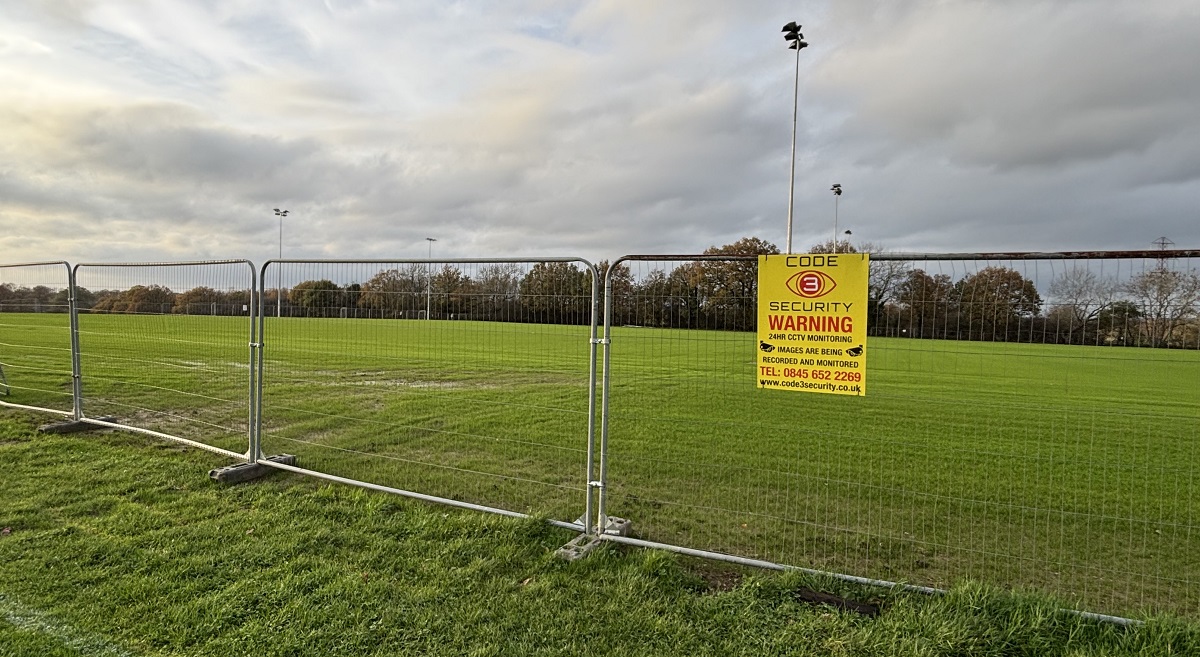
Two of the pitches were re-laid during the summer and will remain fenced off until the start of the new playing season next autumn to give the grass ample growing time to bed in.

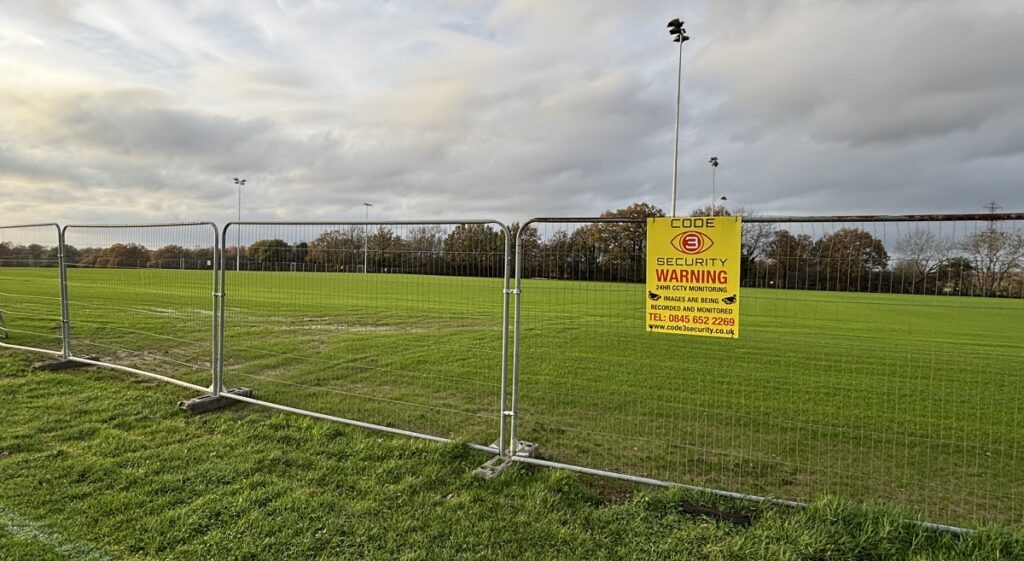
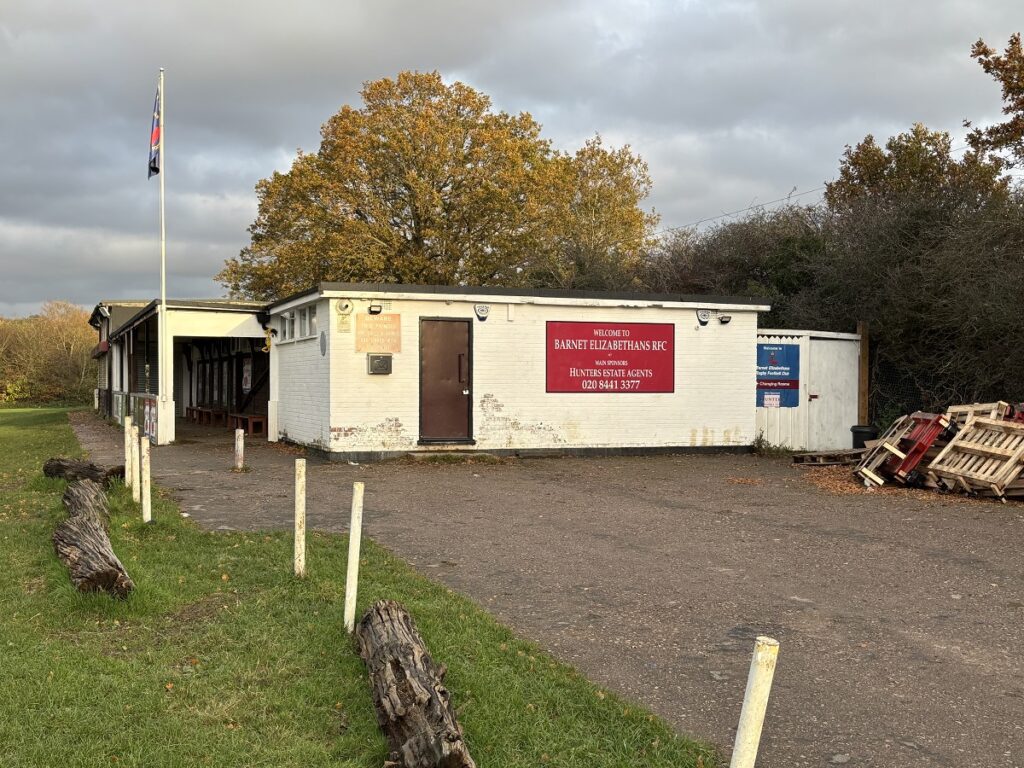
Barnet Elizabethans Rugby Club, which has planning approval for an extensive programme of improvements at Byng Road, is delighted with the council’s investment in new floodlighting which it says will do so much to extend the opportunities for playing and training.

Funding for the floodlighting was provided through the council’s income from the community infrastructure levy which is paid by developers.

Relaying the first two pitches was a costly exercise for the club because of the sloping ground at Byng Road and a poorly drained surface liable to get waterlogged.

During the worst of the winter months the pitches have often been unplayable for up to eight weeks.

If the two newly laid pitches are ready for use next autumn, the club will engage contractors to relay and resurface the playing area nearest the clubhouse.

Alex Bell, chair of the group responsible for ground improvements, said a target date had not yet been set for the demolition of the Elizabethans’ clubhouse, which dates back to the late 1950s, and which is in urgent need of replacement.  

Planning approval for a new clubhouse was obtained two years ago.

“Our aim is to start work on the clubhouse in the next couple of years once we have dealt with and met all the conditions which go with the planning agreement.”

After these conditions were finally agreed between the council and the club, there was a unanimous vote in favour of the scheme by the strategic planning committee despite fears that a new two-storey clubhouse and floodlighting would result in “substantial harms to the sense of openness” to the Green Belt countryside surrounding the playing fields.

There was concern that the scale of the new clubhouse together with 108 car parking spaces and a total of 12 floodlights would be highly visible and have a harmful impact.

Given the strategic significance of the Byng Road playing fields for Barnet Elizabethans – and the importance of maintaining outdoor sports facilities within the borough – the committee considered these “very special” circumstances outweighed any harm to the Green Belt.

The elevation of the new clubhouse – with eight changing rooms on the ground floor and a function area above – far exceeds the dimensions of the current building, increasing the height by 3.4 metres to 7.6 metres and increasing the volume by 150 per cent to just under 1,000 square metres.

However, these dimensions are just below the threshold to be referred to the Greater London Authority.  

Posted on 4 Comments

Protecting green spaces – how serious are our politicians?

View of Christchurch spinney in early autumn

This peaceful spinney in Christchurch Lane is a haven of wildlife less than 200 metres from Barnet High Street – but it’s threatened by new building. How can that be?

Barnet Council declared a Climate and Biodiversity Emergency in 2022. Its recently-adopted Local Plan contains policies and supplementary planning documents specifically to protect green spaces of all kinds.

Mayor Khan has similar planning policies and is currently consulting on London’s first Nature Recovery Plan (LNRS) to reverse biodiversity loss. Surely the spinney’s future is safe?

Worryingly, the answer is no.

Last year the Council authorised the sale of part of the spinney that it owns for £430,000, subject to the buyer obtaining planning consent. Existing covenants on the land restrict development to private residential use. A planning application is expected before long.

The site is mainly well-established woodland with several Tree Preservation Orders but would benefit from sensitive management. Although small in area (0.438 hectare / 1 acre), its ecological value is great because it provides a vital undisturbed ‘green corridor’ for the transit of insects, animals and flying creatures between the Old Fold Manor golf course and Hadley Green, both of which are in the Green Belt.

Local resident Marianne Nix says ‘The spinney is a rich and biodiverse habitat, regularly visited by badgers, foxes, muntjac deer, bats and hedgehogs as well as birds on red and amber conservation list 5.’ Above and below are some of her recent photographs.

The spinney’s location within the Monken Hadley Conservation Area should provide it with statutory protection. But the Barnet Society knows from bitter experience over the Whalebones Estate housing development that the Council can override Conservation Area status if it decides that development would be ‘less than harmful’.

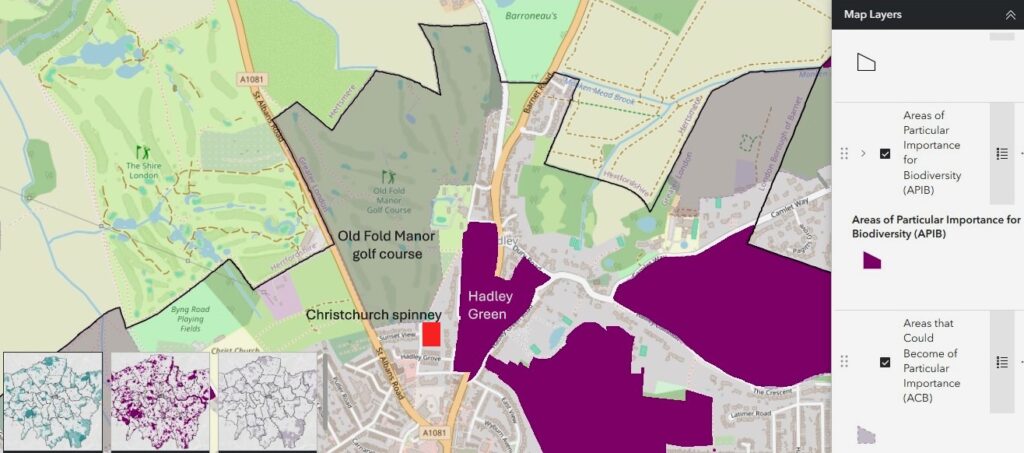
The plan above is based on an interactive map that is a key component of the draft London LNRS. It shows Areas of Particular Importance for Biodiversity (such as Hadley Green – purple on the plan) and Areas that Could Become of Particular Importance (such as Old Fold Manor golf course – sage green on plan).

On it is marked Christchurch spinney, highlighting its value of as a strategic link between the golf course and green. Unfortunately, the spinney itself is not designated in the LNRS.

Mayor Khan’s draft explains the purpose of an LNRS, identifies six overarching priorities for London and describes in impressive detail the range of landscape characteristics and wildlife species that deserve protection. It’s a welcome framework for the guidance of future development across London.

Development of the LNRS has enabled Council Biodiversity Officers to check the existing data. It turned out that much was inaccurate, out of date, incorrect or non-existent. It has now been updated and significant effort has gone into identifying potential sites of particular importance and for taking action. So thanks to the LNRS, we now have a better baseline for our local nature.

There’ll be a chance to suggest new locations such as Christchurch spinney when the LNRS is next reviewed, which will take place every three to 10 years (the government will advise on the timeframe). Until then, the Council’s duty is to protect the spinney.

In 2022, Barnet Labour’s Green Manifesto promised to ‘Protect ALL existing green spaces in the Borough’. In the May 2026 local election Barnet voters will be able to hold Councillors to account.

You can comment on the draft LNRS here. The deadline is Wednesday 29 October 2025.

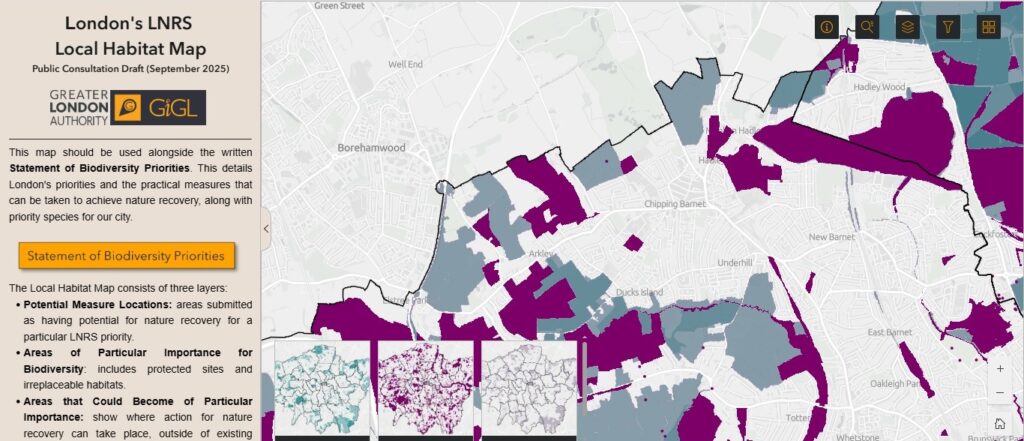
Below: LNRS map extract showing designated areas in Chipping Barnet parliamentary constituency

Posted on 17 Comments

Planning inspector is being asked to reconsider Barnet Council’s rejection of plans for Barnet Football Club’s return to Underhill

Barnet Football Club has launched an appeal against the refusal of Barnet Council to approve an application to build a new stadium at Underhill.

A public inquiry before a planning inspector will give the club a chance to explain what it believes are the reasons why a new football ground should be permitted on playing fields close to the club’s previous stadium.

Despite being within the Green Belt, the club hopes an inspector will overturn the planning department’s advice that a new stadium in a “valued local park” would result in “substantial and irreversible harm to the openness and function of the Green Belt”.

BringBarnetBack, the group which is campaigning to bring the club back to a site as close as possible to its original home at Underhill, believe every effort should be made to secure a full public hearing.

When the application was considered by the strategic planning committee in July, members voted by 6-0 to reject the plan (with three councillors abstaining).

Councillor Barry Rawlings, leader of the council, told the Barnet Society that planning officials were now assessing the grounds of which the club had launched its appeal.

As the debate about whether Barnet FC should return to Underhill – from its current base at The Hive, Harrow – was now “a live issue” once again he was restricted in what he could say.

But he wanted to emphasise that his door as council leader remained open if the club did come forward with other alternative sites for a new stadium in or around High Barnet.

“It is difficult because of the proximity of the Green Belt, but as a council we would be prepared to look at other sites suggested by the club, such as a ground shared with another club or land already designated for sport.”

A survey conducted by the Barnet Society among community groups and councillors before decision in July, showed that the town was split down the middle over whether a 7,000-seat stadium should be built on Barnet Playing Fields.

Underhill Councillor Zahra Beg, who spoke out against the application in July, said she remained opposed to using the playing fields for a football stadium, but she was anxious to understand the grounds on which the club was appealing.

Planning inspector being asked to reconsider Barnet Council's refusal to grant planning permission for new stadium for Barnet Football Club at Underhill.

In view of promotion to League Two of the Football League, BringBarnetBack believe the club’s current success – it is currently placed 10th in the League – strengthens the case for securing a return to Underhill which they argue would provide a tremendous boost to match attendances and boost the High Barnet economy.

Posted on

Campaign underway to secure long-term future for highly successful on-site school farm at Totteridge Academy

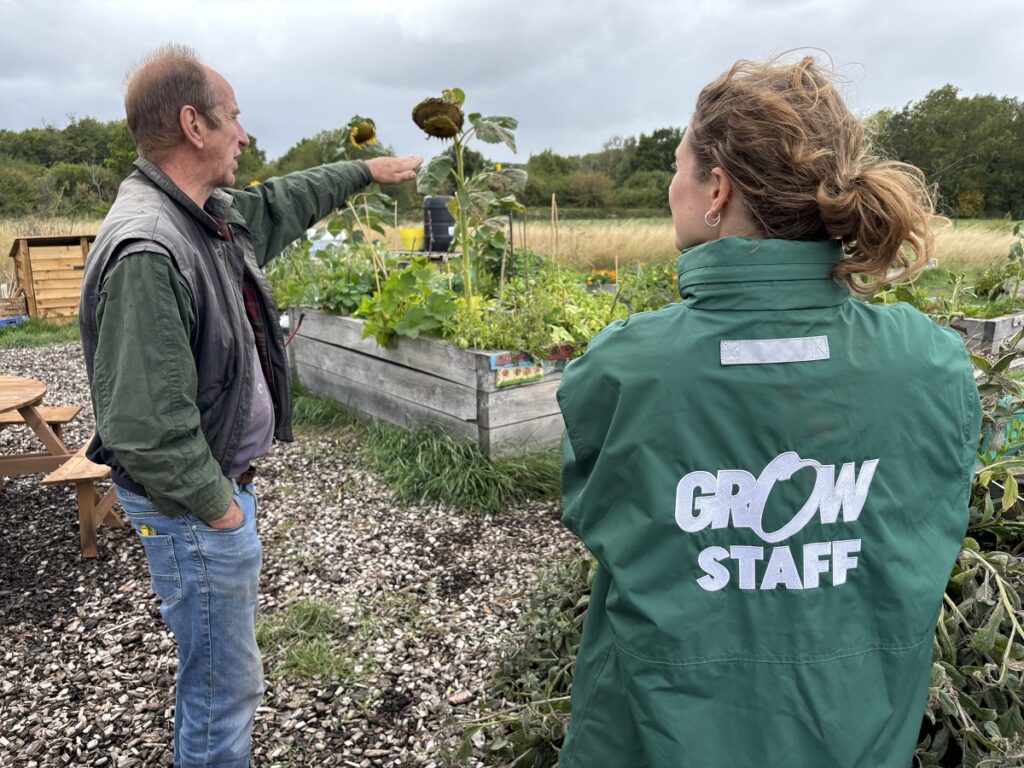
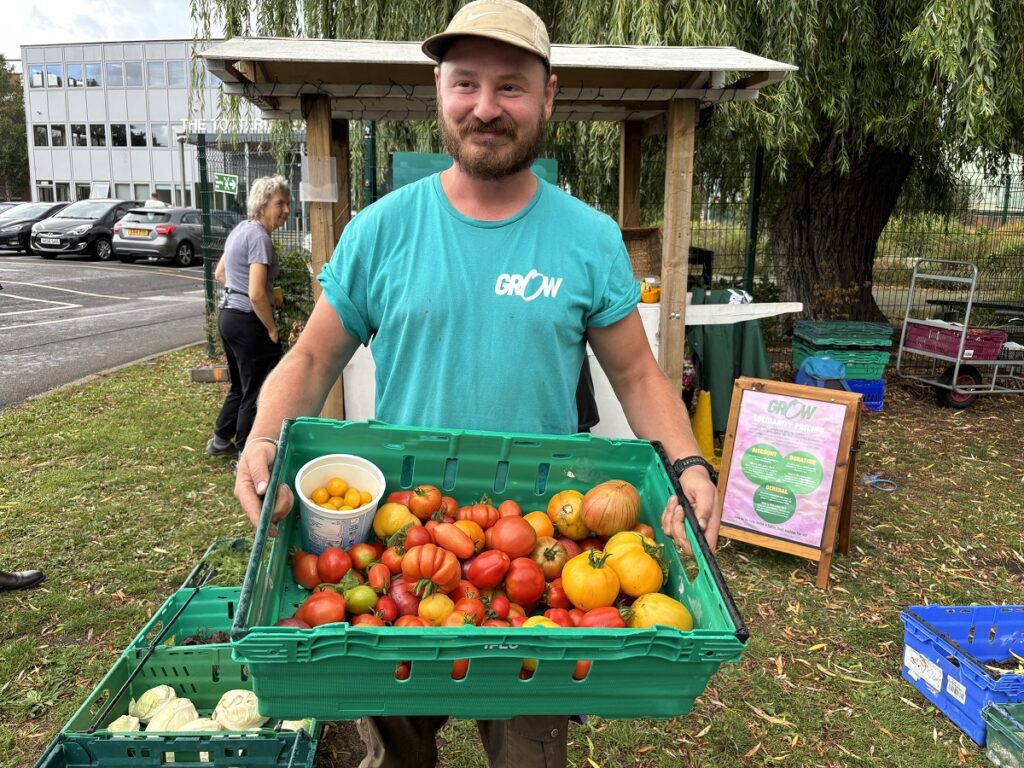
A bumper summer crop of pumpkins, tomatoes, cucumbers and other produce is another illustration of the continuing success of GROW, the school and community farm which has been created on a six-acre field next to The Totteridge Academy in Barnet Lane.

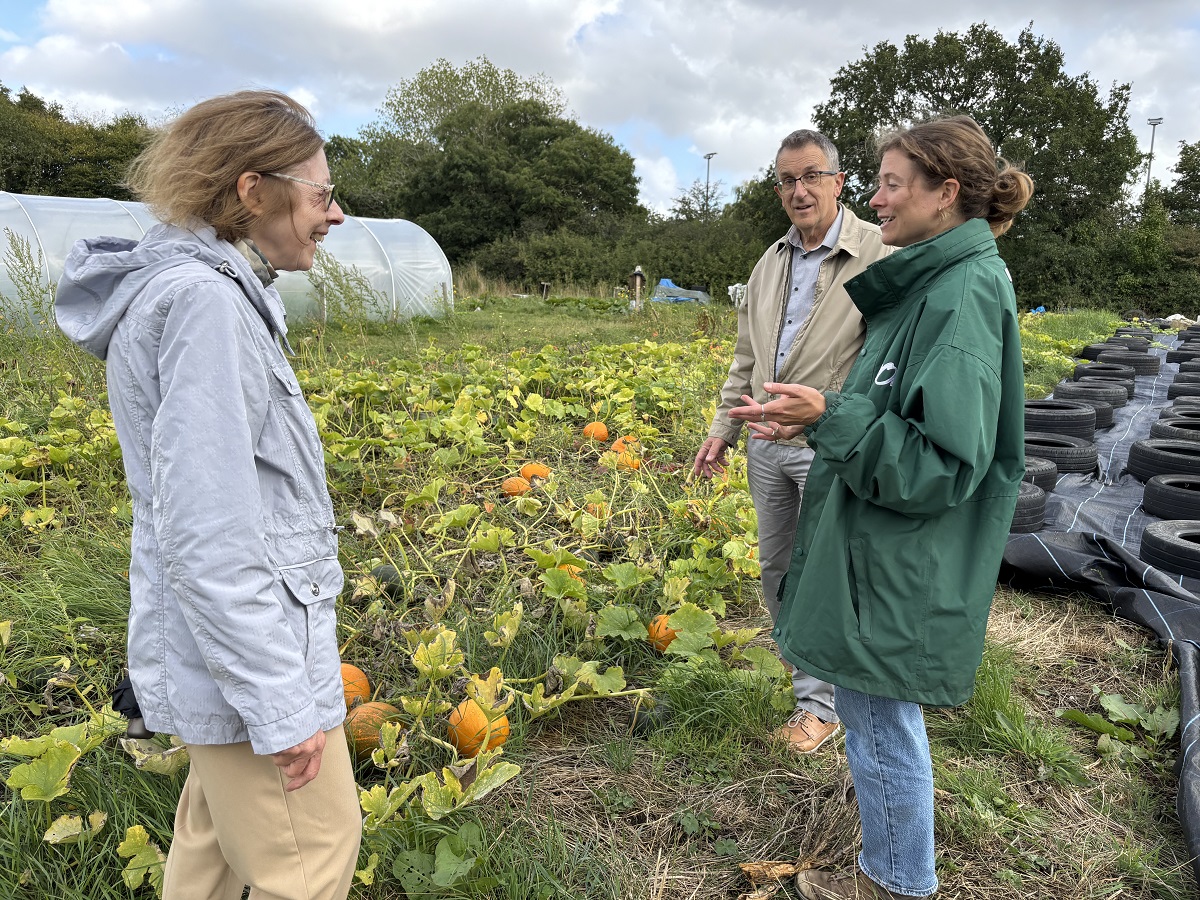
Visitors were welcomed at an open day by the farm’s managing director Lucy Hollis (above, far right) who is encouraging local residents to give their opinions on whether GROW should be granted a ten-year lease of the land.

There was nothing but praise for the way this educational charity has encouraged pupils at The Totteridge Academy to get involved in the planting and growing of vegetables, fruit and flowers.

A fascinating look back at the inspiration behind the development of an innovative school farm – and GROW’s success over the last six years – has been prepared by Anna Robins (see her text below).

Some of the produce from the farm goes straight to the school kitchen for seasonal meals for pupils and surplus is sold at a farm shop at the school entrance.

GROW’s contribution to the community has expanded since it opened in 2019 with the introduction of raised-bed gardens for use by families who have no outdoor space and through the organisation of regular gardening clubs for children on Saturdays and in school holidays.

GROW’s aim is to gain security of tenure of its site with a ten-year lease and ensure community support for any future planning applications.

The open day marked the start of a month-long consultation to test public support for the farm and to gain approval for a lease agreement with United Learning Trust (on behalf of Totteridge Academy) and the Department of Education.

For Rob and Yvonne Verrill – above with Lucy Hollis – the chance to be shown around the farm brought back family memories.

“Our son went to The Totteridge Academy, and it is great to see how the school is now offering local children the chance to learn how to cultivate and grow food.

“It is so beneficial to get children involved out-of-doors activities. It is great for their self-esteem.”

Another first-time visitor Nick Gagen was shown the raised beds where families without gardens can grow produce.

“I live in Manor Road and have walked past the farm lots of times but never been inside. It’s great to see what GROW does for the school and local community.

“I grew up in the Cambridge Fens, so I know how important is to understand all about nature and plants.

“My family used to say that when children who were evacuated from London during the last war arrived to stay, they had no idea that food was grown out in fields. They thought it all came in tins and boxes.”

For farm manager Chis Haigh the tomato crop has exceeded expectations with lots of varieties doing well – heritage tomatoes, Roma, gourmand and gardener’s delight.  

He says that securing a long lease on their field – which was previously unused by the school – would assist in planning future cultivation and make it worthwhile to plant more fruit trees such as apple, pear, quince, plum and mulberry.

GROW has already planted over 60 fruit trees and around 500 hedge-row trees around the perimeter of the farm.

In her history about the development of GROW, Anna Robins (above) – chair of the Byng Road Allotment Committee – explains that this initiative was part of a recovery plan for The Totteridge Academy after several troubled years and a falling school roll.

In 2016, Chris Fairbairn was appointed the new head teacher by United Learning Trust, which had taken over the management of the school, and he set about a five-plan to make Totteridge the “most improved school in London”.

Anna – who said Mr Fairbairn knocked his promise “out of the park within two years” – takes up GROW’s story:

“While Mr Fairbairn and his team steadied the ship and set it on a course to success, the school was also moving up the social ladder. The school’s hall was featured in a 2018 John Lewis advertisement and Mr Fairbairn’s invited his university friends to deliver assemblies and classes – radio and television presenter Rick Edwards, historian Dan Jones, and television presenter George Lamb.

“According to George Lamb’s interview with the Harmony Project, he was having his own crisis that mirrored The Totteridge Academy.  While he achieved success as a radio and television presenter, he ‘felt empty’ and his achievements were ‘pointless and did not know what to do with himself’ – a fact echoed by his dad: ‘a game show host […] Not a very serious guy in the scheme of things’. 

“Affected by the 2011 riots, George Lamb threw himself into volunteer and community work focussing on disenfranchised and disengaged people.  In 2016, like The Totteridge Academy, in times of turmoil, George Lamb also turned to Mr Fairbairn.  Over the next few years, George Lamb became a regular visitor at Totteridge because he “liked the energy that his friend brought to the school”. 

“He was looking ahead to the next generation, realising that raising young people’s environmental IQ was important as ‘there will be no human rights, if there is no planet’.  On his next visit to TTA, George Lamb spotted a derelict six-acre field next to the school’s old car park that was supposed to be redeveloped into football pitches.  Due to a lack of funding and declining pupil numbers, this was never actualised, and so these six acres were dedicated to GROW.

“In December 2019, GROW submitted a planning application to change the use of these six-acres from school playing field to a City Farm with educational farming.  Officially launched in 2019 by George Lamb, the school grounds started their transformation into a community farm. In June 2021 it featured in the Evening Standard, on BBC’s Gardeners World in October 2021, and Children in Need in 2024. 

WHAT DOES GROW DO?

“By far the main beneficiary of GROW is the Academy itself. The initiative’s biggest achievement is connecting the school kitchen to GROW’s food to create seasonal dishes for pupils and staff.  Pupils can see the journey of their food from field to fork. Over the past six years, GROW has provided food for over 100,000 school lunch plates for the Totteridge Academy community.

“Also, GROW’s aim is to integrate itself with the entire school curriculum and to apply the subject knowledge on the farm. While some subjects are easily applied to the GROW farm, like science and the recently revived Food Technology, GROW’s challenge is to support all subjects across the curriculum so all pupils can access and learn from GROW.  Other subjects that have used the GROW farm are photography, English, and geography – most of which were re-introduced to the Academy’s curriculum due to its academic success.

BENEFITS FOR LOCAL COMMUNITY

“The local community can access GROW: by a community stall in the academy’s car park, where fresh food is affordable and accessible for all ( Wednesday 3pm-6pm. from November 3pm-5pm); Grow-Cook-Share which provides local families with no outdoor space with a raised bed to grow fruit and vegetables; and BUNCH an AQA qualification in floristry for people aged between 13-16 years old. 

“GROW also provides after-school programmes and holiday clubs for free school meal recipients. 

“In the last few years GROW has spread its initiative across the London Borough of Barnet.  They are working with Underhill School & Children’s Centre and Whitings Hill Primary School by supporting them to set up their own farms to help their communities access fresh food and enhance their wellbeing through farming.

“Grahame Park now has its own community garden welcoming local residents to grow food, learn new skills, and connect with their neighbours. It is a thriving hub with over 550 visitors joining the community garden. 

“Together with Live Unlimited, GROW runs two additional clubs on Saturdays.  Live Unlimited was set up in 2018 for children who are or have been Looked After by the London Borough of Barnet.  Its aim is to help children gain life skills, build relationships and networks, reduce isolation and providing them with the best opportunities possible.  Live Unlimited ensures that all care-experienced children and young people reach their potential and lead happy and fulfilling lives. 

VOLUNTEERING OPPORTUNITIES

“Residents of London Borough of Barnet can also access GROW by volunteering to help grow food and flowers, learn how to farm their own food as well as help with their mental health.  It is available to anyone over the age of 16 years old and takes place on Wednesday morning from 10.00am – 4.00pm.  Wellies, waterproofs, gloves, and tools are also available for volunteers to use. If that is not enticing enough GROW also provides a vegan lunch made from GROW farm produce and offers a 20% discount at their community stall. 

“Adults who need additional support are not forgotten either.  They are invited to volunteer at GROW Friday from 10.00am to 1.00pm.  Volunteers will work in a group of no more than five adults and will get involved in a range of activities that best suit their individual needs and interests.

“Since January 2025, GROW has sown over 25,000 seeds – 1,200 pumpkins, 5,000 leeks and 450 tomatoes and are on target to sow a total of 64,500 seeds by the end of August.  It has sold a half a tonne of food to the community, had 153 people participate in their various programmes and had another 48 volunteers join GROW.” 

For further information, please visit their website:  https://www.wearegrow.org/.  Or if you have any questions or would like to volunteer at GROW please contact:  hello@wearegrow.org

Posted on

Barnet Council goes to High Court to challenge a planning inspector’s go ahead for a travellers’ caravan site in Mays Lane

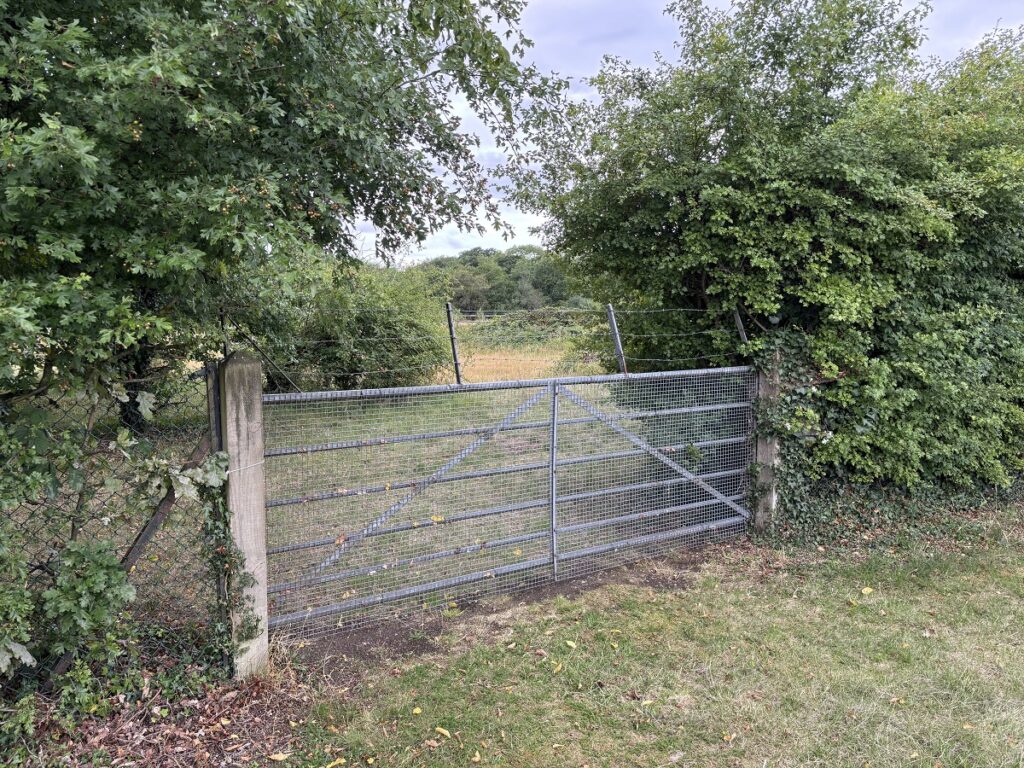
An application has been made to the High Court to challenge the go ahead for a travellers’ caravan site on a field in Green Belt land off Mays Lane, Barnet, on the grounds that the decision was inaccurate.

A planning inspector approved the plan for pitches for two travellers’ caravans because the needs of two gypsy families with seven young children “tipped the balance” in their favour.

Barnet Council had previously refused permission but after a lengthy planning inquiry, the inspector, Graham Chamberlain, decided that the “very special circumstances” of the two families outweighed any harm to the Green Belt.

In seeking to reverse the decision through a judicial review, the council will have to indicate why it believes the inspector’s conclusion was factually flawed.

Mr Chamberlain had concluded that the best interests of the “seven young children” in case would be served by “establishing a secure permanent home” for them at the appeal site”.

But in challenging the decision, the council is expected to argue that the evidence showed that in fact only four or five children would live on the site, with just one of them enrolled in school.

Therefore, the council could insist that the inspector’s decision was legally unsound.

Quinta Village Green Residents’ Association – which opposed the caravan site, and which was disappointed by the go ahead given by the inspector – has welcomed the council’s High Court challenge.

When he overturned the council’s refusal to grant planning permission, Mr Chamberlain acknowledged that a travellers’ caravan site on a two-acre paddock, previously used for grazing horses, would result in “some modest harm to the character and appearance” of the Mays Lane area.

However, he concluded that the balance in favour of the scheme changed significantly when the personal circumstances of the two gypsy families were factored in, especially the best interests of the seven children.

“Indeed, personal circumstances tip the balance in favour of the scheme when all other considerations are contemplated cumulatively…It follows that the very special circumstances necessary to justify the development have been demonstrated.”

Members of the residents’ association have now been told of the legal challenge which is being made by the council close to what would have been the end of the six-week period for a judicial review.

In going to the High Court, the association hopes the council will emphasise that Green Belt protections carried substantial weight under national planning policy.

Inappropriate development of the kind proposed, should only be allowed in “very special circumstances”.

While the welfare of children was rightly a primary consideration, it had to be based on accurate evidence.

The inspector had relied on the advice of the barrister for the brothers Patrick and J Casey, who had made the planning application, but by seeking a judicial review the council implies these submissions were incorrect and failed to consider the actual circumstances of the children involved.

Posted on

Family needs for travellers’ caravan site outweighs Green Belt protection for Mays Lane countryside says planning inspector

Spirited opposition by a residents’ association has failed to prevent the go ahead for the development of a site for pitches for two travellers’ caravans and other buildings on a field in Green Belt land off Mays Lane, Barnet.

An application for permission was rejected by Barnet Council but this has now been overruled by a planning inspector who said the needs of two gypsy families with seven young children “tipped the balance” in their favour.

Quinta Village Green Residents Association, which had argued that a travellers’ site would harm the openness of the Green Belt and the character of Mays Lane, expressed their “deep disappointment”.

After a lengthy inquiry, the inspector Graham Chamberlain acknowledged there would be “some modest harm to the character and appearance of the area” but there were “very special circumstances” which outweighed the harm to the Green Belt.

The application to station caravans for residential use with hardstanding and dayrooms was made by Patrick Casey who appealed against the council’s refusal to grant planning permission on the grounds that it breached the Green Belt.

Mr Chamberlain said that he understood Mr Casey, who was currently living at the Barley Mow site near Hatfield, and his brother J Casey, were both “unlawfully doubling up as a temporary measure” and needed a secure and settled site.

“The Casey brothers are gypsies, and they want to follow a traditional lifestyle that involves living in culturally appropriate accommodation, this being a caravan on a pitch.”

There were seven young children in the case and their best interests would be served by “establishing a secure permanent home at the appeal site given the lack of suitable alternatives, including where they currently live unlawfully”.

Mr Chamberlain did conclude that a travellers’ site was inappropriate development; would harm the Green Belt; and that the unmet need for caravan pitches in the London Borough of Barnet was not extensive.

However, the balance in favour of the scheme changed significantly when personal circumstances were factored in, especially the best interests of the children.

“Indeed, personal circumstances tip the balance in favour of the scheme when all other considerations are contemplated cumulatively…It follows that the very special circumstances necessary to justify the development have been demonstrated.”

In expressing their frustration at Mr Chamberlain’s go-ahead for the site, the residents’ association said that during the inquiry “no robust evidence of these personal or accommodation circumstances was provided by the appellant, despite repeated requests, and yet these claims were given decisive weight by the inspector.

“The decision overrides local and national planning safeguards, potentially setting a concerning precedent for Green Belt protection.”

Much of the inquiry revolved around whether establishing a site for travellers’ caravans on a two-acre paddock which had been used for grazing horses would extend urban sprawl along Mays Lane and encroach the countryside.

Planning inspector agrees to site for pitches for two travellers' caravans in Green Belt land off Mays Lane, Barnet, despites residents' opposition.

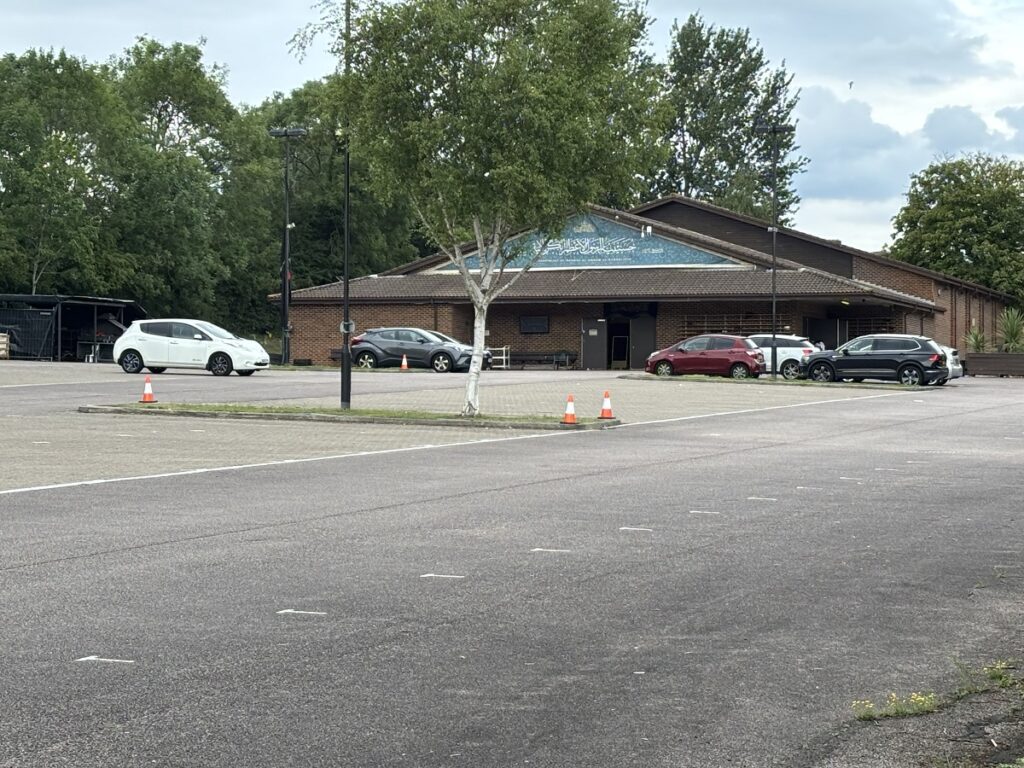
The field is next door to the Mays Lane car park of the Centre for Islamic Enlightening (formerly a Brethren Gospel Hall).

In his report allowing Mr Casey’s appeal, Mr Chamberlain agreed that the paddock had an open rural character free from development, and it was open land that one would expect to “strongly contribute to restricting the urban sprawl of Barnet”.

Accordingly, he recognised that a caravan site next to the Islamic Centre and opposite the Partridge Close estate, would “compound an incongruous finger of development in the countryside” – a factor which was outweighed by the “very special circumstances” he subsequently outlined.

Concerns about the impact on great crested newts and bats were among the issues raised by the residents’ association, but these were not upheld by Mr Chamberlain.

He said a survey showed there were no great crested newts present on the site, and he did not believe either that travellers’ caravans would have an adverse impact on the bat population.

When Mr Casey made his application in 2023, after purchasing the field at auction, the residents’ association raised objections with Barnet Council and welcomed the refusal to grant permission.

The association, which is named after Quinta Village Green and represents 150 families living nearby, succeeded in raising only half of the £15,000 needed for legal representation at the inquiry after already securing a barrister.

“Without access to the council’s expert evidence, the association was left to try to continue contesting the issues alone and under-resourced.

“Adding further controversy, the inspector rejected Barnet Council’s request to limit the planning permission to a five-year temporary term, instead granting permanent consent.

“Residents fear this undermines policy safeguards and opens the door to piecemeal development across London’s Green Belt.

“This is a disappointing outcome for our community, and a worrying moment for Green Belt protections in Barnet.

“Residents engaged in good faith, supported their council, and upheld planning policy – but this decision shows how fragile these protections can be when decision-makers prioritise unevidenced claims over adopted policy.”   

Posted on 3 Comments

Bees stay in Hive for now: Council rejects Barnet FC plans for new Underhill stadium

A 100+ crowd packed planning committee rooms at Barnet Town Hall last night for the big match – Barnet Football Club v defenders of Barnet Playing Fields, the proposed site of a new 7,000-seat stadium. After more than two hours of impassioned debate, the result was announced: 6-0 against the Bees.

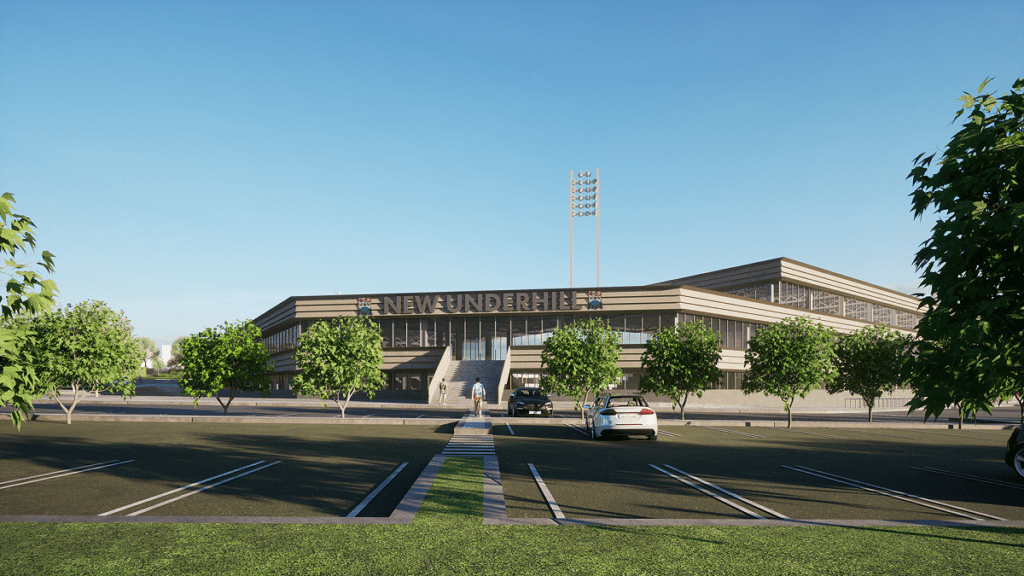
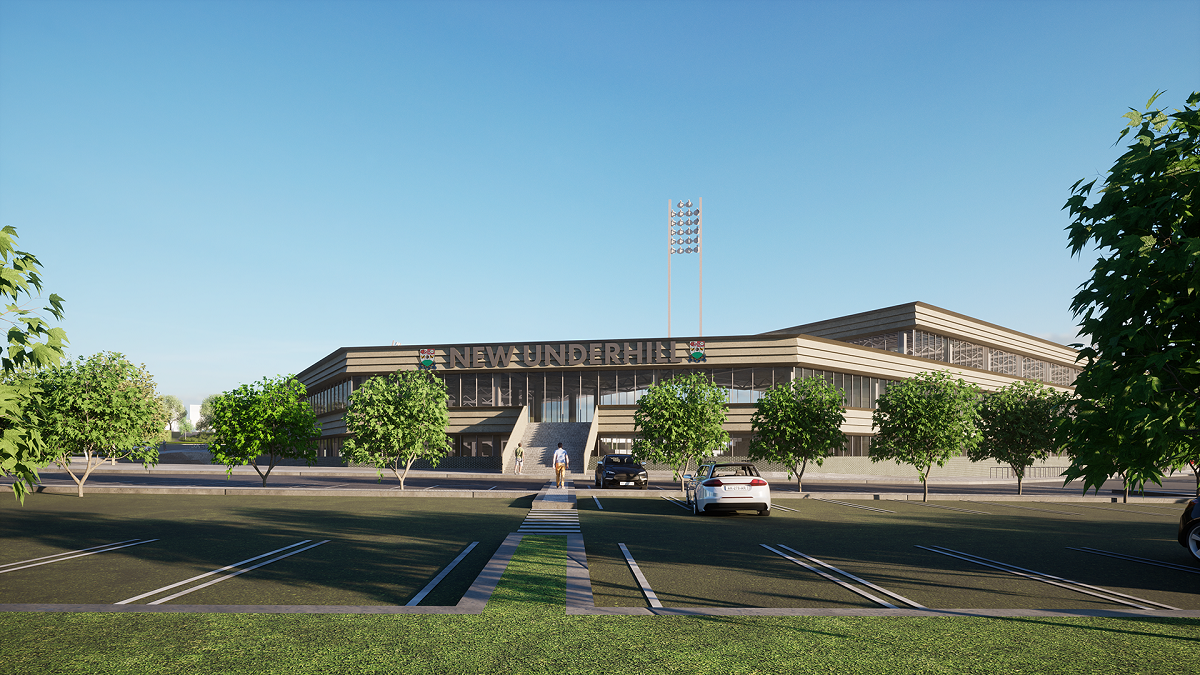
Barnet FC left its traditional home turf at Underhill for The Hive in Harrow in 2013, selling its site for the Ark Pioneer academy. Ever since, fans have pined for its return to the Borough, and the Club’s recent promotion to English Football League 2 has exacerbated pressures on The Hive. Design began on a new stadium, culminating last December in the outline planning application that was now to be determined by Barnet’s Strategic Planning Committee (visualisation by And Architects below).

There have been vigorous campaigns both for and against the proposal. Barnet FC’s Bring Barnet Back (BBB) claimed 9,500+ supporters. Save Barnet Playing Fields (SBPF – see photograph above) asserted that 90% of local residents opposed the development, and CPRE London said that almost 19,000 had signed a petition against it. The Council received 1,274 online comments plus 72 letters supporting the proposal (35%), as against 1,162 online and about 1,308 paper objections to it (64%). The numbers can be disputed, but division was clearly deep.

The Planning Officer’s report, which recommended refusal, ran to 120 pages – unusually thorough for a project of this size. For comparison, the report last year on the Whalebones application was a mere 103 pages. It reflected local sensitivity, especially around development in the Green Belt. As Committee Chairman Councillor Nigel Young noted, approval could set a precedent for building on other Barnet green spaces.

The significance of the matter was demonstrated by no fewer than five local politicians addressing the meeting in person (in addition to the nine Councillors on the Committee itself). Cllrs Zahra Beg (Underhill), Paul Edwards (High Barnet), David Longstaff (Barnet Vale) and London Assembly Member Anne Clarke all wished to see Barnet FC return to the Borough, but opposed a stadium on Barnet Playing Fields. Only Cllr Tim Roberts supported it.

They were followed by Robert Verrall representing opponents of the scheme, and by Ian Botterill and Sean McGrath representing BBB and the Club’s design team respectively.

All spoke with passion, occasionally interrupted by bursts of audience applause and heckling despite the Chairman’s repeated requests for quiet.

Committee members then discussed the proposal between themselves. Most reiterated support for Barnet FC’s return, just not to this particular location. Several called for consideration of alternative sites, but as the Chairman pointed out, the Committee could only decide on the application in front of them.

In the end, the outcome was decisive. Three members abstained but the others were unanimous in denying planning permission.Their key reasons for refusal were that

‘the proposed development would result in substantial and irreversible harm to the openness and function of the Green Belt, and…the applicant has failed to demonstrate the very special circumstances necessary to justify such harm. The proposal would also result in the loss of valued public open space…’

Other reasons for refusal were insufficient information to safeguard protected species; insufficient information on archaeology; inadequate assessment of on-street parking impacts; unacceptable site access and junction design; and lack of a Section 106 Agreement (detailing the applicant’s financial contribution towards community infrastructure costs).

Barnet Society position

Consultation with our members last February indicated that they were roughly evenly split over the scheme.

Our Committee agreed that we wholeheartedly support the principle of Barnet FC returning closer to its historic roots. And a building and landscape design of exceptional quality could enhance Barnet Playing Fields, which make only a limited contribution to local biodiversity and are little used for sport. But we had severe reservations about key aspects of the Club’s case with regard to the Green Belt and the environment; transport and parking; community uses and benefits; and economic value.

We therefore took a neutral stance but submitted detailed comments that you can read on our website.

What will happen next?

Barnet FC has the right to appeal to the Planning Inspectorate against the Council’s refusal, but its chances of overturning the decision are not great – and will involve yet more expense.

A better way forward would be to build on the constructive discussions that its team held with the Barnet Society and Barnet Residents Association, and to engage more closely with the Council and other stakeholders about alternative sites.

Although disappointed, Bees fans remain defiant. As BBB organiser Keith Doe (seen below with Ian Botterill) said after the meeting, ‘One way or another, we’ll bring Barnet back!’

Posted on 8 Comments

With a decision likely within weeks, BringBarnetBack step up their campaign for Barnet Football Club to return to Underhill

In advance of a key meeting which campaigners understand will be held in mid-July, BringBarnetBack have launched a last-minute appeal to Barnet Council to give the go-ahead for a new football stadium at Underhill.

From their own extensive soundings, they believe that there is a 50/50 chance of the council’s strategic planning committee granting planning approval for a 7,000-seat stadium at Barnet Playing Fields.

If the application is rejected, they are confident that the club will launch an appeal and they think it could become a test case in the push by the government to free up some Green Belt land for redevelopment.

However, BringBarnetBack warn that if the playing fields are redesignated as Grey Belt and freed for development, there is a danger the open space might be lost to make way for new housing.

At issue is the argument between many local residents who want to preserve the playing fields as a vital open space and Barnet FC supporters who are fully behind the offer of the club chairman Tony Kleanthous to move the club from The Hive at Harrow to a new £14 million stadium at Underhill.

BringBarnetBack have issued a 14-page dossier examining the arguments for and against the application which ends with a plea to the council to vote for a project that would be a sustainable development; enhance the surrounding Green Belt land; and bring back a football club that has “never stopped believing in coming home”.

(Bring Barnet Back – The Case http://eepurl.com/jhcTaU )

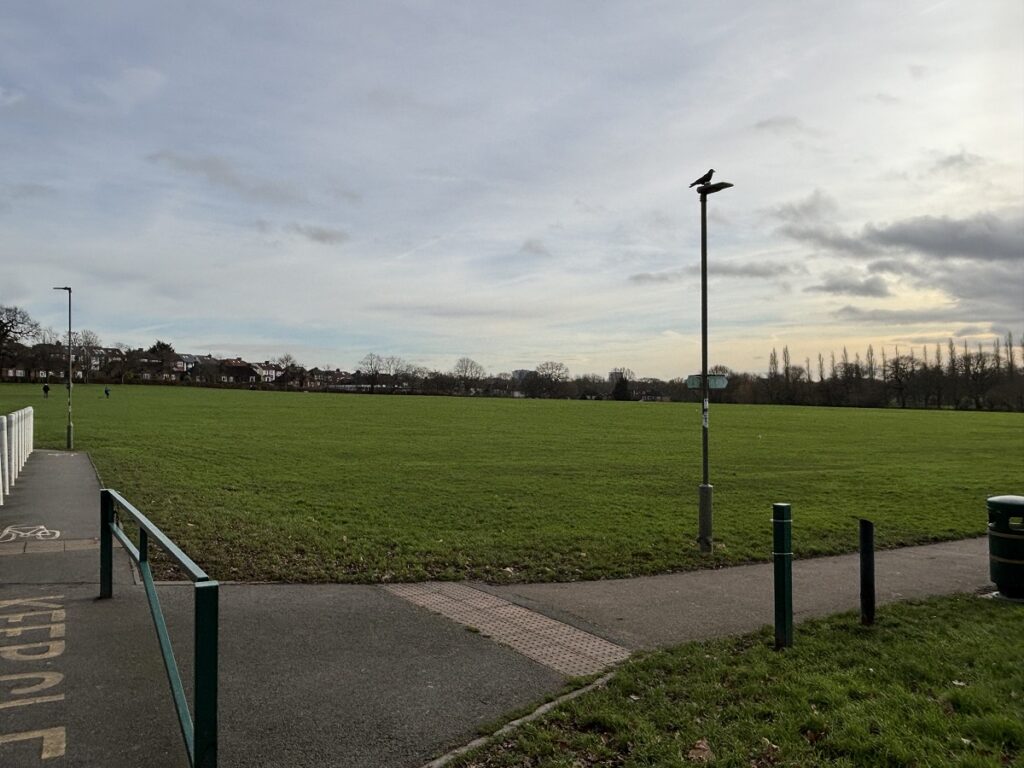
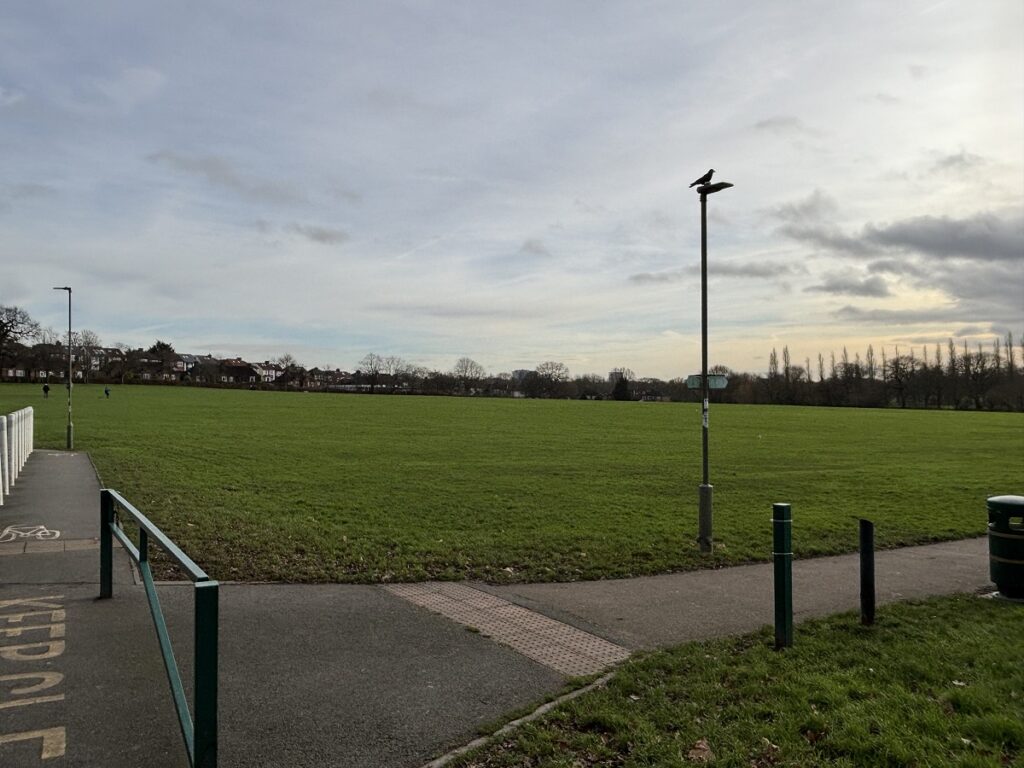
The proposed stadium would take up 22 per cent of the southern section of the playing fields – see above – which BringBarnetBack argue is in effect a “de-facto abandoned field with a monoculture of weeds and grass”.

Campaigners have visited the site at “hundreds of different times and in all weather conditions and claim there were “no people” on the proposed site, beyond the odd dog and its owner.

They believe the case for it becoming the new home of Barnet FC is strengthened by the fact that under a previous plan Barnet Council had proposed redeveloping the playing fields with a new 10,000 square foot destination sports hub that would have included two multi-purpose activity spaces, a cafe, six changing rooms and 55 new car parking spaces.

Because of severe funding restraints the council has not proceeded with its own plan and the reality is that all these facilities – and more – could be included in the new Barnet FC stadium “at no cost to the council”.

 Included in the new stadium would be medical facilities, which could be used by NHS patients; new public toilets which could encourage more use of the existing children’s playground and basketball courts; and community space for local food hubs and other charitable organisations.

One issue not addressed in the BringBarnetBack dossier is the wider use of the playing fields for large public events.

Last minute appeal by BringBarnetBack campaign to persuade Barnet Council to give go ahead for a new football stadium at Barnet Playing Fields

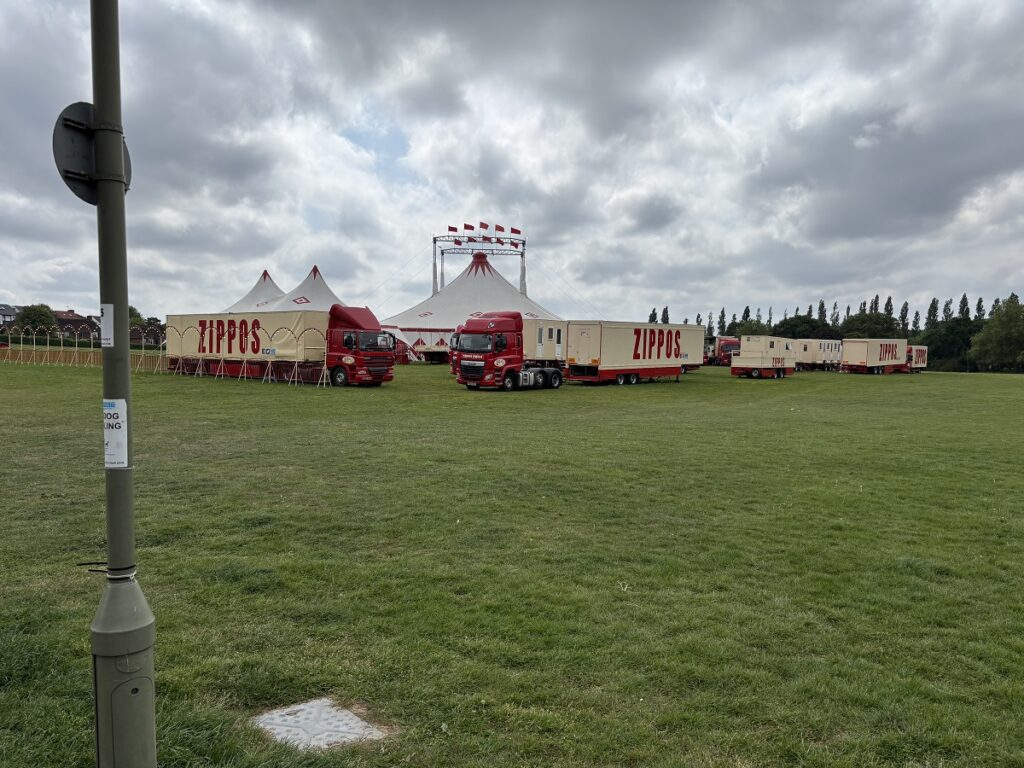
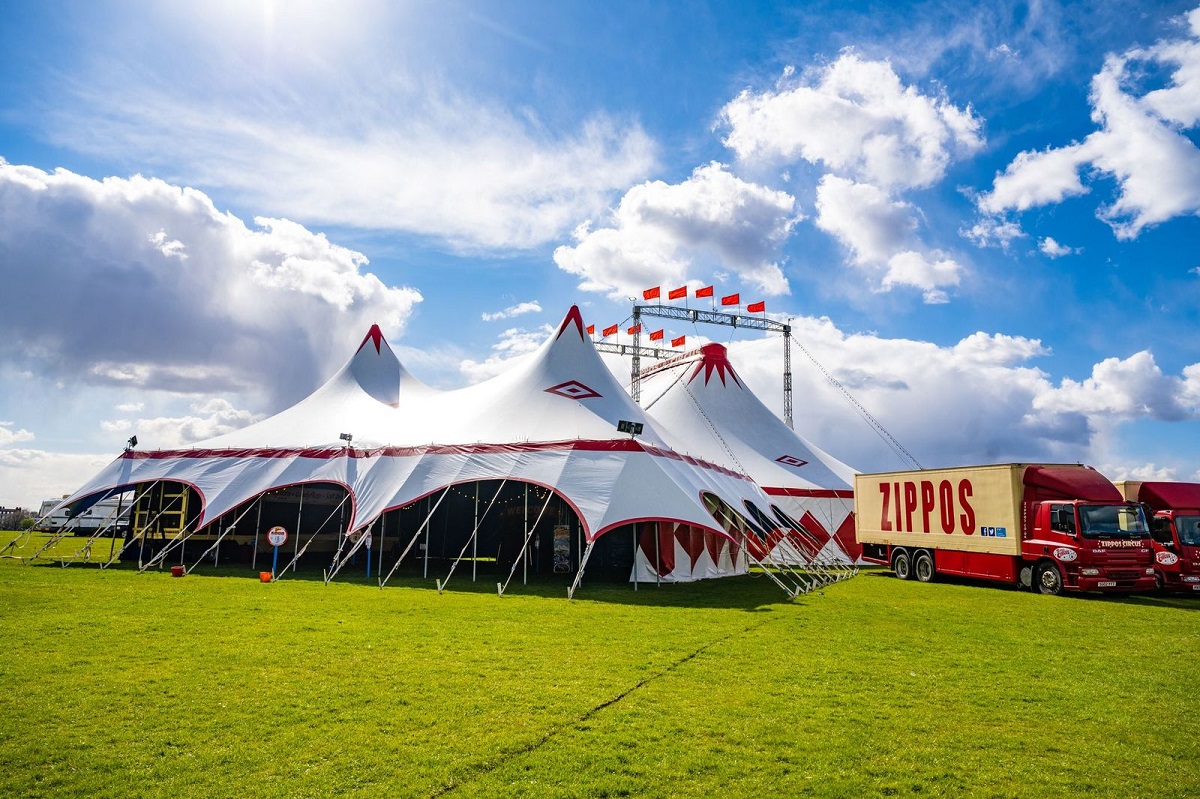
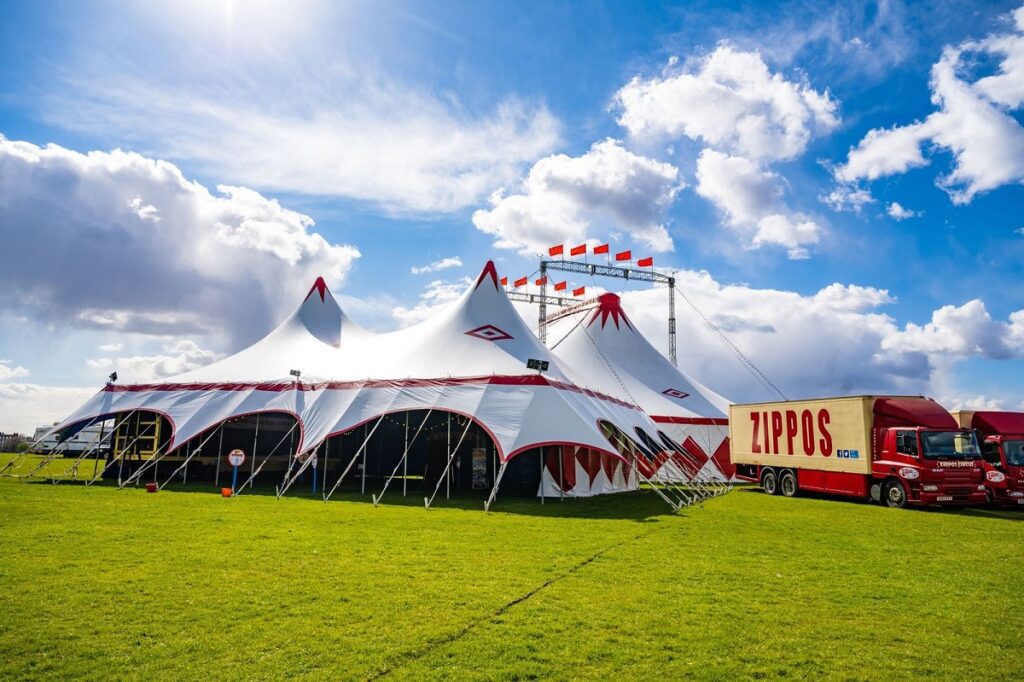
In May the playing fields hosted a five-day visit by Zippos Circus and other events are planned for later in the summer.

Organisers who have previously presented music and community festivals at other nearby sites such as Trent Park and Oak Hill Park, are switching to the playing fields at Underhill because of what they say is excellent access to public transport.

Other events being advertised at the playing fields are the Eagle Festival of Music over the weekend of June 21-22; the Ghana Party in the Park festival and the Mauritius open air festival which will be staged separately on the Saturday and Sunday of July 12 and July 13.

BringBarnetBack underline the urgency of the application: currently Barnet FC is loss-making and kept afloat at Harrow by Mr Kleanthous who is “willing to subsidise the club at a personal loss”.

Since moving to The Hive from Underhill in 2013 the club has lost between 25 per cent and 30 per cent of its core support and despite its promotion to the League Two of the English Football League, Barnet’s future is “unsustainable away from its home”.

Securing a return to Underhill – its home of 107 years — represents in planning terms “very special circumstances” to justify building a stadium on Green Belt land.

Posted on 1 Comment

Mays Lane residents are increasingly concerned about the continuing failure to restore the derelict Quinta Youth Club building

After being boarded up for the last 20 years a fresh attempt is about to be made to see whether it might be possible to get the abandoned Quinta Youth Club in Mays Lane, Barnet, refurbished or rebuilt and returned to community use.

After their success in obtaining and maintaining protected status for Quinta Village Green — which adjoins the derelict clubhouse — residents are increasingly concerned about continuing vandalism and anti-social behaviour.

Barnet Council and representatives of other local groups are to be sounded out by the Quinta Village Green Residents Association to see what could be done to restore a sadly neglected building.

Planning approval was given in 2021for use of the clubhouse to be changed from community use to become a store for the library service for schools in the Borough of Barnet.

Although said to be “derelict and in a poor condition” and vacant since 2006, the council proposed to refurbish the existing single-storey building, install new doors and windows, and use it for the storage, archiving and dispatching of library books as part of the borough’s Schools Library Resource Service.

But nothing further has happened to the building in the intervening four years, prompting residents’ concerns about continuing vandalism, resulting in their appeal for more thought to be given as to its future use. 

After the being re-established and named after Quinta Village Green, the residents’ association has been engaged in several campaigns against threats to the Green Belt and is seeking better consultation on road safety schemes in Mays Lane.

Residents to launch fresh attempt to see whether derelict former Quinta Youth Club in Mays Lanes can be restored for community use.

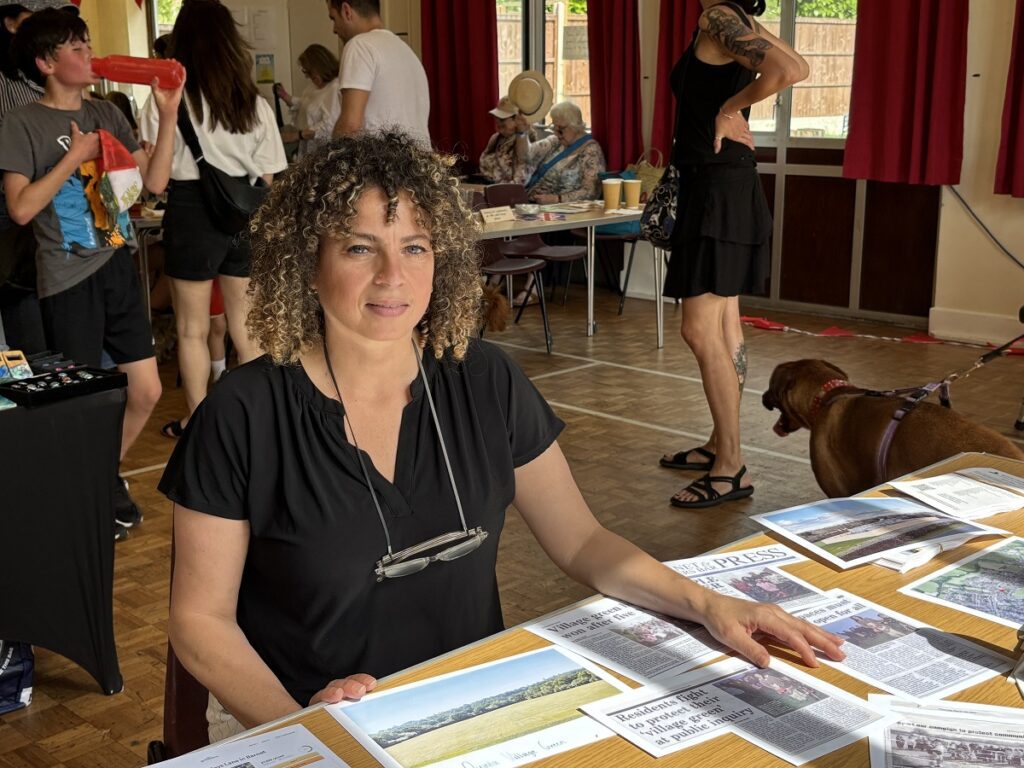
Gina Theodorou, the first chair of the newly formed association, promoted their work with a stall at the Arkley Village Fayre.

“Given all that we have been doing to strengthen the Quinta village community, we do think it is perhaps time to see whether something can be done about the abandoned youth club.

“As it has been boarded up for the last 20 years, we are now reaching out to Barnet Council, who own the building, and to other local partners to explore opportunities for restoring it and bringing it back into community use.”

Currently the association is crowdfunding for the cost of legal representation at a public inquiry into an application for a travellers’ caravan site on Green Belt land in Mays Lane.

So far, a crowdfunded appeal has raised half the cost, but the association still needs to raise almost £7,000.

After getting the village green registered as a public open space, the association liaises with the council to ensure maintenance of the green and to ensure that fly tipping is removed.    

Posted on

Community gardens developed over 70 years ago together with meadows and hedgerows are now a wildlife haven

Tucked away at a wildlife site in the Barnet green belt is an enchanting array of community gardens which were developed in the 1950s, and which played a part in the early development of organic gardening.

Brookdale Wildlife Garden Community was established in 1951 when a group of a wartime allotment holders from Islington secured the lease of a ten-acre field on farmland owned by the Byng family at Wrotham Park.

Together with her friends who were also keen gardeners, Hilda Brooke, had grown fruit and vegetables on Hampstead Heath on what were known as “Dig for Victory” allotments.

When Hampstead Heath was reinstated after World War Two, they had to find a new site.

They moved to Barnet with the help and support of the Soil Association which was founded in 1946 to campaign for sustainable food production because of concern about the impact of intensive farming and resulting soil erosion and depletion.

An entire ten-acre field – which had formed part of a wartime decoy airfield to the north of Barnet — was leased to the exiled group of gardeners by Lady Elizabeth Byng for a first annual rent of £20.

Today, rather than concentrating on cultivation of produce, the Brookdale plot holders cherish their cluster of community gardens which have become a haven for wildlife.

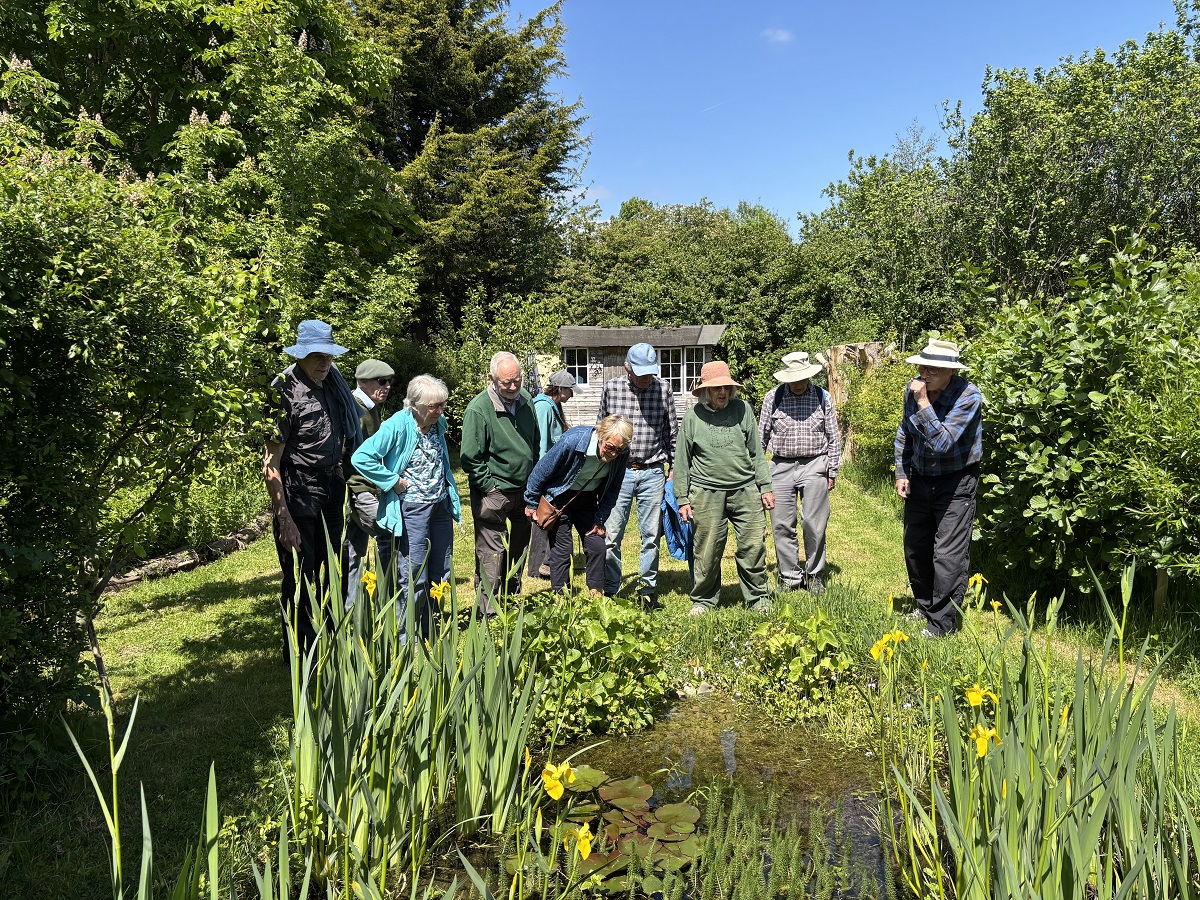
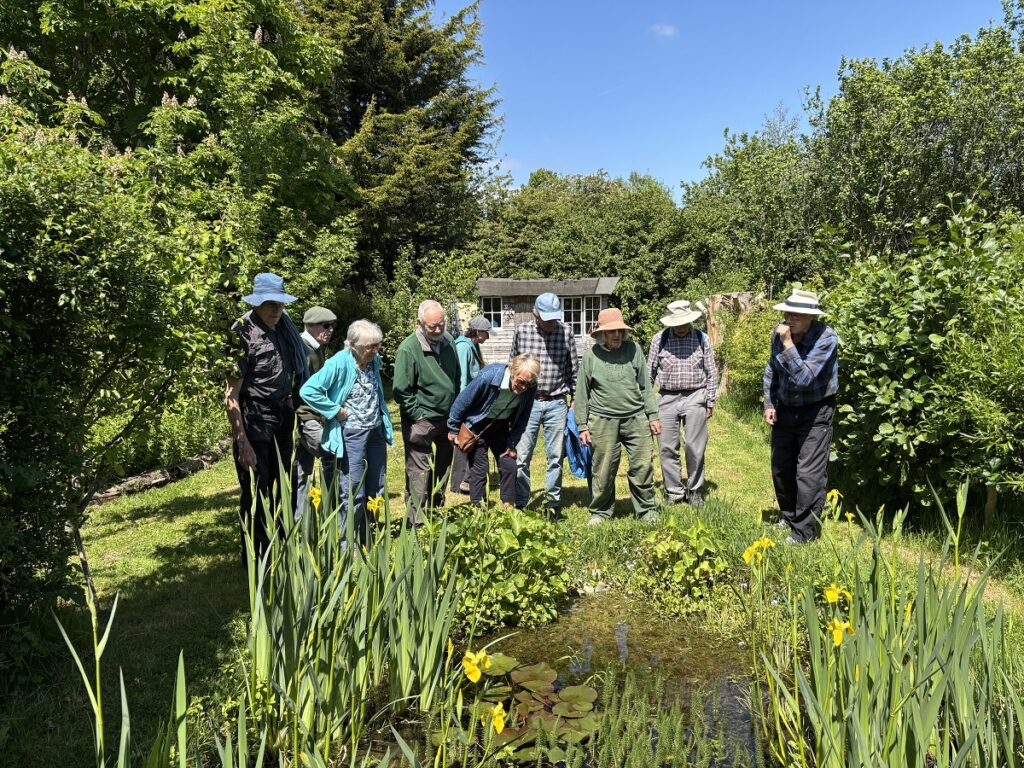
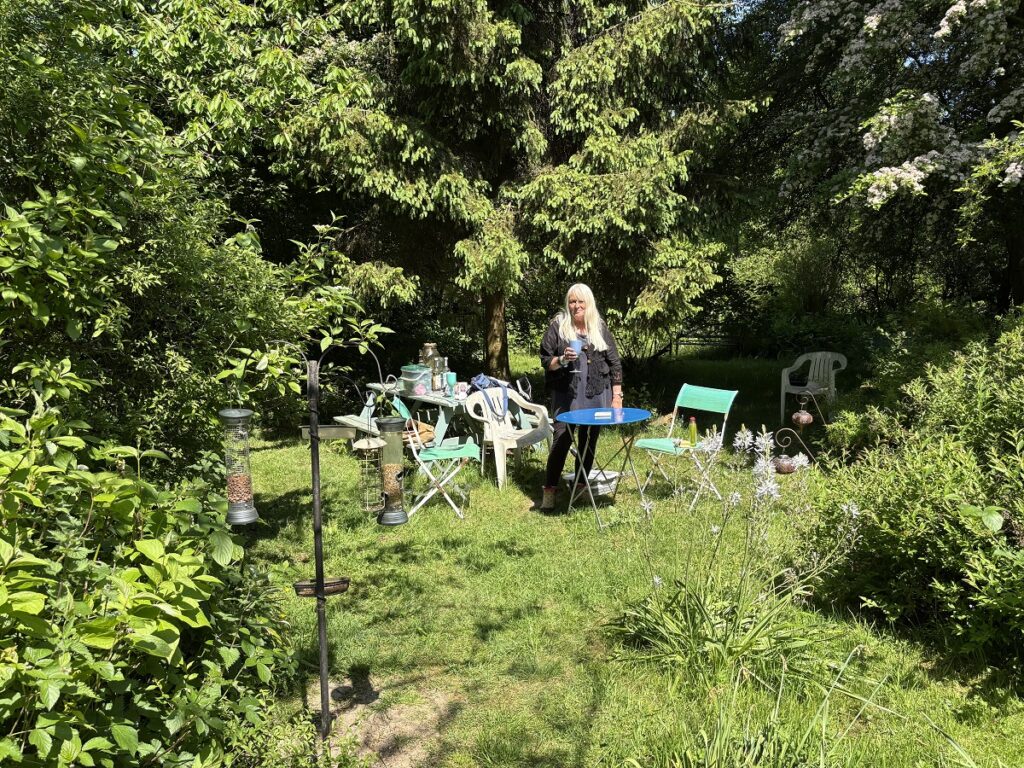
Their individual gardens, community meadows and an ancient hedgerow — which are a designated wildlife site and are protected by an area tree preservation order — were visited recently (see above) by members of the Barnet Environment Centre who maintain the nature reserve in Byng Road.

During a tour of the gardens, they admired several of the small clay-lined ponds which are ideal for aquatic plants, attract dragon flies and provide a home for among others for frogs and great crested newts.  

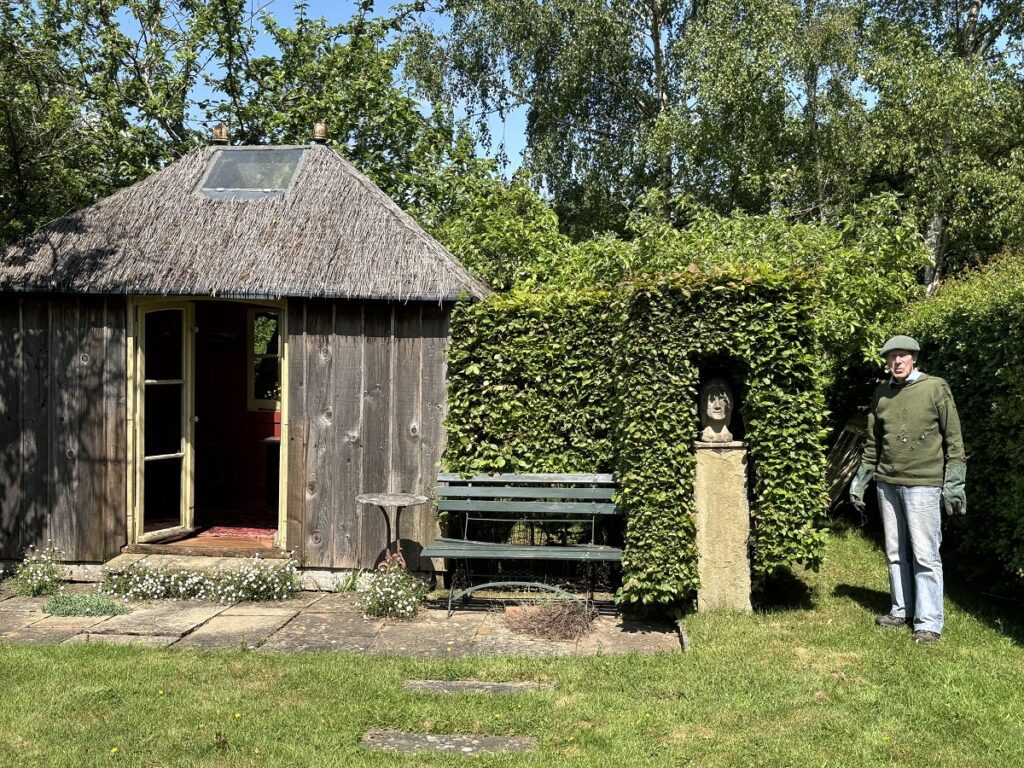
After so many years of care and attention each plot is distinctive and in the case of Michael Bruce – who has the distinction of being Brookdale’s longest tenant – his garden is a much-cherished refuge from the hustle and bustle of everyday life in Islington.

Michael has a much-loved summer house, well-tended borders and numerous features which he has developed during 33 years at Brookdale.

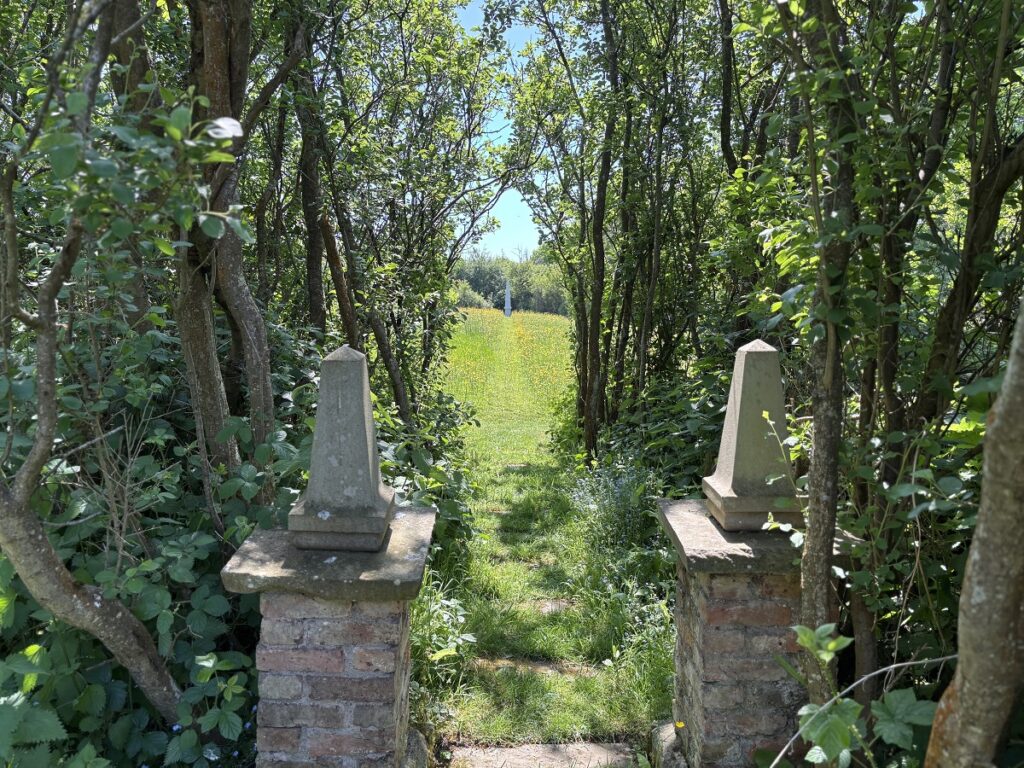
An archway at the end of his plot looks out onto a community meadow. Just visible in the far distance is an obelisk, which Michael made from wood and which he brings in each winter to avoid unnecessary wear and tear during bad weather.

Christine Klein, who is a member of the Barnet Society and has been a plot holder since 2017, enjoys her personal haven of tranquillity and encourages the growth of wildflowers and shrubs.

“Unfortunately, I find it too difficult to grow vegetables. We get rabbits, muntjac and foxes visiting the plots and it would be hard work keeping them at bay.”

Just a step away from one of the community meadows is a former World War Two control bunker, a relic of the days when the site was a one of the decoy airfields intended to attract enemy bombers destined for the RAF Fighter Station at Northolt.

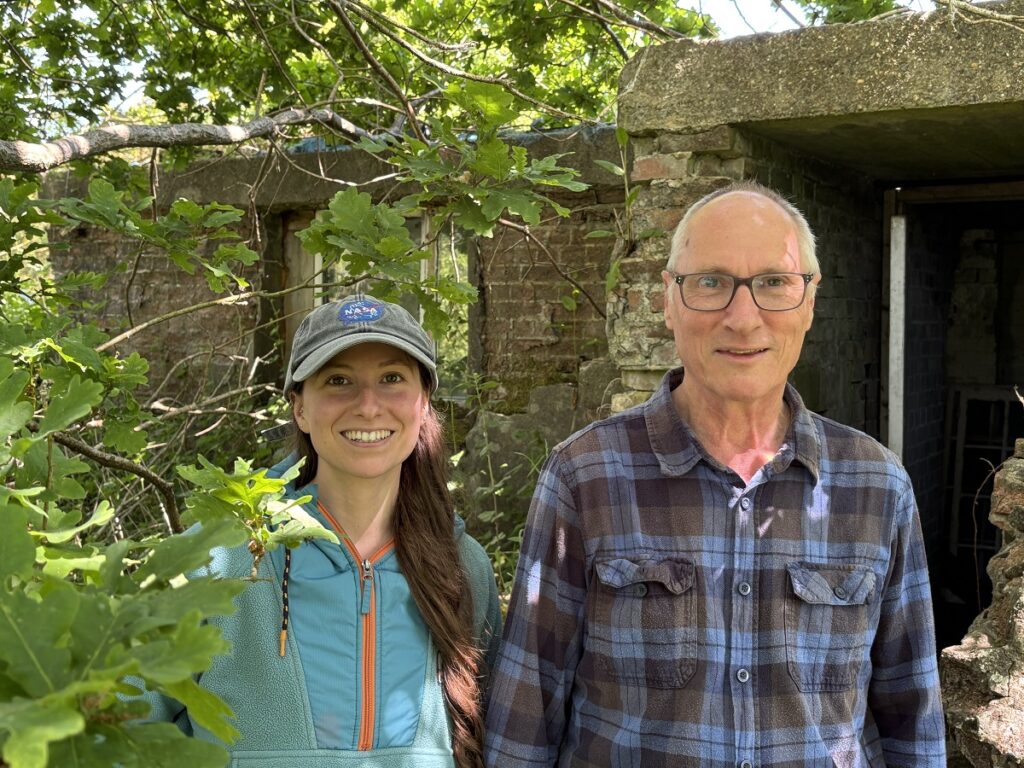
John Nicholls, a former vice chair of the group’s organising committee, seen above with his daughter Becky Nicholls, Brookdale’s membership secretary, said the bunker would have been a centre of operations for the decoy airfield.

“Dummy planes and painted canvases would have been laid out on the grass. We know that at night there were lights laid out to make it look like a landing strip.

“One story which we have been told is that the Germans found out it was a dummy airfield and even dropped a wooden bomb on the field to let everyone know.”

An official history of the decoy airfields says that the fuselages of about half a dozen Hurricanes mounted on wheels and with engines removed were used at Barnet.

Airmen moved about the field periodically at night riding bicycles fitted with lights to imitate aircraft movements.

Wartime gardeners from Hampstead Heath set up a group of community gardens at Barnet in the early 1950s which are now a wildlife haven.

The challenge today for Becky Nicholls is to ensure the long-term future of their garden community after all the efforts over the years by her father and her mother Anna (above).

Whatever the pressures might be on the green belt, the group believe their wildlife credentials and charitable status should give them an assured future.

Brookdale was awarded “wildlife site” status within the Hertsmere local development plan in 1997 and the gardens are covered by an area tree protection order.    

Currently Brookdale has 60 full members and eight associates.    

“We are open to new members and in recent years more of the plots have been taken by people living in and around Barnet,” said Becky.

“This does ensure the gardens are used more regularly than is sometimes the case with those members who still live in Islington or further afield.

“We are happy to welcome volunteers, especially young people doing the Duke of Edinburgh award scheme, to help with the management of the habitat which takes a lot of effort.”

For further information contact Becky Nicholls at email bmnicholls101@gmail.com        

Posted on

Enfield flood drainage work helping to create a wetland habitat in woodland on Monken Hadley Common

Reeds and other wetland grasses and flowers have been planted along the edges of flood relief drainage work in Hadley Woods which has been carried out by Enfield Council with the help of volunteers from Monken Hadley Common Trust.

New pipework and other excavations are designed to end flash flooding in Parkgate Avenue, off Camlet Way, and improve badly drained marsh land close by in the woods which is often inaccessible in wet winter weather.

Plans were first drawn up in 2018 to relieve flooding in nearby houses.

After discussions with the Common Trust and Barnet Council, Enfield gave the go ahead for the construction of a new surface water drainpipe under the footpath that leads to the common at the junction of Parkgate Avenue and Crescent.

A wetland cell – or holding pond – has been created along with a water course through the woods which connects up to Green Brook and leads on to the stream that runs close to Jack’s Lake.

Footpaths around the area have been raised and laid out with wood chips so as to provide year-round access through the woods.

Michael Shorey, Enfield’s senior engineer in water courses, briefed volunteers before they set to work.

He explained that the aim of the scheme was to divert excess flood water through the new pipe under the footpath so that it entered the wet land cell and could then spill into a floodable landscaped wetland area reducing the flow into Green Brook.

Martin Jones (far right), a landscape architect with Enfield Council, said the importance of wetland and marginal aquatic planting was that it enhanced the water quality and added to biodiversity.

A range of pond-edge plants and wildflowers could be used in such locations and could tolerate periods of dry weather.

Roger De La Mare, co-curator of Monken Hadley Common, welcomed the completion of Enfield’s sustainable drainage scheme for Parkgate Avenue and the chance to carry out aquatic planting.

“We have had to lose several mature trees to make way for the pipework and the holding pond, but it has opened up an area which now has great potential, especially with the new raised footpaths.

“The tree canopy in much of the common does make it very dark below and that leaves us with a lot of brambles and holly, so a wetland area like this which has been laid out with aquatic plants is very appealing.”

A chance to take part in the scheme was an opportunity for Anna Colligan (left) to work with Enfield engineer Sarah Dillon to discover more about urban drainage schemes.

Anna is studying water management and the environment at Queen Mary University and was keen to volunteer.

Two Trust volunteers – Peter Davies (left) and David Littlewood – said they were pleased to see such a good turn out as it helped to get across the message that they wanted local people to get involved in looking after Monken Hadley Common.

Wetland habitat is being created within woodland on Monken Hadley Common after Enfield complete flood drainage work in Parkgate Avenue.

Nearby residents Maurice and Esther Kurland said the completion of the drainage scheme would be a great relief to some of their neighbours who had suffered from flash flooding in their properties.

“At long last there is now in place a drainage system to take the surplus water and we know how much that will be appreciated.

“Sorting out the drainage and building up the footpaths is a great improvement as this part of the common is often impassable in the winter because of all the mud. Hopefully that will all be sorted and the landscaping and planting will be a real improvement.”

Posted on 6 Comments

Barnet’s promotion to League Two of the Football League is being hailed as a boost to campaign to build new stadium at Underhill

After Barnet secured their return to the Football League with a decisive 4-0 win against Aldershot, supporters of the BringBarnetBack campaign hope it might strengthen the club’s chances of obtaining planning permission for a new stadium at Underhill.

There was a sell-out crowd for the last home match of the season (Saturday 26 April) at the club’s current stadium, The Hive, Harrow.

Their comfortable defeat of Aldershot ensured the Bees’s promotion to League Two of the English Football League.

Post-match celebrations for the team and spectators made the front page of The Non-League Paper (27.4.2025)

A largely unbeaten run had kept Barnet safely at the top of the Vanarama National League for months on end – a lead which extended for a time to nine points.

Barnet’s success – and a place back in League Two after relegation in 2018 – has boosted the efforts of supporters who have put up banners and posters around the town backing the club’s bid to build a new stadium at Underhill.

After seven years out of League football, securing promotion with a game in hand, has added further impetus to calls for Barnet residents and community groups to back the club chairman Tony Kleanthous who has promised to invest £14 million in a new stadium. 

Arrangements are already in hand by BringBarnetBack for a celebration in High Barnet to congratulate the club and manager Dean Brennan for turning around the club’s fortunes.

Barnet have only lost once this year and nine consecutive wins from February to March had already given the club a commanding lead.

Tickets sold out fast for the crucial match against Aldershot with 4,500 home supporters expected at the stadium together with away fans – for full match report see club’s website above https://barnetfc.com/

Two first half penalties by Mark Shelton and then two goals within four minutes in the second half by Callum Lee Stead sealed the match and promotion with a game to spare.

Victory over Aldershot put Barnet on 99 points (followed in second place by York on 93).

Barnet now have the chance in their final match of the season against AFC Fylde on 5.5.2025 to break the 100-point barrier.

After failing to gain promotion in the two previous seasons after being beaten in the play offs, Dean Brennan’s success in steering the team to automatic promotion does raise the club’s profile at a critical point in their future.

Since moving to The Hive in 2013, Barnet have failed to match previous attendances at Underhill.

The average gate in recent months has been around 1,800 and club officials believe a move back to Underhill could increase that to around 3,500 given the strength of local support.

Campaigners for Barnet FC to return to Underhill encouraged by club's promotion to League Two of the Football League

Discussions are continuing with Barnet Council’s planning department over the plan to return the club to “where it belongs” – a constant refrain of BringBarnetBack.

In February, Barnet FC completed another stage in its attempt to gain approval when its application to construct a 7,000-seat stadium on playing fields at off Barnet Lane was validated by Barnet council, a step which enabled the club’s consultants and architects to start discussions with planning officers.

There is no indication yet of how the talks are going and so far, no date has been set for when the application might be considered by the strategic planning committee.      

Posted on 2 Comments

Summer events planned at Barnet playing fields at Underhill include a circus and music and community festivals   

Zippos Circus will be at Barnet playing fields for five days in mid-May – one of several attractions to be staged this summer at a much-prized open space where Barnet Football Club has applied to build a new stadium.

Organisers who have previously presented music and community festivals at other nearby sites such as Trent Park and Oak Hill Park, are switching to the playing fields at Underhill because of what they say is excellent access to public transport.

Other events already being advertised at the playing fields for later in the summer are the Eagle Festival of music over the weekend of June 21-22; the Ghana Party in the Park festival and the Mauritius open air festival which will be staged separately on the Saturday and Sunday of July 12 and July 13.

So far there is no indication when Barnet Council will make a decision on the application to build a new football stadium at Underhill.

Opinion is divided with Bring Barnet Back campaigning for the club’s return but with equally strong opposition being voiced by those against the loss of such a large open space which is within the Green Belt and beside the Dollis Valley green walk.

Barnet Playing Fields to host summer events including a circus, music festival and community fairs

The potential appeal of the playing fields as a location for music festivals and large community events might well be one of the considerations that the planners take into account when deciding whether the site should be redeveloped.

Advertisements promoting events at Underhill – previously held at Trent Park and Oak Hill Park – say the playing fields off Barnet Lane are an ideal location with excellent public transport nearby including eight bus routes, High Barnet tube station and New Barnet rail station.  

Zippos Circus is currently touring locations in and around London with its new show Bravo!

It will be at Acton Green from April 30 to May 6 and East Ham from May 9 to May 12 before moving to Barnet Playing Fields for five days – May 15 to 19.

The Eagle Festival (June 21-22, from 12noon to 10pm) is billed as a two-day celebration of “music, community and unforgettable events” with 20 “incredible artists”.

Facilities installed at the playing fields for the weekend of July 12 and 13 are to be shared between the Ghana Party in the Park on the Saturday (12noon to 8pm) and the Mauritius Open Air Festival on the Sunday.

The Ghana Party claims to be the biggest gathering of Ghanaians in the diaspora and attracts support from across the UK and Europe.

The Mauritius Open Air Festival offers the best of “Mauritius culture, music and flavour”.

Posted on 20 Comments

Barnet Football Club’s supporters hoping their team’s top-of-the table position in the National League bodes well for a return to Underhill

Leaflets promoting Bring Barnet Back are being distributed across the town as the campaign hots up to persuade Barnet Council to approve plans for a new football stadium at Underhill.

If playing form is any guide, the club might be hoping for a warm welcome: Barnet is currently top of the National League and well placed for promotion to League Two of the English Football League.

Barnet haven’t been beaten in their last 21 National League fixtures. The Bees have now established an nine-point lead at the top of the table after their stunning mid-week 5-0 defeat of Yeovil Town at The Hive (4.3.2025).

However promising their performances on the pitch, the chances of Barnet playing again at Underhill are finely balanced.

The outcome depends on whether Barnet Council can be persuaded that there is a special case for a new stadium to be built within the Green Belt on playing fields at Underhill, close to the site of the original stadium which was demolished to make way for the Ark Pioneer Academy.

Opponents to the project, who are against the loss of Green Belt land and who fear traffic congestion generated by a new stadium, are rallying support around a petition which has attracted over 18,800 signatures.  

A strong case is being made for the new site on the grounds that careful landscaping would reduce the visual impact of the stadium, and that the environment and biodiversity would be greatly improved with extensive tree planting and the creation of a pond between the stadium and the Dollis Valley green walk.

Supporters hope Barnet Football Club's top of the table position boosts chances of return to Underhill

Seen above with an artist’s impression of the site are Sean McGrath (left) of consultants WSP and architect Manuel Nogueira of AndArchitects

Much of the emphasis in the club’s campaign to play again at Underhill is based on the economic impact.

Club chairman Tony Kleanthous has promised to finance the building of the new stadium, at a cost of around £14 million, and the estimate is that it should sustain the equivalent of 78 full-time jobs when taking into account all those working part time on match days.

On some estimates the return of the club could add £6 million a year to the Barnet economy, including £2.1 million from extra business for the town’s traders over a 23-week season.

If the application for a new stadium fails to get approval – and Barnet are denied a chance to rebuild the strong local support which they once enjoyed – there are stark warnings that the club’s long-term future is in grave doubt.

Representatives from community groups including the Barnet Society, Barnet Residents Association and Love Barnet have been advised that attendances at the club’s current base at The Hive Football Centre are not sufficient for long-term financial viability.

What was described as “a considerable financial shortfall” is having to be made up by Mr Kleanthous, the Barnet FC chairman and owner.

The Hive, midway between Edgware and Standmore, which is also owned by Mr Kleanthous, is a separate financial entity.

Its pitch, training facilities and diagnostic centre are used by a range of other clubs as well as Barnet and because of its proximity to Wembley it is often used as a training camp by visiting teams.

Since moving to The Hive in 2013, Barnet have failed to match the attendances at Underhill.

Currently the average gate is around 1,800. A move back to Underhill could increase that to around 3,500 given the strength of local support with the new stadium having a maximum capacity of 7,000 spectators.

Additional revenue from ticket sales could bring in an extra £500,000 a season and that could be matched by an equivalent amount in sponsorship which together would be make up the current shortfall which on some estimates is around £1 million a year.

If the club fails to get approval for a new stadium there are doubts as to whether Mr Kleanthous would be prepared to make a fresh attempt to return to Barnet.

His view is that if the community are against the club’s return and there is not the support which Bring Barnet Back believe there is, then there is little more that he can do.

But without the injection of additional revenue, the fear is that within four to five years’ time Barnet might no longer be sustainable financially.

With help from the distribution of funds from the Premier League, the club says it would establish a new charitable foundation at Barnet which would offer a range of activities with an outreach to local schools and support for local clubs.

Once back in Barnet, the club’s aim would be to establish community initiatives and there any number of possibilities, including, for example, the possibility of providing space for a local foodbank or other projects.

The club would open a new diagnostics and imaging centre at the new stadium in line with the facilities provided at The Hive which a said to be recognised as one of the best screening facilities at a football club.    

Posted on 3 Comments

MP says Barnet’s councillors should take final decisions on blocks of flats at High Barnet tube station car park and possible new football stadium  

When responding to the debate over the two most controversial development applications to have emerged since he was elected Labour MP for Chipping Barnet seven months ago, Dan Tomlinson is insisting he will maintain his neutrality.

He says final decisions on whether to construct blocks of flats at High Barnet tube station car park or build a new stadium for Barnet Football Club at Underhill should be taken by Barnet Council on the advice of its planning officers and committee.

When members of the Barnet Society discussed the two projects – immediately before hearing Mr Tomlinson’s response – there was a unanimous vote against Transport for London’s bid to build flats on the tube station car park and a split vote over a possible new stadium.

In reply, Mr Tomlinson – seen above with Robin Bishop (left) and chair John Hay (right) — was adamant that as the town’s MP he believed his duty was to address the concerns of residents and try to secure for them the best possible outcomes.

Personally, he thought a ten-storey block of flats at the tube station was too high.

He felt the football stadium was unlikely to get planning approval from the council because it would mean taking Green Belt land.

But he would not be intervening directly himself either in support or against the two projects.

“It is up to the elected Barnet Council to decide whether these schemes are in accordance with the local plan and whether or not they should be approved.”

He acknowledged that his predecessor, the former Conservative MP Theresa Villiers, had taken firm positions either for or against certain planning applications in the past, but this had resulted in local residents being “marched up the hill and down again” only to see schemes being approved in the end.

He believed his task was to help ensure that the views of his constituents were expressed to Barnet Council and to the developers and that he worked in conjunction with them and the residents to see how such schemes could be improved for the benefit of the community.

When it came to the blocks of flats at the tube station, he was keen to persuade TfL to keep much more space for car parking.

He would be following up ideas to see if underground car parking spaces could be provided beneath the development.

Mr Tomlinson was also in full agreement with tube passengers on the importance of providing a bus service direct to the station entrance and moving the north bound bus stop on Barnet Hill closer to the pedestrian crossing at the station approach road.

He was challenged over why he had not been influenced by the fact that no one in the room at the society’s meeting had voted in favour.

MP says Barnet’s councillors should take final decisions on blocks of flats at High Barnet tube station car park and possible new football stadium

An outline of the scheme had been given earlier by committee member Nick Saul (above) who said the development was unacceptable. The blocks of flats would utterly dominate the town, and he doubted whether the project was viable.

Mr Tomlinson reminded his audience that the land at the station was already allocated for 292 homes in Barnet Council’s local plan.

Building on station car parks was also included in the London plan, so there was a strong presumption in favour of the High Barnet scheme, but a ten-storey block of flats was too high and was not in keeping with the local plan’s recommendation of more than seven storeys.

“But if we can’t build flats for young people here on this site, where are we are going to put them?

“As your MP I will try to make the scheme as good as possible.”

When it came to the controversial application to build a new football stadium at Underhill, he was personally split 50/50 over whether it should be approved.

When discussing a return of the club with residents of the Dollis Valley estate he found there was strong support among some of those he spoke to.

Nevertheless, it was one of the few large open play spaces in the town and he did not think it likely Barnet Council would give approval because it was a site within the Green Belt.

If Barnet FC was refused permission, he undertook to work with the club and the Bring Barnet Back campaign to see if an alternative site could be found.

Green Belt land should be protected and if the housing target could be met with developments such as High Barnet station, then the council would not be under pressure to encroach on the green belt.

When challenged by one questioner over whether his stance of being neither for or against planning applications – and leaving it to the elected councillors – would protect the Green Belt, he gave this assurance:

“If there is a really abhorrent scheme, I won’t be agnostic.”

In his opening remarks, he said he had been working members of Chipping Barnet Town Team and Love Barnet to see whether more could be done to improve Barnet High Street.

One idea being explored with the Greater London Authority was to have a rental auction of empty High Street shops.

Under such a scheme, if a property had been left vacant for more than 12 months, Barnet Council could auction off a rental so that empty retail premises could be brought back into use.

An earlier discussion at the meeting had explored ideas for rejuvenating The Spires shopping centre.

As a previous redevelopment scheme was now in abeyance because of the financial difficulties facing the owners of the centre, Mr Tomlinson said he would be delighted to work with community groups to bring forward alternative proposals.

Barnet Council owned the freehold of the shopping centre site and there was every reason to open a discussion about the future of The Spires.    

Posted on 2 Comments

Barnet Beyond Brexit -Saving our green spaces

Chipping Barnet is surrounded on three sides by Green Belt – virtually unspoiled open countryside from Hadley Wood in the east to Whitings Hill in the west and south along the valley of the Dollis Brook. Together with substantial areas of Metropolitan Open Land (such as Tudor Park), surviving farmland (such as the Whalebones estate), several attractive parks and many street trees, we are lucky to have so much greenery. It helps give our area its special identity.

Continue reading Barnet Beyond Brexit -Saving our green spaces

Posted on 6 Comments

Building Threat on Potters Bar & South Mimms Green Belt

Hertsmere Council is consulting on the possibility of building up to 2,620 new homes plus new places of work between Wrotham Park and Potters Bar, westwards as far as South Mimms and eastwards beyond M25 junction 24. This would have a huge impact on our Green Belt.

Continue reading Building Threat on Potters Bar & South Mimms Green Belt