
Promise of 100 affordable new homes influences final go ahead for tower blocks at High Barnet tube station and loss of car parking
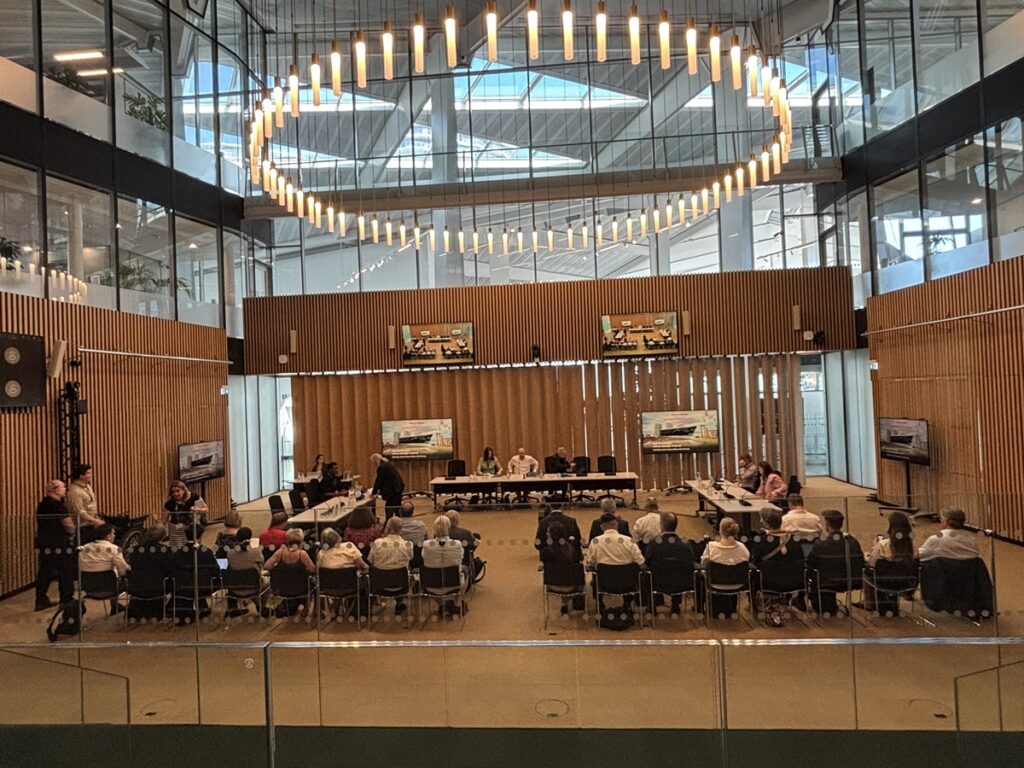
Approval has finally been given by the office of the Mayor of London for the redevelopment of land around High Barnet tube station with five blocks of flats despite warnings this would cause irreparable damage to an historic skyline.
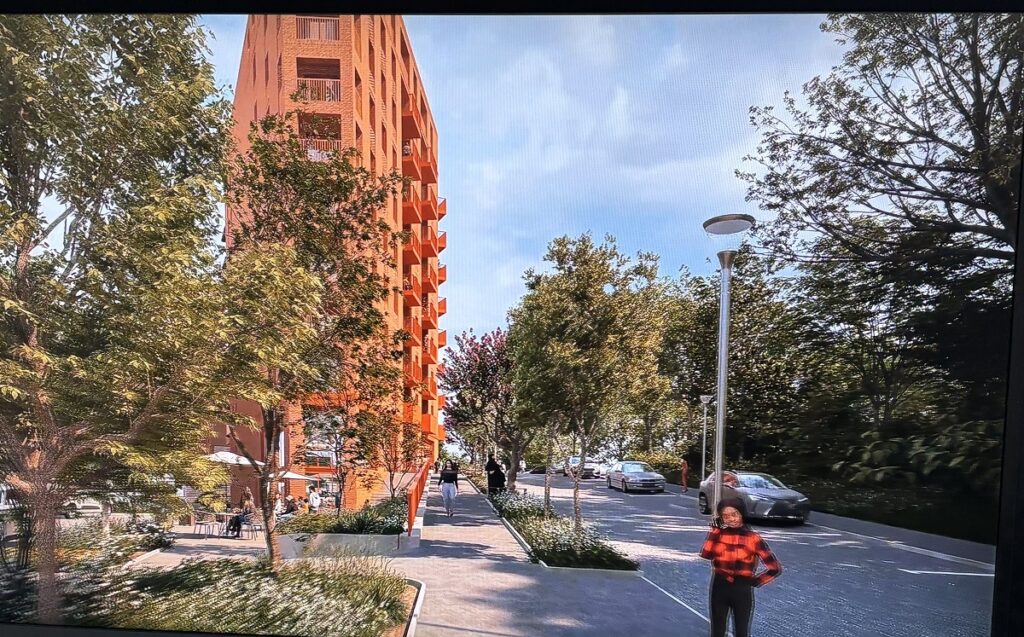
A deputation from the town’s community groups told a hearing at City Hall that squeezing 328 new homes into a narrow strip of land between the tube line and the Barnet Hill trunk road was the “wrong scale in the wrong place”.
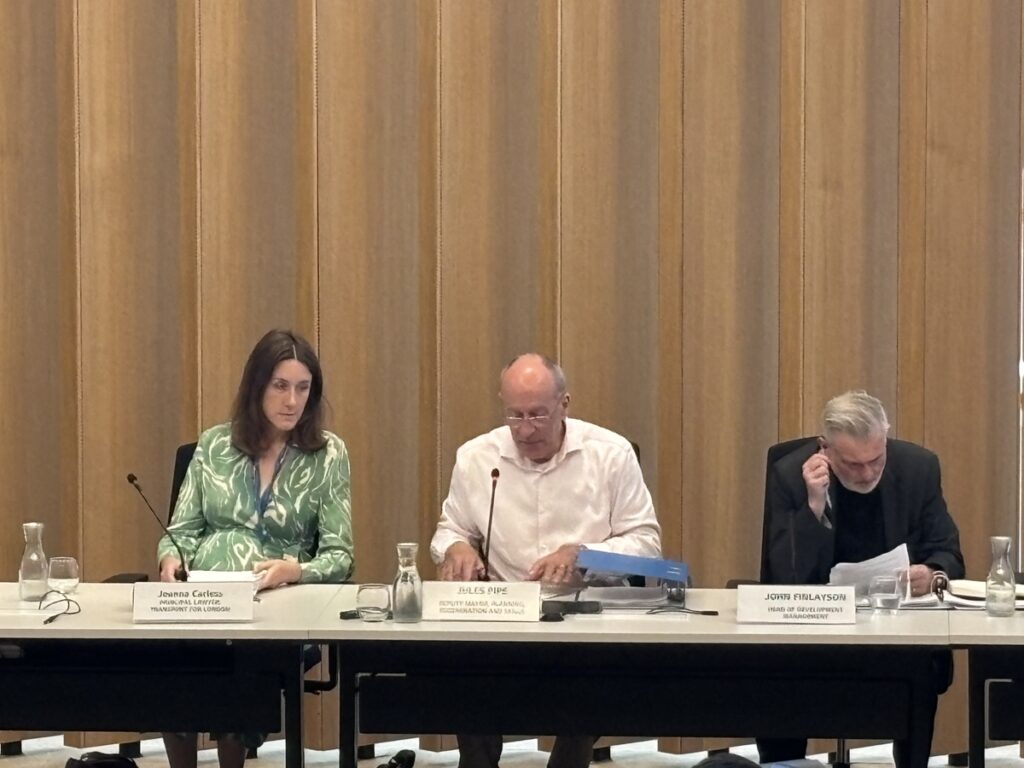
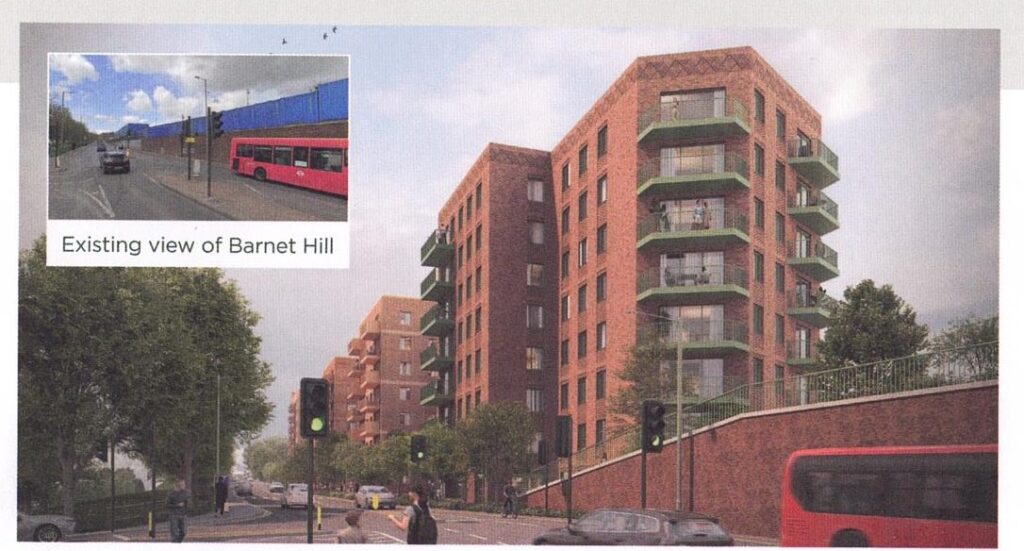
Objections were overruled by Jules Pipe, Deputy Mayor for Planning and Regeneration, who said that although three of the blocks would exceed the seven-storey limit agreed in the Barnet local plan – and one block would be 11 storeys – the impact of the height and massing of the flats would be negligible on the neighbourhood and no reason for refusal.
Building more affordable homes was the mayor’s priority and the High Barnet Place scheme would provide 100 new homes at low-cost rent or shared ownership.
“We must take advantage of sites which offer a high proportion of affordable homes and where the key travel infra-structure is in place,” said Mr Pipe.
“Inevitably schemes like High Barnet Place would be visible, including long range views…but the alternative would be to drive such schemes to the green belt and to less sustainable sites.”
Objections to the loss 160 spaces in the station car park – and the provision of only eight places for Blue Badge holders – were rejected by Mr Pipe on the grounds that encouraging tube passengers to walk to the station or take a bus would encourage “more sustainable means of travel and improve air quality”.
Developers Barratt and Transport for London’s investment subsidiary, Places for London, hope to start construction in February next year with the first affordable homes being available in February 2029 and the scheme completed by April 2030.
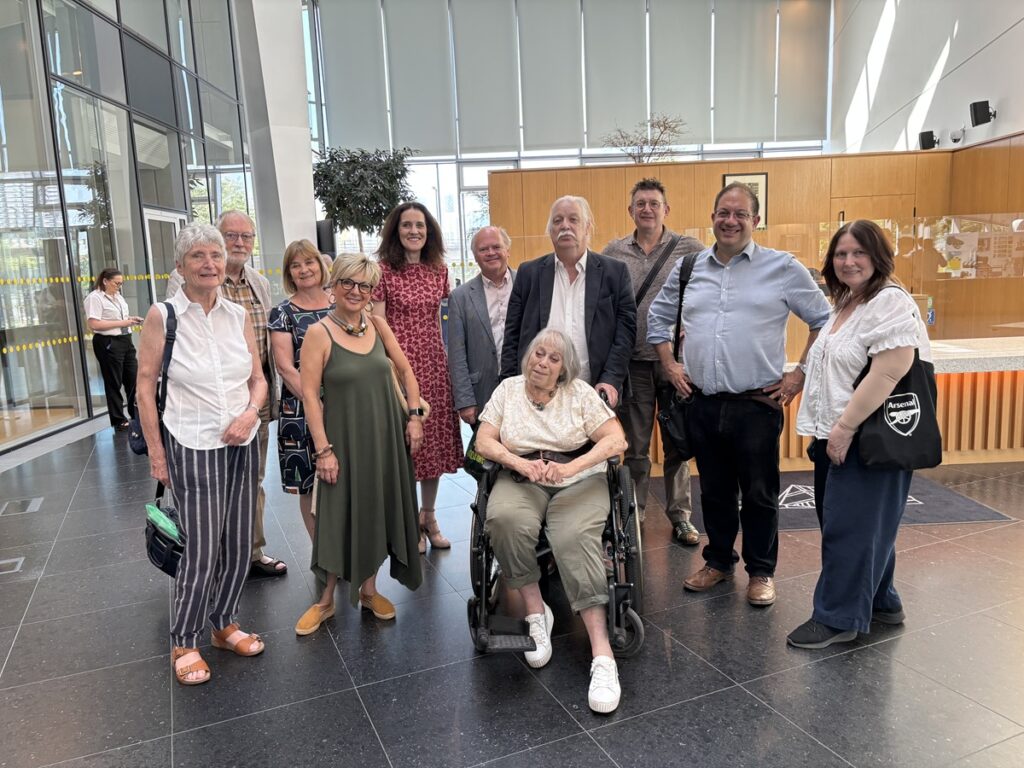
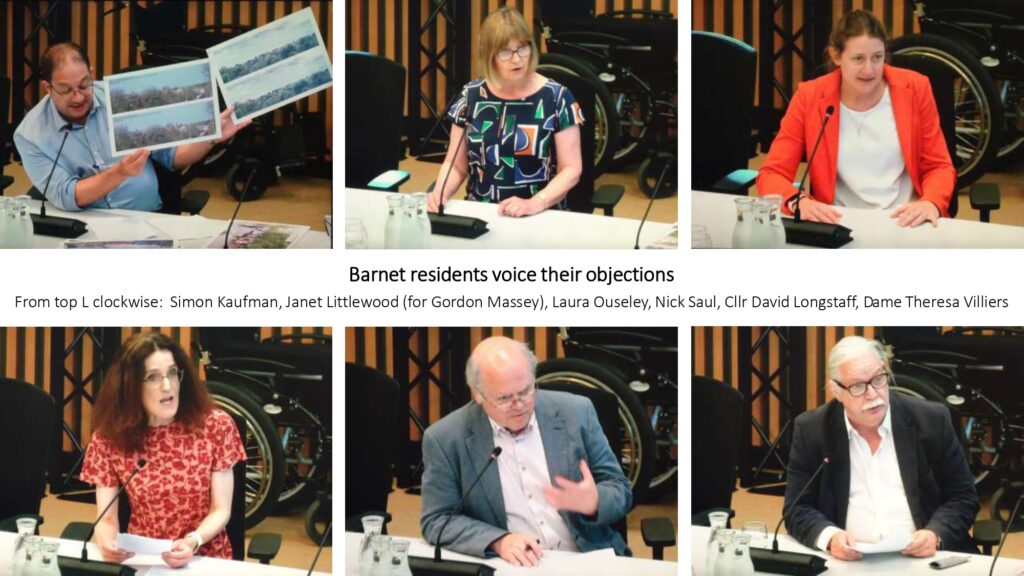
Simon Kaufman, a chartered architect (above, second from right), made a joint presentation on behalf of members of the Barnet Society and Barnet Residents Association.
He said many of the flats in the five tower blocks would be of poor quality, single aspect and reliant on mechanical ventilation.
The design of the scheme exemplified the social and management failures of high-density blocks of flats built across London in the 1960s and 1970s.
After Mr Pipe announced the scheme would go ahead, Mr Kaufman said the conscience of the objectors was clear.
“We listened to the lessons of history, and we are not prepared to see a repeat of the mistakes of the past. We did our best to prevent a development which we fear will become a disaster in years to come.”
Neil Smith, senior project planning officer for the Greater London Authority, opened the hearing by reminding the Deputy Mayor that Barnet Council had refused permission for the blocks of flats because of their excessive height and harm to the character of the surrounding area.
However, the GLA considered the height and massing of the blocks responded well to the immediate context and would make “a positive contribution to the local townscape”.
Given the loss of the car park, there would be nine drop off short-stay spaces and eight Blue Badge spaces, but otherwise the development would be car-free with an enhanced public footpath on the station approach.
A significant public benefit of the scheme would be 100 affordable new homes and there were “no material considerations of sufficient weight to justify refusal”.
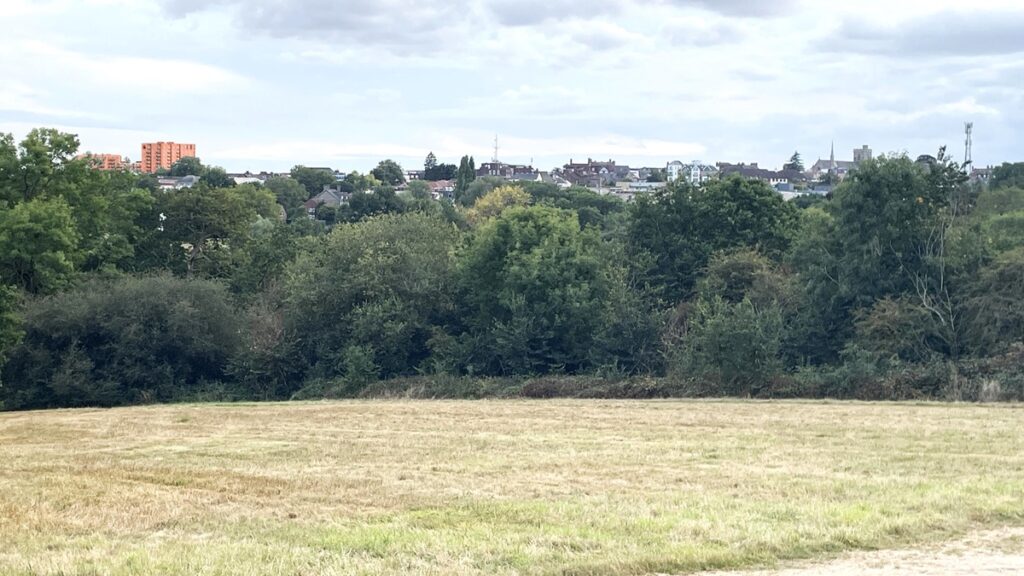
In opening for the objectors Simon Kaufman said that when seen from the surrounding green belt countryside the proposed tower blocks harmed the historic skyline of High Barnet where the defining landmark on the hill had been the parish church.
“This is an over-scaled urban insertion imposed on to an historic hill town.”
An issue which eroded public confidence was that many residents were troubled by the fact Transport for London was effectively promoting development on its own land while the Greater London Authority and the Mayor of London were the decision-maker.
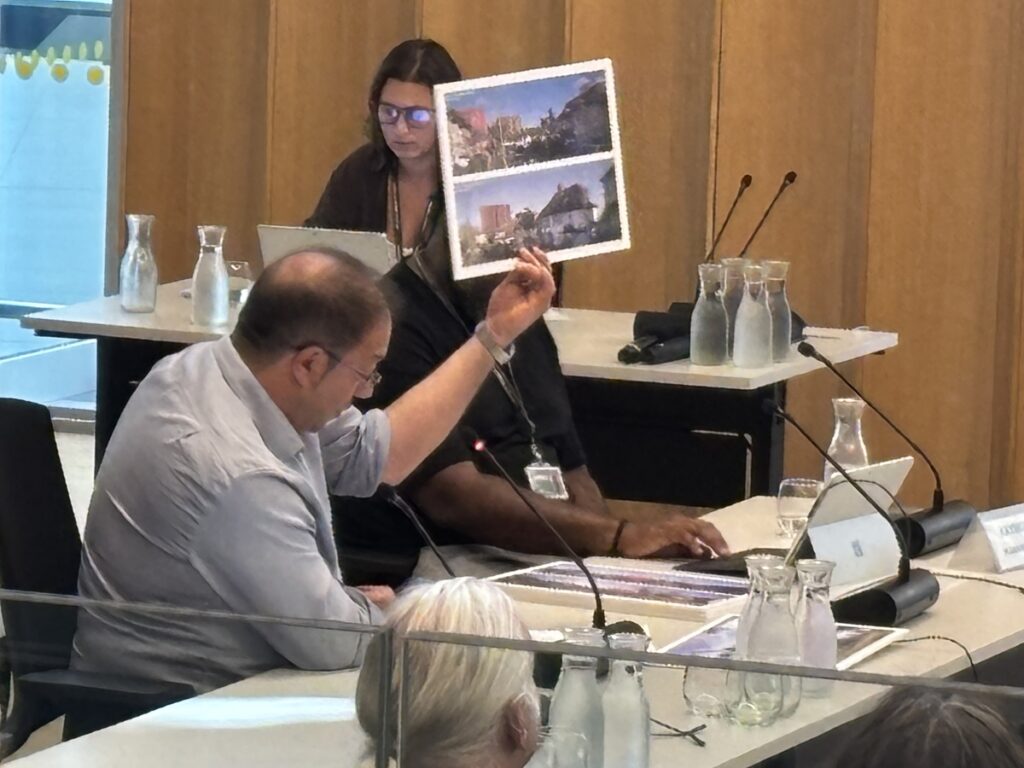
Mr Kaufman criticised the removal of the station car park without providing a realistic alternative and the steep topography of the station approach meant that women, older residents and disabled users would continue to face intimidating routes, particularly after dark.
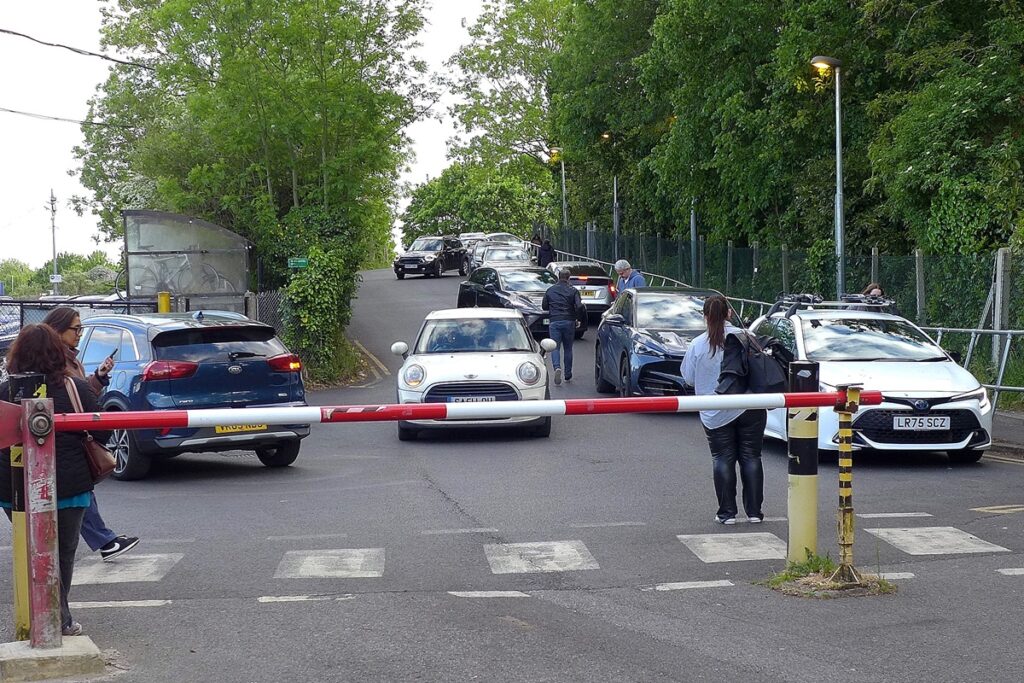
Janet Littlewood of Barnet Residents Association, speaking on behalf of Gordon Massey, said the blocks of flats on the site would add to the existing chaos on the station approach where there were often traffic jams.
The area around the station was isolated and many women would not leave the station unless they could exit by car.
Nick Saul, a retired civil engineer, warned that the loss of the car park and the failure to provide bus access to the station forecourt raised serious concerns for women and the disabled.
Serious assaults to passengers when on foot or on cycle were not uncommon where parking had already been lost at tube stations.
Flaws in the design and access in and around suburban stations were a key factor in the prevalence and location of attacks.
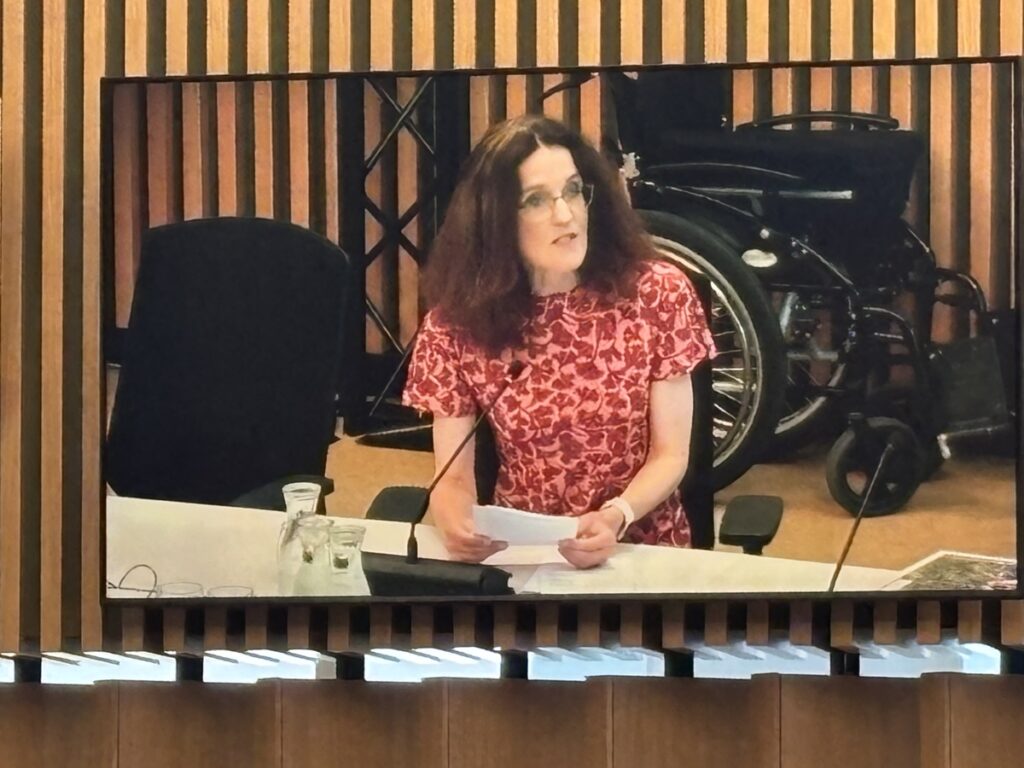
Dame Theresa Villiers, formerly MP for Chipping Barnet, who described herself as a resident and passenger, insisted that the loss of the station car park would damage the quality of life of many thousands of Barnet residents.
Anyone with impaired mobility would be at a disadvantage and the suggestion that more people might like to cycle to the station ignored the steepness of Barnet Hill – as she could testify personally it was “a tough climb for cyclists”.
“High Barnet station has been my station for 21 years. It is our get away to the world. Please don’t curtail the freedom of High Barnet people to live our lives the way we want to.”
There was one speaker in support of the scheme, High Barnet student Yana Kostova, who said that given the pressure on local housing the only chance was to build upwards.
The prospect of more affordable homes was a relief. She thought High Barnet could “blossom and attract a younger generation with such schemes”.
In response to questions from the deputy mayor, Martin Scholar, head of planning for Places for London, said the developers Barratt Homes had maximised the number of affordable homes at High Barnet Place which would allow more people to get on the housing ladder.
“Forty per cent affordable homes at High Barnet is much higher than for most schemes in London” – a consideration that was given emphasis in the deputy mayor’s final decision.
In a statement issued after the hearing, Dan Tomlinson, MP for Chipping Barnet and Exchequer Secretary to the Treasury, criticised the go ahead for a scheme which was clearly not in line with the local plan.
“Planning decisions aren’t mine to make as the local MP, but Barnet Labour has made it views very clear on these proposals.
“It is in black and white in Barnet’s local plan that seven storeys is the maximum for housing on this site.
“It is not right for the GA to overrule elected councillors to approve a scheme with an 11-storey block that contravenes the plan.”
Mr Tomlinson’s statement was followed by a statement from Barnet Labour Party expressing its opposition to the go-ahead for high storey blocks of flats at High Barnet tube station and GLA approval for the Great North Leisure Park development:
“It is extremely disappointing that two local planning decisions based on the local plan and London plan and with the backing of the local community have been overturned by the GLA.
“Local councillors should be trusted to make decisions based on the best interest of their communities.”
Tags: #Barnet Council #Development #High Barnet #Planning
28 thoughts on “Promise of 100 affordable new homes influences final go ahead for tower blocks at High Barnet tube station and loss of car parking”
Comments are closed.
Why not become a member? Receive our latest newsletter hot off the press four times a year, and support our work with a membership.
If you have some local news, history or want to bring something to our attention please email us.
https://barnetresidentsassociation.org.uk/news/high-barnet-tube-station-decision
https://publiclawproject.org.uk/content/uploads/2019/02/Intro-to-JR-Guide-1.pdf
We have limited time (6 weeks to apply for a Judicial Review) – who is leading the charge on this? I’m happy to help in some capacity. Do we need to hold an urgent meeting?
https://barnetpost.co.uk/2026/05/29/deputy-mayor-of-london-overturns-barnet-council-decision-on-controversial-developments/
I can not come to terms with the fact that a refusal by the council has been overruled by both tfl and the mayor ( who obviously tries to run tfl).
the decision has been made with absolutely no consideration to the residents within the area, disabled people, safety, infrastructure, the list goes on and on.
I think that the only people who would benifit from this scheme are those who do not know the area, the developers and maybe the mayors office.
It seems there is nothing the residents of Barnet can do to stop this money making plan!
https://www.mylondon.news/news/north-london-news/north-london-labour-mps-fury-34026426
A great pity that the public transport elements have been completely ignored and that TfL/GLA are more interested in commercial property development than decent tube-bus interchange.
So no “development gain” provisions to improve the tube station, bus stops, pick up & set down, or a travelator on the steep footpath approach.
And presumably all the red buses going empty to and from Potters Bar garage will not become a regular public service!
Sadly London TravelWatch have been impotent in representing users at the Deputy Mayor’s hearing.
There has been a newly published document by Just Space which recommends a total change in the manner that developments are currently being built across Greater London as follows here: https://justspace.org.uk/wp-content/uploads/Justspace_Alt_Plan-2026.pdf
Poor design and a bad decision, but brownfield is better than green. It’s the slow destruction of the local greenbelt that needs to be the focus of future campaigns.
Clearly the efforts of Barnet Society and Barnet Residents’ Association to ask if they could count on Chipping Barnet MP Dan Tomlinson’s support at the Mayor of London’s representation hearing on this planning application (7 May 2026) failed to muster the desired effect.
As I recall from back in March 2026 within comments on the flat development on High Barnet tube station car park, our MP said he was broadly neutral and would not commit to siding with those for/against (though I hardly think anyone living in High Barnet would have been in favour of such a hideous plan). He said it was a planning issue that needed to be decided on by the Council.
OK, MP Tomlinson stated following the latest decision: “It is not right for the Greater London Authority (GA) to overrule elected [Barnet] councillors to approve a scheme with an 11-storey block that contravenes the plan.”
I just wish he had been more vocal in his opposition (now) to the plan months ago. After all, as our local Labour MP, one will see on his website front page it states: “I’m here to listen and take action on the issues that matter most to you.” It’s a bit late now after the horse has bolted, so to speak, and I doubt this will be forgotten.
This is dreadful news. This redevelopment will ruin the character of Barnet Hill forever. Surely there’s something we can do to stop these tyrants slowly but surely destroying our towns, cities and our country?
They mention the steepness of Barnet Hill (when referring to how it won’t be feasible for people with limited mobility to cycle to the station instead of using the car park), but there’s still been no mention of how Barnet Hill’s current incline is actually man-made. Maybe I’ve missed it?
The slope used to be uneven and they had issues with subsidence when use of the hill intensified. So in the early 1800s it was shored up with whatever they could get their hands on to even out the slope and stop it from collapsing. I could be wrong but I also seem to remember reading that parts of it had to re-enforced it again in preparation for the trams, which were introduced in 1907.
A redevelopment of this size on such a narrow strip of land, parallel with a predominately man-made incline that’s being held up by who knows what sounds like a recipe for disaster.
Im a fan of the mayor and I don’t know how much he actually would have heard about the plans but this is clearly the wrong decision.
‘would exceed the seven-storey limit agreed in the Barnet local plan – and one block would be 11 storeys – the impact of the height and massing of the flats would be negligible on the neighbourhood and no reason for refusal.’ – this is a disgusting slap in the face for devolution.
‘that encouraging tube passengers to walk to the station or take a bus would encourage “more sustainable means of travel and improve air quality”’- this is so flawed its funny.
Dan mate what’s the point of you being an mp and only talking about an issue when it’s irreversible, I know the public don’t want labour infighting but we would have probably been happy on this occasion. grow a back bone.
Absolute shambles. Thank you Labour, thank you Dan, thank you Emma, for stumping over your constituents. We will never forget that. 11 storey in High Barnet is an absolutely bizarre, almost sadistic scheme. Shameful.
I am assuming you are talking about Councillor Emma Whysall? If you are, the tube station development is in the Barnet Vale Ward and the councillors are David Longstaff, Richard Barnes and Sue Baker – nothing to do with Emma Whysall.
Sorely disappointed at this news of the development, is there anything more residents can do apart from writing, protesting? How can it be challenged? Is there a way to contribute to legally taking action? It’s our town, we live here and we need to advocate that this is not the right decision for the character or infrastructure of the area. Floored to hear the MP, Dan, wasn’t present during this.
Perhaps referring to potential residents as scum is 1 reason permission was granted.
Your sort make me sick & I’m over the moon it’s going ahead
Please share where this word was used, as I don’t think the word ‘scum’ has ever been used anywhere by the Barnet Society in relation to this development. Having read all their output I don’t recall seeing this anywhere. I would hope that the society would apologise and retract the comment if it was used.
I do agree that the characterisation of the development as ‘slums of the future’ was a poor choice of words, and I’m aware that some of the social media invective around this and other developments is pretty toxic.
This is extremely disappointing. As a local resident and unsuccessful candidate, I lobbied heavily against the approved scheme at every stage including the submission of a 15 page report which was referenced.
It is unfortunate that not enough people made their opinions known to the GLA. Less than 150 comments received ahead the the stage 3 report.
I have contacted the developers to request design amendments and to ensure that this scheme is not value-engineered. There are also points for the council and TfL around parking and public transport infrastructure.
Why couldn’t Dan turn up for his constituents at the hearing instead of making a statement after the event? That would have been worth more than 10 of his Instagram videos.
The ‘High Barnet student’ is a student at Barnet College who acknowledged that she does not live in High Barnet, but commutes here for college. It is telling that the developers could not find a local person to speak in support of the scheme. She was also the only person to speak in support of the developement when the application was refused by Barnet Council last December.
Yes I agree that Dan should have turned up for this hearing.
Is there any further action that we can now take to prevent these tower blocks from being built here?
There is very little left to do, I understand, but still some alleys. Since May 2026, the Mayor (sadiq khan) has expanded powers, so he can overrule local councils in decisions regarding housing schemes of 50 homes or more (this one has 283).
But, I understand there are some options for Barnet residents and society, too:
1) Judicial Review of the Mayor’s decision in the High Court.
I believe there is a chance for this, as the Barnet Society has also highlighted a potential conflict of interest: Mayor Sadiq controls TfL, which owns the site and commissioned the project and will profit from the construction.
There is a direct precedent: the London Borough of Hillingdon sought judicial review after the Mayor approved a 514-home scheme, on grounds that the scale was inappropriate and that full consideration had not been given to air quality impacts, and also that the Mayor failed to act in accordance with London Plan tall buildings policy after being directed to update it by the Secretary of State.
However, a Judicial Review must be filed within 6 weeks of the decision, i.e. latest by early July.
2) Delaying via Conditions and S106 Negotiations
The Mayor’s permission will almost certainly be subject to a Section 106 legal agreement (dealing with affordable housing obligations, infrastructure contributions, etc.) and various pre-commencement conditions (surveys, detailed design approvals, etc.). Barnet Council, as the local highway and planning authority, will need to sign off on many of these conditions and is a party to the S106. In practice, this gives the council some limited ability to slow the process – however you have to be a real optimist to believe Barnet Council (esp. now controlled by Labour) will do much there.
3) Political and Parliamentary Pressure
Not really legal, but in theory we can all call Dan (haha, sounds a bit like a joke, I know) or the Secreteray of State to raise the matter in the parliament.
So there is a bit that can be done, but I believe with the May 2026 expansion of Mayor’s power + the Labour government’s “oh we need to build thousands of new homes” craziness, it’s a bit of a stretch. Still, we should not go down easily.
FWIW, I think this will finish Labour in High Barnet (and in overall Barnet) for good.
We definitely need Dan and our councillors to very quickly provide details about what they are prepared to do here. Even if this goes ahead, it appears that Pt 2 above provides ample means to put local residents first. Traffic management (Barnet Hill is a critical corridor in and out of London and it is a vital route to the hospital), safety (on the hill, the interchanges to public transport, the drop off/pick up area, which if anyone actually uses it, knows 9 cars waiting, plus no parking will 100% back cars onto the hill during rush our periods), links to public transport and availability of early and late connections), etc. There are many very specific areas that would improve outcomes for residents – they need to start providing specifics now. The entire community should be pushing for that asap. Dan, Emma, James – when can we expect to hear from you?
Yes I believe that a Judicial Review of the Mayor’s decision would be a good idea for the group to consider as this type of action has been successful in overturning planning approvals before.
We should demand to hear from our MP and our local councillors on this complete override of the views of the community. This decision was conveniently made after local elections and after two (clearly meaningless) “consultations.” What are their responses to the decision and are they willing to fight for their immediate constituents. There are so many flaws in this development giving them many ways they could push to improve the outcomes for the local community. If they can’t or won’t take this on, it should be made very clear that they will not get reelected.
What a total joke and disaster for the area. Just means roads around the area will be clogged by cars with people using the station and who, in their right minds, wants to live sandwiched between the train lines and a main road. The whole Mayor’s team, and the Mayor, should be fired. So upset at what is happening to our area.
What a shame. This scheme is lazy and unimaginative and seems to have been designed for another location. The loss of the car park is bizarre for a terminus serving a large area of Hertfordshire.