
Government and developers set their sights on the Green Belt
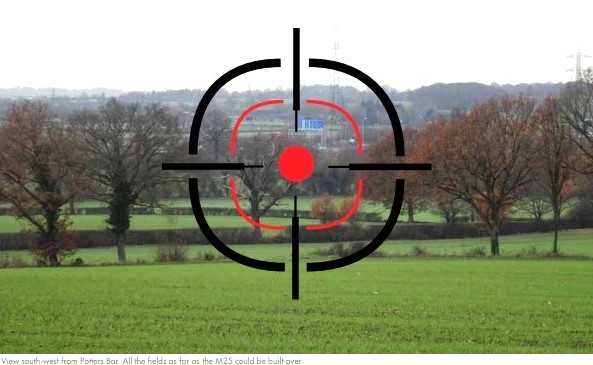
This swathe of Green Belt (above) will be mostly built over if current plans are approved. And within Barnet, dozens of so-called ‘Grey Belt’ sites are being targetted for new homes (few of which are likely to be affordable). The Labour Council promises to create a Regional Park, which could prevent that. This should be an issue in our local election in May – but do voters know or care?
Between Potters Bar and Borehamwood, several enormous data centres have already been approved on land in the foreground of the photo above. Beyond the M25 will be a major expansion of Sky studios. For land off to the left of the photo, a planning application for 900 new homes has been refused by Hertsmere Council, but the developer has appealed against the decision.
Crews Hill & Chase Park new town
Between Barnet and Enfield, the government proposes a new town of 21,000 homes on Green Belt land. The plans are supported by Enfield Council and the Mayor of London but opposed by the Enfield Society and Enfield RoadWatch.
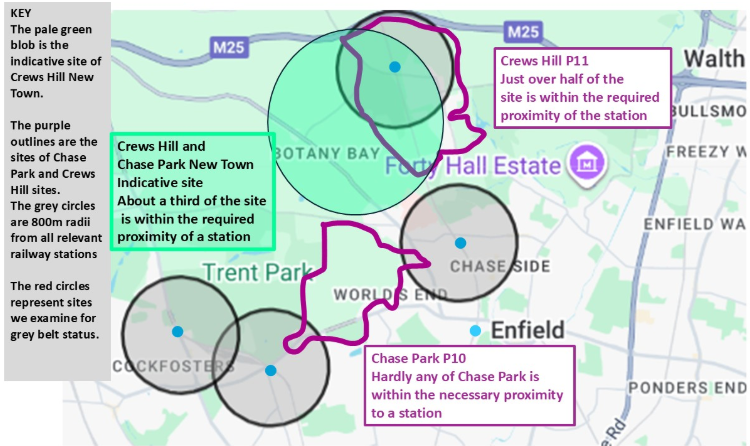
The Barnet Society has objected to any loss of the green buffer that exists between Barnet and Enfield. It is vital to preserve the separate identities of settlements that would otherwise merge into amorphous suburbia, and a vital reservoir of biodiversity.
Just ahead of the local elections in May, groups and communities across the UK will be taking part in a UK-wide Day of Action for Nature, Parks and Green Spaces on Saturday 18 April. Its purpose is to demonstrate, visibly and collectively, that people everywhere care deeply about the natural world and want to see it protected and restored. Join the national day of action here.
Barnet’s Green Belt
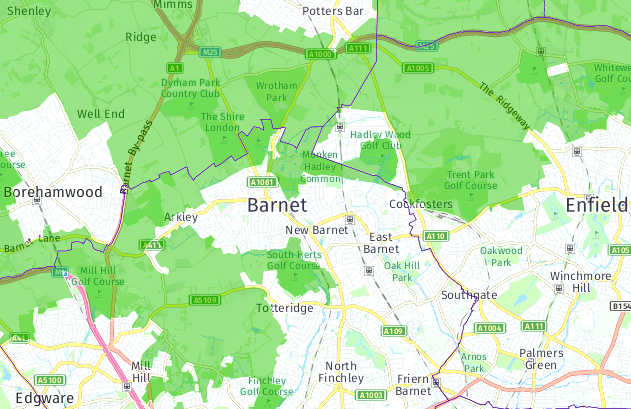
The countryside on three sides of Chipping (or High) Barnet was saved in 1945 from housing development, largely by the efforts of the Barnet Society. In 1955 it was formally designated part of the London Metropolitan Green Belt. The map above shows how well it has survived – at least until now.
For decades developers have tried to build in it. So far, our Council has effectively prevented most new development. Exceptions have generally been restricted to replacement of obsolescent farm buildings.
Lately, however, we’ve seen an increase in speculative purchases of, and planning applications for, Green Belt land. Also notable has been unsightly and apparently deliberate neglect of existing buildings and landscape. The prospect of profiting from escalating land values and house prices beats the cost of maintaining or restoring property.
Expectations have been fuelled by the housing crisis, which has driven up mortgages and rents. And building costs have soared due to Brexit, Covid-19, wars in Ukraine and the Middle East and the higher safety standards introduced since the Grenfell Tower tragedy. Building on city brownfield sites has become less financially viable. No wonder the Green Belt, where building is cheaper, has become so appealing to developers and politicians.
And Labour politicians have opened the door to its development.
Grey Belt sites
In 2024, Sir Keir Starmer promised to release low-quality or neglected Green Belt land for housebuilding. In 2025, the National Planning Policy Framework (NPPF) was revised to allow housing development on Grey Belt sites subject to ‘Golden Rules’. And public consultation recently closed on further relaxations of the NPPF.
The consequence has been a flood of planning applications for allegedly Grey sites. In December 2025 CPRE, the countryside charity, reported new research revealing that the Grey Belt policy is enabling large-scale development on England’s unspoilt rural landscapes – not, as ministers promised, on unused car parks and derelict petrol stations.
Since December 2024, when the policy was introduced, 13 developments of 10 or more homes have been approved by government Planning Inspectors on Grey land in the Green Belt. The approvals have been granted over the heads of local councils. Of the 1,250 homes these schemes will deliver, 88% will be built on previously undeveloped countryside.
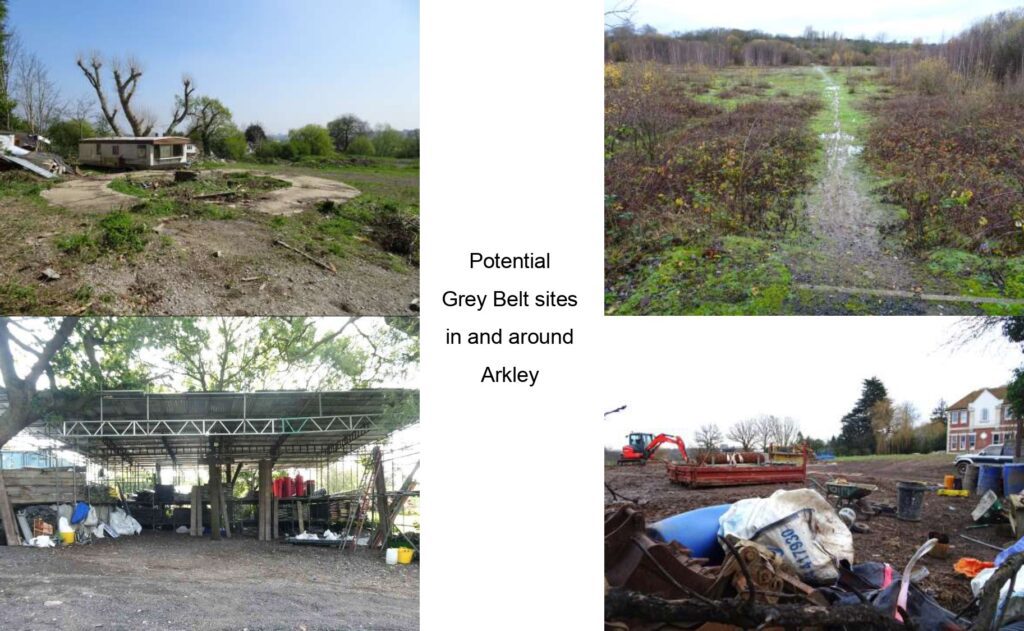
In Barnet, it’s becoming routine for prospective developers of Green Belt land to describe their sites as Grey. Although some sites are quite small, they’re dotted around and have a disproportionately harmful impact on the countryside. Most aren’t served by public transport and won’t be developed for affordable (let alone social) housing. A selection is illustrated below.
Barnet Regional Park
Barnet Labour Party’s local election leaflet contains this pledge:
“We will… create a ‘Regional Park’ in the green belt.”
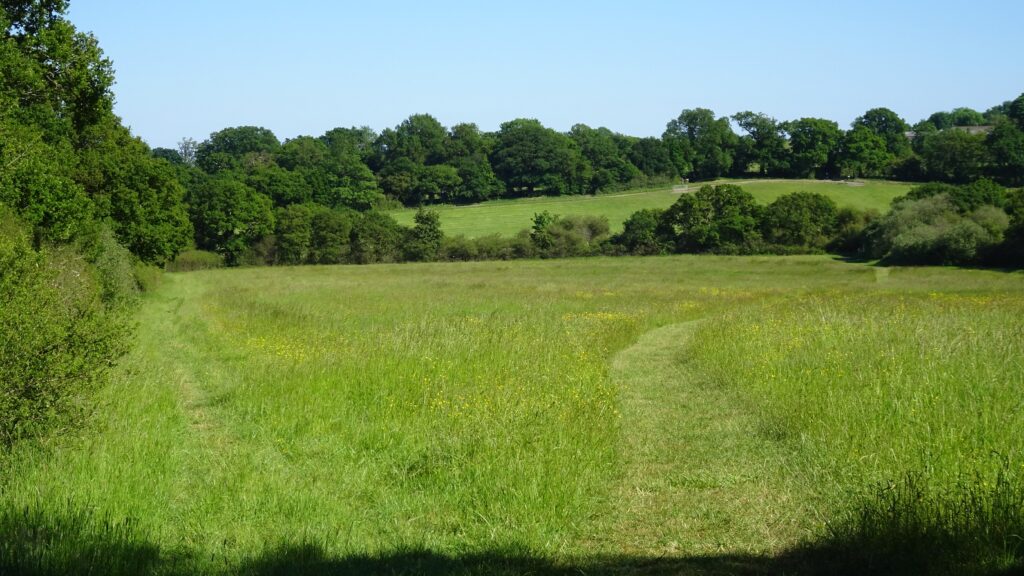
It would be centred on the astonishingly intact and peaceful fields and woods between Arkley and Mill Hill (below).
The concept is already embedded in Barnet’s Local Plan (adopted by the Council last year) where Policy GSS13 states,
“The Council supports the creation of a new Regional Park within designated Green Belt or Metropolitan Open Land in the Brent Valley and Barnet Plateau Green Grid Area…”
Inspired in part by the success of the Lea Valley Regional Park, interventions would include “the enhancement of footpath, cycling and bridleway networks; improved green corridors and nature conservation areas [and] a network of new strategic recreational destinations.”
The map below (from the Council’s 2019 Growth Strategy) shows its intended configuration.
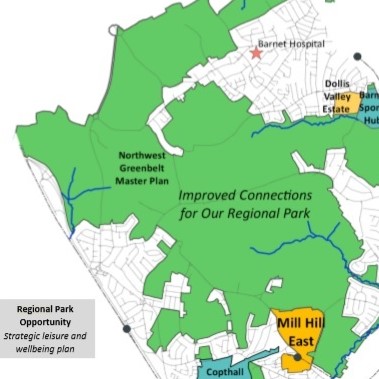
Most importantly – since the Regional Park contains several of the Grey sites illustrated above – designation should provide stronger protection from inappropriate development. It would bring better public awareness and funding to ensure high design standards and long-term management of the area.
An imaginative suggestion from Roger Chapman of Barnet Green Spaces Network is for a regional food and biodiversity park to encourage a wide range of food growing practices. Linked with primary, secondary and post-16 education institutions and forest schools, it would provide an inspiring setting for environmental education and pathways to vocational qualifications in horticulture, animal husbandry and other skills essential for future food security.
As Roger says, “The park would build upon Barnet’s extensive agricultural history and heritage, enabling old stories to be retold and new ones to be created.” That’s an idea worth voting for.
The need for proper planning
Debate about the Green Belt is hampered by the lack of any regional strategy. There has been no planning body for the South-East for decades. Responsibility for the Green Belt is split between dozens of Local Planning Authorities.
The Mayor of London launched a London-wide review of the Green Belt to identify Grey Belt land for housing to tackle London’s housing crisis, but it is limited to the Greater London area. It was expected to be completed by the end of 2025 but is still awaited.
As a consequence every planning application in the Green (or Grey) Belt, however minor, becomes a bitter battle between developers, planners and residents.
The creation of the Green Belt was made possible by the government’s adoption of Patrick Abercrombie’s Greater London Plan, which created a ring of new towns around London, outside the Green Belt, to absorb the demand for new housing and promote alternative centres of growth. If we had a vision as sensible and comprehensive as that for our society – and for the natural world with which we co-exist – surely most of us would accept development in the most sustainable (or least harmful) locations in exchange for guaranteed long-term protection of our most beautiful and biodiverse environments.
Crews Hill & Chase Park new town and Barnet Regional Park could be examples of such an approach. As yet details of both projects are far too hazy for a final public decision. But each could transform substantial sectors of their borough. Whether to proceed with project planning, feasibility studies and technical investigations ought to be a matter of great public interest. This coming election is an opportunity to test the popularity of both projects.
Tags: #Barnet Council #Barnet Regional Park #Chipping Barnet #Crews Hill & Chase Park New Town #Development #Grey Belt #Planning
3 thoughts on “Government and developers set their sights on the Green Belt”
Comments are closed.
Why not become a member? Receive our latest newsletter hot off the press four times a year, and support our work with a membership.
If you have some local news, history or want to bring something to our attention please email us.
The threat to our Green Belt is real, and deeply concerning. A Regional Park sounds like a good idea, but a vague promise made pre-election offers no guarantee. As for the Crews Hill and Chase Park plans, apart from the environmental impact, which will be immense, no one associated with these developments will answer questions about the infrastructure needed to support such an increase in population in such an area: most particularly in terms of healthcare, when Barnet General and Chase Farm are already under such strain, following cuts in services elsewhere, and more to come, eg the loss of maternity services at the Royal Free. Lastly: as usual there is absolutely no assurance that the new housing provided will actually be accessible to those most in need, and every reason to expect this to be yet another profit driven annexation of precious green space by developers and the construction industries.
The author suggests that potential Green Belt development should be a local election issue yet he only mentions one political party throughout.
In the interests of balance – which I gather the Barnet Society is committed to – would it be possible to have a follow-up piece outlining the plans other parties have, not only for the Green Belt but the housing crisis in general?
Apologies, local resident – I should have credited Barnet Conservatives for floating the idea of a Regional Park years ago. It would be nice to know if they still support it. And Boris Johnson, who when Mayor of London pointed out that London’s Green Belt and other natural assets are among the most important factors making for civilized life in London.
If the Greens, Lib Dems and Reform tell us where they stand on the Green Belt, we’d be delighted to publicise their views.
As for the housing crisis, we’ve written about it in our newsletter. Join us to read it.