
Strong objections registered to a possible threat to a much cherished and historic setting at Monken Hadley
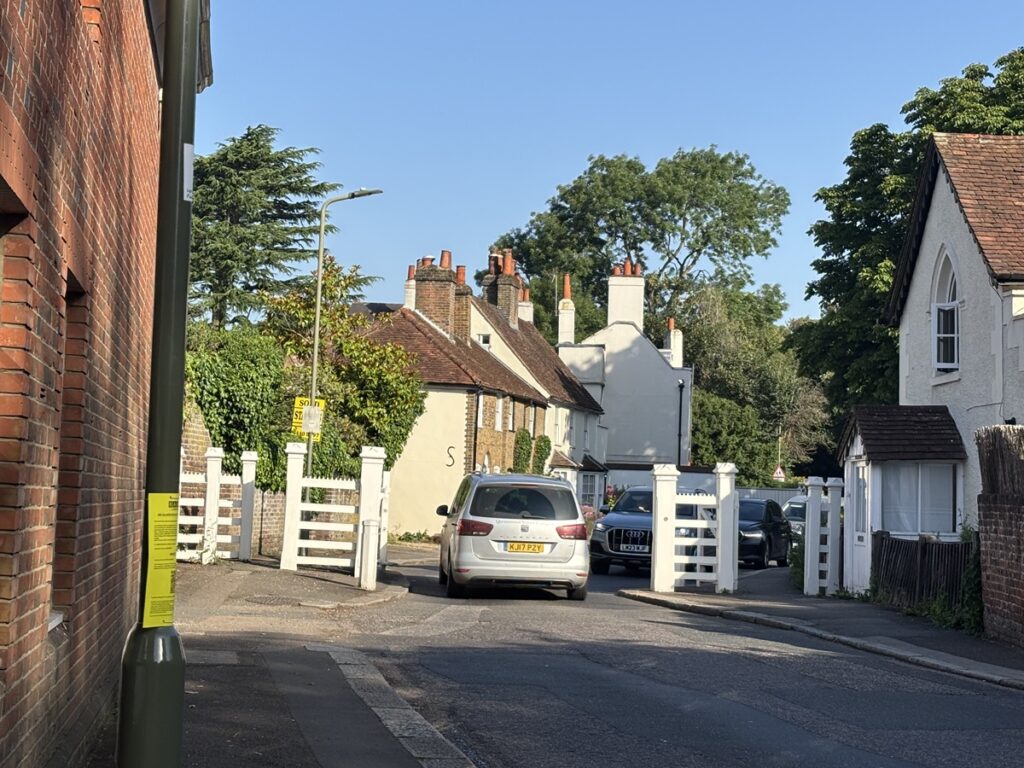
Residents and conservationists have reacted with alarm at a proposal to include the historic gate at Monken Hadley within an eruv – a symbolic boundary for Orthodox Jews – which would require the installation of two 5.5metre high poles with a crosswire over the road.
If planning permission is granted, an eruv would be created largely within the Borough of Enfield which would take in the United Synagogue in Hadley Wood, but which would also require eruv installations at three boundary points which are within the Borough of Barnet.
The application affecting Monken Hadley – establishing a boundary from Hadley Common – is for permission to install a 5.5metre pole on the footpath outside Rectory Close; another 5.5 metre pole on the other side of the road on the footpath outside Clocktower Cottage; and an overhead a connecting wire.
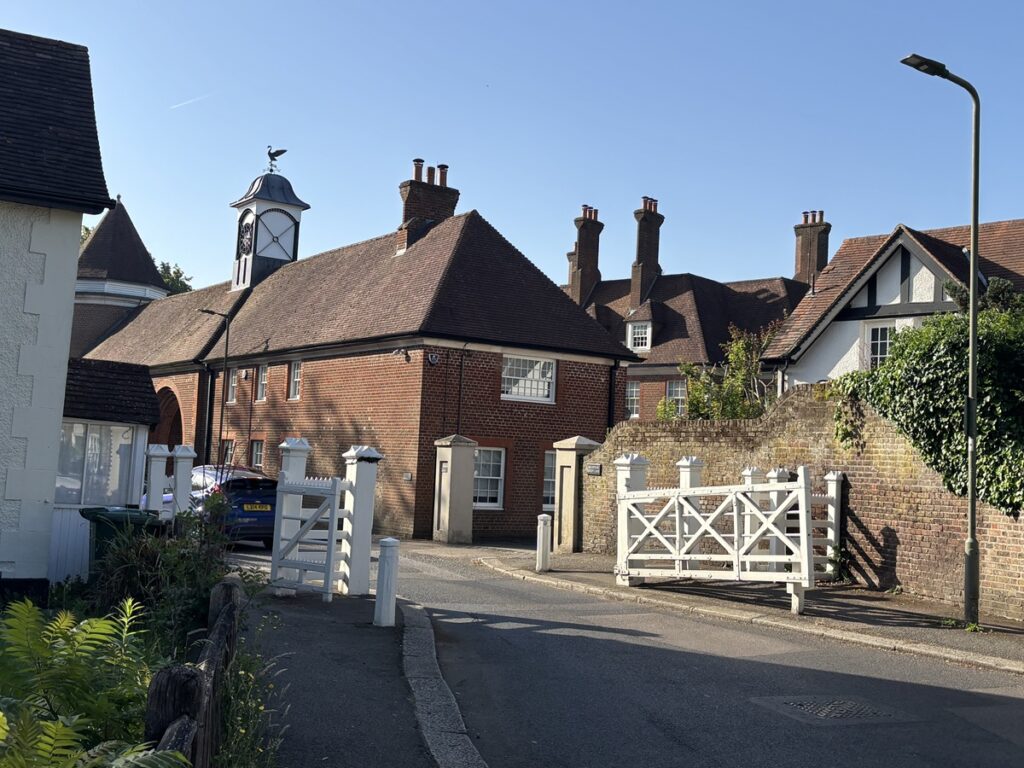
A series of objections posted on the Barnet Council’s website (closing date 25.6.2026) claim the two poles would be unsightly and an unacceptable intrusion into the most sensitive and significant setting within the Monken Hadley Conservation Area.
The Reverend Francesco Aresco, recently appointed rector of Monken Hadley Parish Church, says that as a nearby resident he objects to the installation because it would result in visual harm to an historic setting and create hazards for pedestrians.
The pavements outside Rectory Close and Clocktower Cottage are both “very narrow”.
They are used regularly by school pupils, requiring pedestrians to step into the road when trying to pass parents pushing prams.
Among the objectors was the Hadley Wood Neighbourhood Planning Forum Committee which considered the eruv would be of no benefit to the population at large and hoped that an alternative option would be to use the tollgate itself as a symbolic boundary – a suggestion which is apparently to be considered by the relevant “eruv” authorities.
Monken Hadley Common Trust agreed with the planning forum committee that the white tollgate might itself form the eruv boundary.
In its application, the United Synagogue Trust Ltd – of which the Hadley Wood Jewish Community of 471 members is a constituent member – says the proposal would encourage social cohesion within the community.
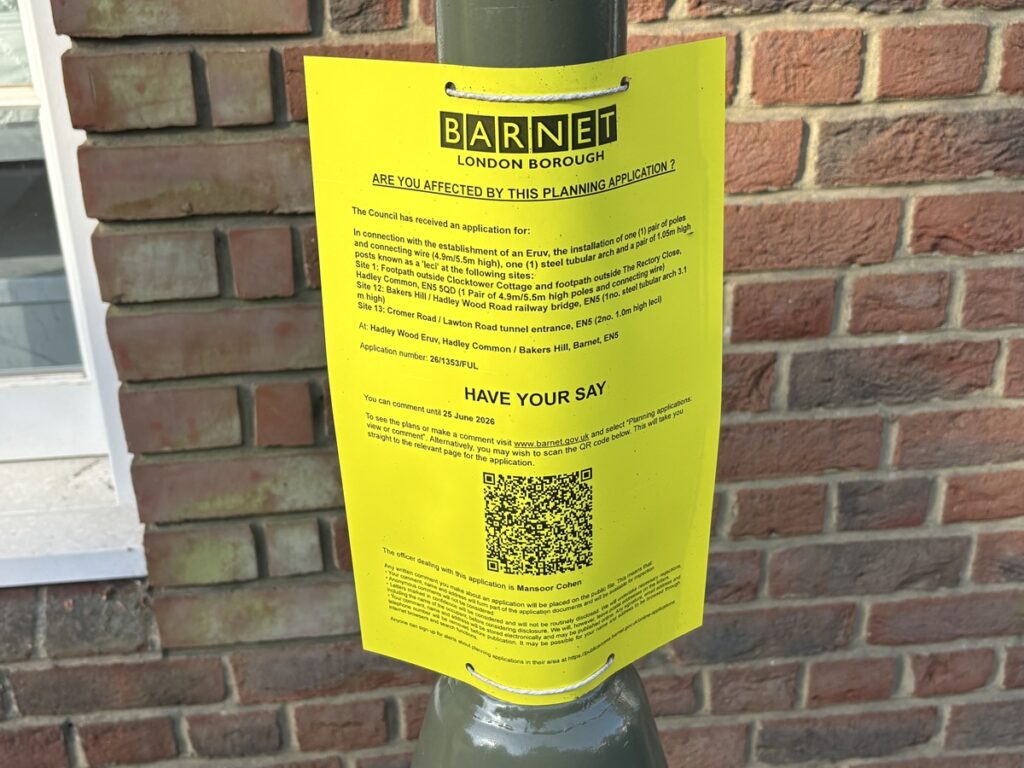
There would need to be three eruv installations at three locations within the Borough of Barnet – two poles and a crosswire at Monken Hadley; a tubular steel arch at Bakers Hill at the Hadley Wood railway bridge; and an installation at the Cromer Road/Lawton Road entrance to the pedestrian tunnel under the main railway line.
These three installations would achieve linkage with an existing New Barnet eruv.
An eruv allows observant Orthodox Jews to carry and push objects – such as housekeys, medication or prams – between private and public domains on the Sabbath.
According to biblical law, carrying anything in a public space is considered a form of work, which is forbidden on the Sabbath. An eruv solves this by symbolically turning a neighbourhood into one large, unified “private domain”.
A comment from a supporter of the application sets out the case: an eruv would enable observant Jewish families to attend synagogue, join community events and maintain normal social connections, especially family visits and celebrations.
Eruv boundaries have been installed across London and the UK during the last 15 years including in nearby areas such as Stanmore, Bushey, and Camden apparently without objections and at no public cost.
18 thoughts on “Strong objections registered to a possible threat to a much cherished and historic setting at Monken Hadley”
Comments are closed.
Why not become a member? Receive our latest newsletter hot off the press four times a year, and support our work with a membership.
If you have some local news, history or want to bring something to our attention please email us.
Unless you looked really hard, you wouldn’t know an eruv was there. It feels like lots of people get triggered simply by the notion of something new or different being introduced.
The ‘trigger’ is not the notion of something new but the complete lack of sensitivity to the heritage of the iconic Monken Hadley toll gate site by adding unnecessary street furniture when there are perfectly adequate existing boundary markers or alternative places to set the Eruv boundary.
The planning application suggests that the Eruv boundary would increase social cohesion in the area (this can be achieved on the 6 days that the orthodox abiding Jews are not restricted by their religion). From the objections to the erection of the poles at the Monken Hadley gates I doubt this will be the case. Additionally, the Eruv pole outside Rectory Close will further compromise an already narrow pedestrian pathway for parents ferrying their children to and from the schools on Camlet Way.
This is a misguided project by the applicants and does not sit favourably with the residents living in the Monken Hadley Conservation Area. The majority of the Hadley Wood community who will benefit from the Eruv giving them freedom from their religious constraints do not live in the Monken Hadley Conservation Area and their Eruv boundary should reflect this.
This is not the first time the Rev Aresco has objected to planning proposals submitted by faith groups different to his own. Readers may be aware that his contribution to the High Barnet Islamic Centre application concluded with a note that “There hasn’t been a demonstrated need for an additional place of worship in High Barnet”. Perhaps a boundary should be set between the vicar and the comments section of the Barnet planning portal?
The vicar is just as entitled as anyone to raise concerns about the planning proposals, whether you agree or not.
This proposal is completely unacceptable for a conservation area. I hope the Council turn the application down.
I’ve always wondered why they need to erect poles and fishing wire to mark eruv boundaries. Can’t they mark them on a map and refer to that so they know where the boundary limits are? Or if they really need a visual boundary in Monken Hadley why not just use the existing white gates? Wouldn’t extending the modern day use of the gates be more inclusive while also being respectful to the Christian history of the area?
It wouldn’t have any effect on the surroundings at all, and normal would there be any public cost. It’s quite snarky if they don’t get planning permission.
There are a number of eruvs in barnet and these go unnoticed. They are not intrusive and are a simple wire attached to already existing poles. I believe the ULeZ post that was put up is more intrusive than the eruv wire which is barely visible. Reporting the objection is not a balanced view and doesn’t sound like residents are very welcoming to members of their own local community who live in the area.
This reads less like balanced reporting and more like an attempt to shape opinion. The headline alone is loaded with phrases such as “strong objections”, “possible threat”, “much cherished” and “historic setting”, encouraging readers to view the proposal negatively before they’ve even seen the facts.
The article also fails to mention that an eruv typically consists of thin wires attached to existing poles which are generally inconspicuous and often go unnoticed. It also fails to mention that there are already other structures like lamposts cluttering up the historic streets. That seems like an important piece of context for readers to make an informed judgement.
I’m not saying the article is necessarily anti-Semitic, but the one-sided framing, combined with the approval of comments referring to “religious cults” and suggesting one religious group is seeking “more power”, certainly gives off uncomfortable vibes.
Perhaps a community publication should strive to inform, not inflame.
To be fair it’s the same with most Barnet Society articles. Hysterical NIMBYism at its worst.
I believe you will totally not notice this at all and if it helps people in the community it would be a wonderful thing to live in kindness and understanding.
The conservation area restrics many improvements to homes which would improve the lives of residents on grounds of historic conservation yet out of character installations as these poles are being considered. Just as residents are told by planners that they should be aware of the conservation requirements before moving to the location this should apply to all without bias
Here we go.Eruvs exist all over North London and cause no issues. The first was approved over 30 years ago and was approved after a long public inquiry and finally installed after I gave permission for a few polls on council land…The objections are just excuses for anti semitism. There are no planning grounds
Personally, I do not understand, nor agree, with the above objections to this planning application.
However, it is inappropriate for a former councillor to use his previous public standing to label anyone raising legitimate planning concerns as antisemitic. Comments like this only intimidates or deters residents from objecting, and supporting, this planning application.
Religious Jews attempting to circumvent Jewish religious laws?
It is a conservation area for good reason. Residents do not want their homes and their views obscured and ruined by poles and fishing wires.
The notion that this would improve social cohesion is madness – it would do exactly the oposite
What a ridiculous idea and notion. This is within the Monken Hadley Common Conservation area and absolutely should not be erected. Somehow they’ve managed to put them in Hadley Road much to our disagreement. This absolutely should not go ahead. ULEZ cameras are bad enough!! NO MORE Barnet council, please!!!!
Proposals to deface a conversation area with so much heritage should not be considered and any loopholes in the regulations should be tightened. If this proposal is accepted, it will pave the way for other religious groups represented in the area to request their religious artefacts. It is a multi faith area and one religious group should not have more power than another.
I think this carbuncle of an proposal is ridiculous and only suits a religious cults rights for a boundarys .